
The Crypto.com Visa card, weighed against its tiers, fees and the people it actually serves
 Available in US
The Crypto.com Visa is one of the more layered cards in this corner of the market. It pays CRO token cashback on every purchase, runs a paid subscription that gates its better rates, and locks rewards to a CRO token whose price you have to take on faith. The card itself is prepaid, so you top it up before you spend, and the rules around who can hold one, what it costs to keep, and how the rewards tier up are where most of the friction lives. I went through the card’s own pages, the help articles and the public data on the company, and what follows is what I think you should know before you apply.
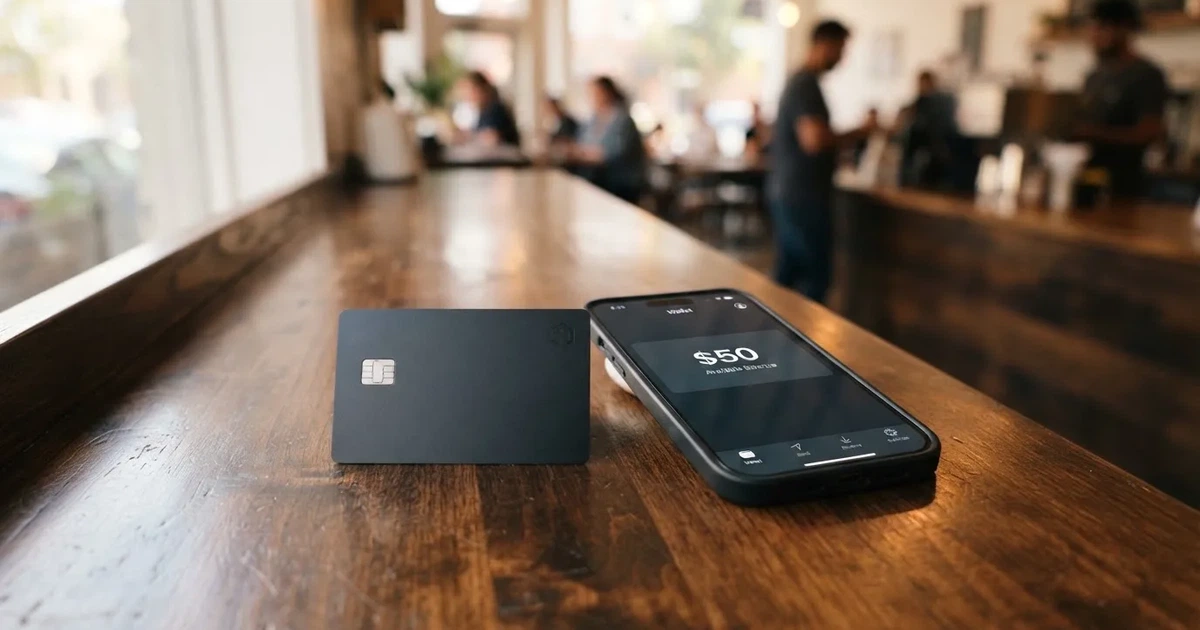
Conditions are current as of October 28, 2026.
Verdict
Crypto.com comes in at 7.0 out of 10. That score is a composite of the card’s reach, its cost, the way you fund it, the trust signals around the brand and how it behaves day to day. The number is the same as the card’s research score; my job here is to walk you through the reasoning behind each piece.
| Criterion | Mark | Why it landed there |
|---|---|---|
| Who can get it | 8 / 10 | Issued across the US, 31 European countries, Singapore, Canada, Australia, the UK and Brazil, with a separate USD card for Brazil; eligibility is by residential address |
| Cost | 6 / 10 | Tiered subscription (Free, $4.99/month, $29.99/month) plus card issuance, top-up, ATM and FX fees, with rates that change by region |
| Top-up options | 6 / 10 | Fund from the in-app Crypto Wallet, a Cash Account or a debit or credit card, but crypto must be converted to local currency before loading |
| Reliability and complaints | 6 / 10 | Multiple regulated issuers across regions; Trustpilot reading sits at 2.0 out of 5, with most criticism aimed at the app and exchange rather than the card |
| Everyday use | 9 / 10 | Prepaid Visa, virtual card on approval, free ATM allowance, mobile wallets (unofficial reports) and an app that handles the whole flow |
The card suits residents of Europe and Singapore who want a tiered, subscription-based crypto rewards product and who are comfortable buying and holding the CRO token. It suits them less if you live in a country that is not on the issuer list, if you would rather not pay a monthly fee to unlock the better rates, or if your idea of a payment card is “spend and forget” rather than “manage a token and a tier”. In the verdict below, I talk through each of these in turn and explain where the line falls for different kinds of readers.
Who they will give the card to
The first thing to check, before anything else, is whether you are even in a country where this card exists. Crypto.com does not run one global card; it runs several programmes, each with its own issuer licensed in that region. As of the help article dated 20 July 2026, the European programme is run by Foris MT Limited and covers Austria, Belgium, Bulgaria, Croatia, Cyprus, Czech Republic, Denmark, Estonia, Finland, France, Germany, Greece, Hungary, Iceland, Ireland, Italy, Latvia, Lithuania, Luxembourg, Malta, Netherlands, Norway, Poland, Portugal, Romania, Slovakia, Slovenia, Spain, Sweden, Switzerland and the United Kingdom. The US card is issued by Community Federal Savings Bank, the Singapore card by Foris Asia Pte. Ltd., the Canadian card by Digital Commerce Bank, the Australian card by Foris GFS Australia Pty Ltd, the UK card by ForisGFS UK Limited, and the Brazil card (a USD card for use outside Brazil) by Foris MT Limited.
The rule that decides whether you can apply is your residential address. The fee articles are split into “residential address in Europe”, “residential address in Singapore” and “non-Europe Brazil and LATAM” sections, which tells you the issuer’s interest is in where you actually live rather than where you hold a passport. Citizenship is not stated in the pages I read, so a citizen of an unsupported country who lives in a supported one may still qualify, and the opposite is also possible. This is the kind of detail that matters, because if you apply with the wrong residential address or the wrong documents you can find yourself rejected at verification with no clear reason given.
Unofficial third-party listings (CryptoCardHub, August 2026) name Russia among ten restricted countries alongside Afghanistan, China, Cuba, Iran, North Korea, Somalia, Sudan, Syria and Yemen, although the same source lists Sudan among “available” countries, which is inconsistent. The card’s own pages do not publish a restricted-country list, so I would treat any third-party tally as unofficial and worth confirming with support before you apply.
How to get it
The application runs inside the Crypto.com App. The card’s own page shows only the identity notice that the US PATRIOT Act requires: name, address, date of birth, national identification number (a Social Security Number for US applicants or a country ID for everyone else), and possibly a driver’s licence or other photo ID. The card’s pages do not state a minimum age, what counts as proof of address, or which level of identity verification unlocks which tier, so you should expect to upload more than the minimum to reach the higher tier cards.
Unofficial third-party reporting (CryptoCardHub, August 2026) describes a fuller process: government ID, a selfie, and proof of address. Unofficial reporting also says a virtual card is available immediately on approval, with the physical card shipped after, but the cards page itself does not confirm this, so I would not plan around it.
The Level Up plan is what decides which card tier you can apply for. The Midnight (entry-level) card is free; the higher tiers require you to lock up CRO tokens for an extended period, which is the model’s defining trade-off. We will get to the lockup and what it costs you in the next section; for the application itself, the steps are the same: install the app, complete the identity checks, choose your tier, and either receive a virtual card immediately or wait for the physical one to arrive.
Issuance and replacement fees are not on the cards page. The European help article is where I found the figures: the Midnight physical card is EUR 4.99, the Ruby is EUR 24.99, replacement is EUR 45.01 for Midnight and EUR 50 for other tiers, and the fee is waived for some Level Up Plus subscribers and for CRO stakers. Unofficial reporting on US figures puts the Midnight at USD 4.99 and Ruby at USD 29.99, with replacement at USD 7 for Midnight and USD 50 for higher tiers, although I have not confirmed those against a primary source. Delivery time is not stated on the cards page or in the help article I read, so if you need the card by a specific date, the only safe plan is to ask support before you apply.
What it really costs: a fees walkthrough
Cost is where the Crypto.com card is most likely to surprise you, and where I would urge you to read carefully. There are four kinds of fee on this card: a subscription tied to your card tier, a one-off issuance fee, transaction fees (top-up, FX and ATM), and inactivity or closure fees if you stop using the card. The published tiers are Free, $4.99/month or $49.90/year or $500 in CRO lockup, and $29.99/month or $299.90/year or $5,000 in CRO lockup, with two further lockup tiers at $50,000 and $500,000 that unlock the premium metal cards and additional benefits like subscription rebates and airport lounge access.
The card page itself says top-up fees, an interbank exchange rate and ATM fees “may apply” depending on jurisdiction and tier, without naming the amounts. The numbers live in the per-region help articles, and the European article is where I pulled most of what follows. Issuance for the Midnight is EUR 4.99, for the Ruby EUR 24.99; replacement is EUR 45.01 on Midnight and EUR 50 on other tiers; closure is EUR 50; and inactivity is EUR 5 per month after 12 months of no cardholder-initiated activity, rising to EUR 6 from 1 October 2026.
| Fee or limit | Amount or rule |
|---|---|
| Card issuance (Europe, Midnight) | EUR 4.99 |
| Card issuance (Europe, Ruby) | EUR 24.99 |
| Card replacement (Europe) | EUR 45.01 (Midnight) / EUR 50 (other tiers) |
| Card top-up by debit/credit card (Europe) | 1% |
| ATM withdrawals (Europe) | 2% above the monthly free allowance |
| Foreign-transaction fee, Midnight (EU/UK) | 0.2% |
| Foreign-transaction fee, Midnight (outside EU/UK) | 2.0% |
| Foreign-transaction fee, Ruby (outside EU/UK) | No fee up to EUR 400/month, then 2.0% |
| Foreign-transaction fee, Jade/Indigo (outside EU/UK) | No fee up to EUR 800/month |
| Foreign-transaction fee, Icy/Rose/Obsidian | No FX fee |
| Inactivity fee (Europe) | EUR 5/month after 12 months without cardholder activity, rising to EUR 6 from 1 October 2026 |
| Account closure fee (Europe) | EUR 50 |
| Minimum card top-up (Europe) | EUR 20 |
| Aggregated top-up limit (all tiers) | USD 25,000 per month |
| POS purchase limit (Europe) | EUR 25,000 daily and monthly, EUR 250,000 yearly |
| Max card balance (Europe) | EUR 25,000 |
| ATM daily limit (Europe) | EUR 2,000 |
| ATM monthly limit (Europe) | EUR 10,000 |
| ATM yearly limit (Europe) | EUR 75,000 |
| Free ATM allowance, Free tier | USD 200 per month, USD 5,000 cap |
| Free ATM allowance, $4.99 tier | USD 400 per month, USD 10,000 cap |
| Free ATM allowance, $29.99 tier | USD 800 per month, USD 10,000 cap |
| Free ATM allowance, $50,000 tier | USD 1,000 per month, USD 10,000 cap |
| Free ATM allowance, $500,000 tier | USD 1,000 per month, USD 10,000 cap |
To make those numbers feel less abstract, here is what three everyday payments actually look like.
A EUR 50 lunch paid with the Midnight card in a eurozone country has no FX fee (0.2% applies to non-EUR transactions) and no top-up fee if the card was already loaded, and it earns 0% CRO cashback because the Midnight Blue tier sits at the bottom of the rewards table. The cost of that lunch is the price on the menu. A USD 200 purchase made in New York on the same Midnight card is converted to euros at the interbank rate plus the 2.0% non-EU FX fee, so the cost of the conversion alone is about USD 4 on a USD 200 charge. A EUR 100 ATM withdrawal on the Ruby Steel tier inside Europe hits the 2% ATM fee on the part above the free allowance, so on a 100-euro withdrawal the fee is roughly EUR 2 if the Ruby Steel allowance is fully used, and the fee is zero if you have not yet hit the monthly free amount. None of these numbers is a sum you should bank on to the cent, but they give a sense of the moving parts: tier, region, currency, and whether you have already used the free allowance that month.
The clearest way to think about the cost is this: if you stay on the Free tier and only spend in your card’s home currency inside the issuer’s region, the fees are mostly a top-up percentage plus a small ATM fee when you exceed the monthly cap. The moment you start crossing currency borders, travelling outside the EU/UK or wanting a higher cashback rate, the subscription and the FX schedule start to matter, and the EUR 5 to EUR 6 inactivity fee is what you owe the card if you simply stop using it.
How to top it up
Top up is where the Crypto.com card departs from the “spend crypto directly” mental model that some readers arrive with. You cannot load crypto onto the card; you load local currency. The Crypto.com App lets you fund the card from three sources: the in-app Crypto Wallet, a Cash Account, or another debit or credit card. When the source is the Crypto Wallet, the app converts the chosen crypto to your card’s local currency at the prevailing rate, with a conversion fee built in, before the funds land on the card. The networks and on-chain mechanics of that conversion are not visible from the card page; what you see is a balance in euros (or dollars, Canadian dollars, Australian dollars, Singapore dollars, or pounds, depending on the issuer).
In Europe, the top-up rules are: minimum EUR 20 per top-up by card, 1% fee on card top-ups, an aggregated cap of EUR 25,000 daily and monthly (and EUR 250,000 yearly) across all top-up sources, a maximum card balance of EUR 25,000, and a load frequency limit of 12 top-ups per day and 140 per month. Crypto-to-card and Cash Account-to-card top-ups share the same cap. The process is: open the app, choose top-up, pick the source (Crypto Wallet, Cash Account or external card), enter the amount, and confirm. The funds arrive on the card balance within a few seconds in my experience with prepaid cards in this category, although the cards page does not state a settlement time.
Two practical consequences follow. First, the conversion is the point at which you decide whether to realise a taxable gain or loss in your jurisdiction; the card itself does the conversion, not you, and the receipt is the app screen. Second, because the card balance is a stored value rather than a live link to your crypto holdings, you carry the price risk of having already sold your crypto. If CRO is the asset you spent, you have also taken on the price path between conversion and spend, which for a card used a few hours later is usually negligible, but for a card topped up a month in advance is a real exposure.
Paying with it every day
The card behaves as you would expect a Visa prepaid card to behave. You tap or insert at point of sale, you enter your PIN at ATM, and you see the deduction in the app. The Crypto.com App is the management surface: you can freeze the card, view transactions, set spending limits and see the CRO rewards land in your Crypto Wallet after each eligible transaction. The App Store listing for “Crypto.com: Trade Every Market” is 4.7 out of 5 from around 336,000 ratings as of 20 October 2026, with Russian among the supported languages, which is worth noting because it is unusual among English-language crypto card apps.
CRO cashback rates by tier, on the main table the page shows, are: Midnight Blue 0%, Ruby Steel 1.5% up to USD 750 per month, Jade Green / Royal Indigo 2.5% up to USD 1,500 per month, Icy White / Rose Gold 3.5% up to USD 3,000 per month and 0.5% above that, and Obsidian 4.5% up to USD 5,000 per month and 1% above that. Travel bookings through a partner can earn up to 5%, 20%, 25%, 30% or 40% depending on tier, and certain merchant categories and channels are excluded from rewards. The page points to a help article for the full exclusion list, which I did not read in full; the practical effect is that you should not assume every transaction you make will earn cashback, even within the cap.
Unofficial third-party reporting (CryptoCardHub, August 2026) says Apple Pay, Google Pay and Samsung Pay are supported with availability varying by region, and that the App Store rating is 4.7 out of 5 from 321,114 ratings and the Google Play rating is 4.5 out of 5 from 661,155 ratings. The cards page itself does not mention mobile wallets, so I would check with support before you buy a new phone with the assumption that the card will tokenise into it.
The card is prepaid, which is the most important behavioural fact for everyday use. It cannot overdraw, because the funds have to be on the card first. The merchant sees a Visa authorisation, the network routes the message, and the issuer (Foris MT Limited in Europe, Community Federal Savings Bank in the US, and so on) approves or declines. A decline can happen for the usual prepaid reasons: insufficient balance, the merchant’s BIN or country filter, the merchant’s Address Verification Service, or a 3-D Secure challenge the app does not handle the way you expect. Disputes (chargebacks, fraud claims, goods not received) are not described on the cards page, which is a real gap; you should expect to go through the app’s support chat rather than a phone line to a card-services team.
What can go wrong
The card’s own pages do not record a major incident in 2026. The headlines you hear about Crypto.com tend to be about the exchange and the app rather than the card, which is worth distinguishing. The card programmes sit behind regulated issuers in each region: Foris MT Limited in the EU and for the Brazil USD card, Community Federal Savings Bank in the US (a Member FDIC bank), Foris Asia Pte. Ltd. in Singapore (a Major Payment Institution under the Monetary Authority of Singapore), Digital Commerce Bank in Canada, Foris GFS Australia Pty Ltd (an Australian Financial Services Licence holder), and ForisGFS UK Limited in the UK (FCA-authorised as an e-money institution, not covered by the Financial Services Compensation Scheme). The implication is that the card is a regulated payment instrument, not an unregulated wallet, which matters if anything goes wrong.
That said, the public reviews paint a less tidy picture. Trustpilot for Crypto.com sat at 2.0 out of 5 from 9,493 reviews as of 20 October 2026, with 72% of those reviews at one star, although the company responds to 31% of negative reviews. The recent themes in October 2026 are mostly about the app and exchange: people who cannot fund the card, payment failures, subscriptions that were cancelled but still charged, cashback terms that changed after sign-up, withdrawals that fail, support that feels like a chatbot and a token delisted without conversion. Some of those complaints are about the card specifically (funding, payment failures, changed cashback terms), but most of the volume is on the exchange side. Read the Trustpilot picture as a proxy for support quality rather than a verdict on the card itself, and treat the recurring themes as the most likely place you would feel friction if you did.
The custody model is the other thing to take seriously. The card is custodial: your crypto sits on Crypto.com’s books, you do not hold the private keys, and you do not have a seed phrase to fall back on. The cards page cites AICPA SOC, ISO 27701, ISO 22301 and PCI DSS as the standards the company works to, which is reassuring but is not the same as deposit insurance; the cards page does not state an insurance or safeguarding arrangement for the card balance, and the UK issuer explicitly is not covered by the FSCS. If you treat the card as a prepaid spending tool with the smallest balance you can get away with, you are reducing your exposure to anything going wrong with the wider platform.
The third category of risk is structural and worth naming. The card’s rewards are paid in CRO, a token whose price can fall. The subscription that unlocks the higher cashback rates is denominated in fiat but the lockup that opens the higher tiers is denominated in CRO, so the value of your lockup moves with the market. The published rewards table is the public schedule today, and the public reviews include complaints about the terms changing after sign-up, which is the experience to budget for: the rates and the tier rules are the company’s to revise.
The fourth risk is the platform-level risk that is not unique to this card but has hit similar programmes. Visa and Mastercard do not issue cards to consumers; they license issuers, and they can suspend a programme. Visa terminated its global agreements with FTX in November 2022 and the FTX US debit card was wound down by its issuer. In 2018, Visa’s suspension of WaveCrest closed every WaveCrest-issued crypto Visa programme in Europe. The pattern, when a programme closes, is a notice period, then a stop on new spending, then a stop on loading, then a window to withdraw your balance. It is not the Crypto.com card’s specific risk so much as the category’s risk, and it is the reason a prepaid crypto card is best used as a spending tool with a balance measured in weeks of expenses rather than months.
What to take instead
If the Crypto.com card is not for you, here is what else sits in the same corner of the market. These figures are starting points; always check the provider’s own page for current terms before you commit.
- MSX (score 6.4 / 10). I could not find official information on who can apply, the card’s network or the fees, which is itself a finding: a card with no public facts on the official page is hard to recommend on its own terms, because you would be making the decision on third-party descriptions rather than the issuer’s.
- Bybit Card (score 6.0 / 10). The card is a Mastercard or Visa prepaid or credit product depending on region, available in Argentina, the AIFC in Kazakhstan, Georgia, Kazakhstan, Australia, Mexico, Brazil, Peru and Asia Pacific. The cards page says “This product is not meant for European Economic Area customers. All European Economic Area customer participation is strictly prohibited”, which puts the EU out of reach. Bybit’s fiat-service restricted list includes Belarus, the Russian Federation, Serbia, China and the United States, although no card-specific rule on Russian or Belarusian citizens was published. Issuance is free for the virtual card until further notice and the physical card is USD 29.99 in Australia and the AIFC, USD 5 in Argentina and the Asia Pacific, and free in Brazil and Mexico, with VIPs holding Australia, AIFC, Georgia or Asia Pacific cards exempt. The crypto conversion fee is 0.9% over the One-Click Sell rate (0.5% in Argentina), the FX fee is 2% in Australia, Asia Pacific, Georgia and Mexico, 7% in Argentina, 1.5% in Brazil and 1% in Peru. From 5 October 2026, only crypto-funded transactions earn points or cashback; fiat-funded spending does not, which is a meaningful shift if you were planning to keep a fiat balance on the card. The cashback tiers are Base 2.00% (cap USD 5), Beta 2% (USD 50), Alpha 4% (USD 150), Apex 6% (USD 250), Omega 8% (USD 400) and Infinite 10% (USD 600), with a spend threshold to unlock for non-VIPs. A welcome offer of 10% cashback up to USD 110 in the first 30 days applies.
- MEXC (score 5.6 / 10). The card is virtual only; the page lists the Philippines, Taiwan and Thailand among supported regions without showing the full list. Issuance is USD 20, the service fee is 0% and other fees vary by card type per a guide I did not read. Funding runs through a Fiat account topped up with USDT, and rewards are paid by the 15th of the following month at 4% (Standard, cap USD 100), 6% (Premier, USD 300) or 10% (Elite, USD 800) based on the M-Score tier. The 10% top rate is the most generous of the three alternatives on the page, but virtual-only and the region list is not transparent, which is the trade-off.
The honest summary is that none of the three alternatives replaces the Crypto.com card on every axis; each one wins on something different (Bybit’s reach across Latin America and Asia Pacific, MEXC’s headline rate, MSX’s positioning) and loses on something else (Bybit’s EEA exclusion, MEXC’s lack of a physical card, MSX’s lack of public facts). If the Crypto.com card’s cost or country list rules it out, the choice is between a card with a real cashback rate in fewer regions (MEXC), a card with broader reach outside Europe (Bybit), and a card that requires you to do more of your own research (MSX).
Who I would recommend it to
I would recommend the Crypto.com card to a reader who is already inside the Crypto.com ecosystem, who lives in one of the supported countries (and ideally in the EU, the UK, Singapore, the US, Canada or Australia where the issuer is regulated in a jurisdiction they are familiar with), who is comfortable buying and holding CRO, and who is happy to do the small monthly housekeeping the tier model requires: choosing the right tier for the spend they actually do, watching the FX schedule, and remembering that the free ATM allowance is reset each month.
I would steer a reader away from the card if any of the following is true. You live in a country that is not on the issuer list, or your residential address is in an unsupported jurisdiction. You want a card you can leave loaded for months without thinking about it, because the EUR 5 to EUR 6 inactivity fee after 12 months of no activity is real. You do not want a subscription, because the higher cashback rates sit behind a $4.99 or $29.99 monthly fee, and the only way to keep the subscription cost down is to stay on the Free tier with no cashback. You do not want price exposure to CRO, because the rewards and the lockup are both in CRO. You rely on mobile wallet tokenisation and cannot confirm with support that Apple Pay, Google Pay or Samsung Pay works in your region, because the cards page does not state this. Or you keep most of your crypto in self-custody, because this card is custodial and the conversion to fiat happens inside Crypto.com’s app.
If those filters leave you still in the audience, the Crypto.com card is a reasonable prepaid Visa with the right tier for the right level of commitment. The score of 7.0 out of 10 reflects a card that does the everyday job well and offers a competitive tier structure, balanced against the cost of the subscription, the price of CRO, and the platform-level support concerns that surface in public reviews. It is a card I would use; it is not the only card I would use.
Frequently asked questions
What is the Crypto.com card?
The Crypto.com card is a prepaid Visa card issued under the Crypto.com brand, with regional issuers behind it (Foris MT Limited in Europe, Community Federal Savings Bank in the US, Foris Asia in Singapore, and so on). You load it with local currency from the Crypto.com App, and you earn CRO token cashback on each eligible purchase according to a tier schedule.
How does the Crypto.com card work?
You install the Crypto.com App, complete the identity checks, choose a card tier, receive a virtual card immediately or wait for the physical one, and top up the card balance from the in-app Crypto Wallet, a Cash Account, or an external debit or credit card. When you tap or insert the card at a merchant, the issuer authorises the payment from the card’s stored balance and the CRO cashback lands in your Crypto Wallet after the transaction.
Is Crypto.com a bank?
No. Crypto.com is the brand; the cards are issued by regulated banks and e-money institutions in each region. In the US the issuer is Community Federal Savings Bank, which is FDIC-member, and in the UK the issuer is ForisGFS UK Limited, which is FCA-authorised as an e-money institution but not FSCS-covered, so card balances are not deposit-insured in the same way a bank account would be.
Who owns Crypto.com?
Crypto.com is the trading name behind the card programmes. The site footer reads “Crypto.com”. The card programmes themselves are run by regional issuers (Foris MT Limited, Community Federal Savings Bank, Foris Asia, Digital Commerce Bank, Foris GFS Australia and ForisGFS UK) under licence from Visa, with Crypto.com as the programme manager and brand.
Is the Crypto.com card available in my country?
The card is available in the US, 31 European countries, Singapore, Canada, Australia, the UK and Brazil, with eligibility decided by your residential address. The cards page does not publish a restricted-country list, but unofficial third-party reporting names ten restricted countries including Russia, China, Iran and North Korea; I would confirm with support before applying if your address is in a country you are not sure about.
How do I apply for the Crypto.com card?
You apply inside the Crypto.com App by completing the identity verification (the cards page shows a USA PATRIOT Act identity notice covering name, address, date of birth and a national ID number, with photo ID possibly requested) and choosing a tier. The Midnight card is free to apply for; higher tiers require a CRO token lockup.
Does the Crypto.com card require KYC?
Yes. The cards page shows the identity notice that US PATRIOT Act-regulated programmes publish, covering name, address, date of birth and a national ID number. Unofficial third-party reporting says proof of address and a selfie can be requested, although the cards page itself does not state the full set of documents.
How do I top up the Crypto.com card?
Open the app, choose the card, tap top up, pick a source (Crypto Wallet, Cash Account or external debit or credit card), enter an amount above the EUR 20 minimum in Europe, and confirm. The card cannot be loaded with crypto directly; the app converts the chosen crypto to your card’s local currency at the prevailing rate before loading, with a top-up fee of 1% on card top-ups in Europe.
How do I add the Crypto.com card to Apple Wallet or Google Pay?
Unofficial third-party reporting (CryptoCardHub, August 2026) says Apple Pay, Google Pay and Samsung Pay are supported with availability varying by region. The cards page itself does not mention mobile wallets, so I would confirm tokenisation works in your country and on your device before you rely on it.
Is the Crypto.com card safe?
The card is custodial, so Crypto.com and the regional issuer hold the funds rather than you holding private keys. The card is a regulated payment instrument (the EU issuer is Foris MT Limited, an electronic money institution, and the US issuer is an FDIC-member bank), and the platform cites AICPA SOC, ISO 27701, ISO 22301 and PCI DSS as the standards it works to. Card balances are not the same as deposit-insured bank balances, especially in the UK, so the safer posture is to keep a small working balance and treat the card as a spending tool rather than a store of value.
Exchange card options – cryptocardoptions.com
Content created by the «cryptocardoptions.com» team