
A USDC-backed Visa card for people who can't open a normal bank account, but the fees and the small print work against it
 Available in US
I went through whitecryptocard.com the way I go through any card: who it is for, what it costs to live with, what happens on a bad day, and what I would buy instead. The headline is simple. If you keep USDC in your own wallet and you can find no ordinary bank that will issue you a card, this is one of the few products that lets you spend that USDC directly, with a real Visa number, on the Visa network. That is genuinely useful. What is less useful is the price: a $5 setup fee, a $3 monthly account fee, a 1.99% fee on anything that is not in dollars, a $0.20 surcharge on payments under $25, and an ATM withdrawal that costs at least $1.50. Add the fact that the brand is small, there is no public list of countries, the apps in the stores still say “Coming soon”, and a self-custody wallet that you have to back up with a 24-word phrase, and you have a card that solves one real problem and creates several smaller ones.
The conditions described in this review are current as of October 28, 2026.
Verdict
Whitecryptocard.com scores 5.4 out of 10. That is the result of weighting five criteria the way a card user, not a marketer, would weight them: who can actually get one, what it costs to keep and use, how flexible the top-up is, how reliable the operation looks, and how it fits into daily life.

| Criterion | Mark | Why it matters |
|---|---|---|
| Who can get it | 6 / 10 | No public country list; eligibility is decided at application, only residence is named, and sanctioned persons and countries are excluded. |
| Cost | 3 / 10 | $5 to issue, $3 a month, $10 to close; 1.99% on non-USD payments, $0.20 on payments under $25; top-up fee table says 2% while the site also says “0% deposit fees” — a contradiction I cannot reconcile. |
| Top-up options | 6 / 10 | USDC only, kept as collateral in a self-custody wallet on Base, Arbitrum or Ethereum; the home page and the FAQ name the networks slightly differently. |
| Reliability and complaints | 6 / 10 | Operated by Codego Group; cards are issued by an unnamed Visa Principal Member; the company clearly says it is “not a bank”; the contract is governed by English and Welsh law; I could not find a Trustpilot page or any incident reports. |
| Everyday use | 7 / 10 | Virtual Visa only, no plastic; Apple Pay and Google Pay work; ATM is $1.50 fixed or 1% + $1 depending on the line of the fee list you read; the iOS and Android apps in the stores are still “Coming soon”. |
| Total | 5.4 / 10 | A working USDC-to-Visa bridge for a narrow audience, held back by fees and a young operation. |
Who it suits: a person who already holds USDC in their own wallet, who lives somewhere an ordinary bank account is hard to open, who is comfortable holding a 24-word recovery phrase, and who plans to use the card mostly for non-USD online spending where the 1.99% foreign-exchange fee is the dominant cost. Who it does not suit: a person who only needs a card for local dollar spending, who wants a no-monthly-fee card, who expects cashback, who needs a physical card, or who lives in a country the unnamed Visa issuer will not serve.
Who whitecryptocard.com will issue a card to
The honest answer is: I do not know in advance, and neither will you until you apply. The card’s own pages do not publish a country list. What they say is that eligibility is “determined during your application” and that the decision depends on where you live. Citizenship is not mentioned. The same page is clear on the floor: sanctioned persons and sanctioned countries are not served. That single line is doing a lot of work, because it means the issuer, whoever it is, runs its own sanctions and risk filters and can refuse you for reasons that are not on the website.
The reason this matters more than with most cards is that the underlying Visa programme is run by an unnamed Visa Principal Member (a bank or e-money institution licensed by Visa to issue cards under its network). When a card programme is small and the issuer is not named on the public page, the only way to know whether your country is in is to start the application. If your country is not in, you will probably learn that at the identity check stage, not before. For readers in the United States, Canada, the United Kingdom and most of the European Union this is unlikely to be a surprise, but for readers in Latin America, the Caribbean, much of Africa, and most of South and South-East Asia, the answer is genuinely unknown until you try.
A second point that I think deserves to be read out loud: the agreement is governed by the laws of England and Wales, and the brand itself says it is “not a bank”. That means two things. You are not protected by a bank deposit guarantee, and if something goes wrong, the dispute runs through English law on the terms of the cardholder agreement, not through your local consumer protection regime. The card is run by Codego Group; the press release I read claims more than 350,000 users, but that is a company figure rather than an audited one and I would not lean on it.
How to apply for the card
The sign-up flow, as the card describes it, has two stages: identity verification and card issuance. I will describe each, then flag what the card does not say.
The identity check asks for a government photo ID and a live selfie that is matched to that ID. That is standard liveness, the kind where the app asks you to turn your head or read numbers, designed to defeat a still photo. You also need a proof of address — a recent utility bill or a bank statement. The card does not publish a minimum age; prepaid and debit cards in this category are typically limited to adults (18 and over in most jurisdictions), but I would not assume that, and you should check the terms that apply to your country at application.
Once your identity is verified, the card is issued. Whitecryptocard.com sells only a virtual card. There is no plastic card in the standard plan, so the question of “where is it delivered” does not really arise; the number and the card details appear in the app. The fee schedule names “virtual card setup” at $5, and it also lists Visa Infinite, with Platinum and Signature mentioned as alternatives, so the tier you end up with depends on what the unnamed Visa issuer is willing to put on the file for you.
The card does not publish processing times for the application, does not publish rejection reasons, and does not publish what happens to your documents if you are rejected. It does say it applies standard due diligence before issuing, source-of-funds checks above certain risk thresholds, and enhanced due diligence for higher-risk cases. In other words, expect a follow-up document request if anything looks unusual, and expect the case to take longer in that scenario. The card’s terms also reserve the right to refuse a relationship where due diligence cannot be completed, which is the language European and UK regulated institutions use when an account is closed or an application is denied.
What I would check first, in order: that you have a readable government photo ID and a recent proof of address in the same name; that the address on those documents matches the address you enter; and that the name on your USDC wallet can be reconciled to the name on your ID, because the collateral model means your wallet address is part of your file.
What whitecryptocard.com really costs
I worked through the fee pages line by line. The numbers below are taken from the card’s published fee list, and where the same fee is described two different ways on the site I have flagged it.
| Fee or limit | Amount |
|---|---|
| Virtual card setup | $5.00 per card |
| Account residency fee | $3.00 per card per month |
| Account closure | $10.00 one-time |
| Non-USD transactions (FX) | 1.99% |
| Small transactions (under $25) | $0.20 per transaction |
| ATM withdrawal | $1.50 fixed, or 1% + $1 (both listed) |
| Auth / balance / decline | $0.60 per attempt |
| Dispute / chargeback processing | $35.00 per case |
| Top-up fee (table) | 2% on all listed coins and networks |
| Top-up fee (home page) | “0% deposit fees” / “No fee on USDC top-ups” |
| Network gas | Paid by the user to the blockchain |
| Daily and monthly limits | Not published; shown in the app, depend on verification tier, card type and risk profile; user can set own limits |
| Free ATM allowance | Not stated |
| Annual fee on Standard tier | None, per the FAQ |
A few things to draw out of that table. The first is the contradiction. The top-up fee table says 2% on all listed coins and networks. The home page says “0% deposit fees” and the FAQ says “No fee on USDC top-ups”. Those two statements cannot both be right. I cannot tell you which one will be applied at the moment of funding, and neither can you until you do it. That alone is reason to ask support, in writing, before you commit any meaningful amount, and to keep a screenshot of the answer.
The second is the $3 monthly account fee. A flat monthly fee is unusual for a card aimed at the unbanked, because the people most often described as “unbanked” are the people most sensitive to a recurring charge. You will pay $36 a year in account fees whether you use the card or not, and an additional $10 to close the account when you stop using it. If you only use the card a few times a year, that fixed cost is the dominant cost of the product.
The third is the 1.99% on non-USD transactions. This is the fee you will see most often if you live outside the United States or buy from non-US merchants, because the card is denominated in USD. It is not the worst I have seen, but it is also not the best. The fourth is the $0.20 surcharge on payments under $25. This is an old fee that some prepaid products still charge to deter micro-payments; if you pay for a coffee with the card and the coffee is $3, you are paying a surcharge on top of the FX fee. The fifth is the $35 dispute fee, which is charged per case regardless of outcome, so opening a chargeback is not free.
Let me walk through three everyday situations to make those numbers feel real.
Coffee in a non-USD country, $3. You are paying 1.99% in FX on top of the $0.20 small-transaction fee, on a $3 transaction. If you do that twice a week for a year, the fees alone are significant, before the $36 in account fees.
A $200 online subscription in a non-USD currency, billed monthly. The FX is 1.99%, which is $3.98 a month. The $0.20 small-transaction fee does not apply because the transaction is over $25. The account fee of $36 a year applies on top. So your $200 a month subscription effectively becomes more expensive in fees and charges, before any conversion cost on the USDC side.
A $100 ATM withdrawal in a non-USD country. The fee list shows two lines: a $1.50 fixed fee, and 1% + $1. Whichever applies, you are paying between $1.50 and $2.00 on the withdrawal itself, and another 1.99% on the FX, so a total of about $3.49 to $3.99 on a $100 cash withdrawal. There is no free allowance stated, so this is on every withdrawal.
The Standard tier is the only tier named in the FAQ. The fee list mentions Individual and Business accounts as separate categories, but it does not publish the per-tier differences for the Standard card. I would treat anything a salesperson tells you about a “premium” or “VIP” version of the Standard card as unconfirmed until you see it in the fee schedule for your account.
How to top up the card
Top-up is the part of this product that is genuinely different from most cards, and the part you should understand before you commit any money.
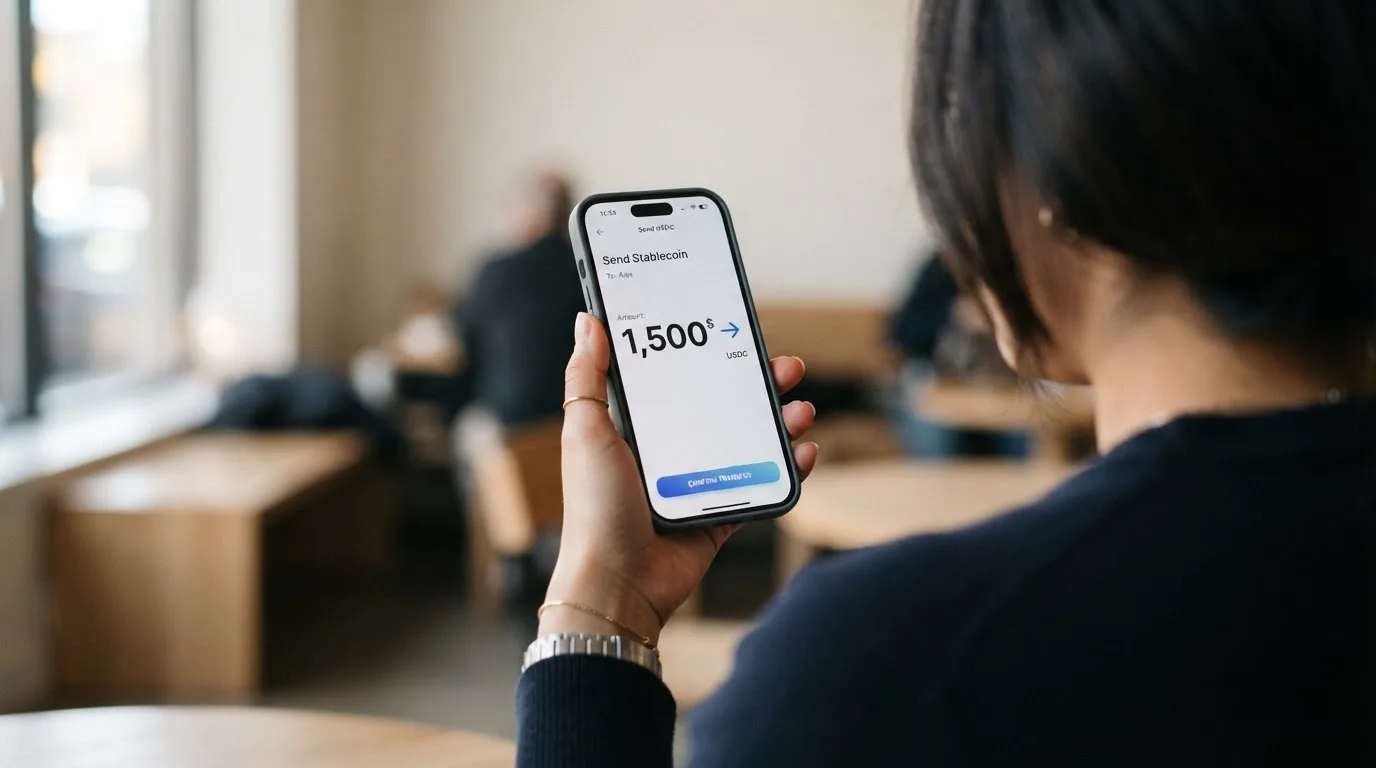
The card holds USDC, not dollars, as collateral. The USDC sits in a self-custody wallet that you control, on one of three networks: Base, Arbitrum or Ethereum. The home page names all three; the FAQ names Base and Arbitrum only. That is the second contradiction in the card’s documentation, and again I would not assume one network is or is not supported until I see it in the app or hear it from support.
Self-custody means you, the user, hold the private keys. The card provider does not. The card shows you a deposit address, you send USDC to that address from your own wallet, and the card uses the USDC as collateral when you pay. The benefit is that the card provider cannot lose your money in a hack, because it never had custody of it. The cost is that you bear the full responsibility for the keys. The card’s security page is explicit on this: the wallet is controlled by a 24-word recovery phrase, and if you lose the phrase the wallet cannot be recovered. There is no “forgot my password” link that can give you back the USDC.
The other cost is gas. Every on-chain transfer costs network fees, and those fees are paid in the native token of the network, not in USDC. On Base and Arbitrum the fees are usually low (a few cents at most) because they are Layer 2 networks sitting on top of Ethereum; on Ethereum mainnet the same transfer can cost several dollars during busy periods. The card does not charge you gas — the network does — so if your wallet has USDC but no ETH, you will not be able to move the USDC until you also hold a small amount of ETH on the same network.
The card only accepts USDC. There is no BTC, no ETH, no USDT, no SOL. If you hold other coins, you have to convert them to USDC yourself, in your own wallet, before you send. The card does not offer a built-in conversion at the point of top-up, and it does not offer a fiat top-up path — there is no card-to-card top-up, no bank transfer, no SEPA, no ACH mentioned.
The top-up fee problem is the one I would not let go of. The fee table says 2% on all listed coins and networks. The home page and the FAQ say 0%. Until that is resolved, treat the worst case (2%) as the cost you are budgeting for, and assume the better case only if you have a written confirmation. There is no published minimum top-up.
The card does not publish what happens to the collateral after you close your account. It says only that the collateral stays in your self-custody wallet after termination, which is consistent with the model: the USDC never leaves your wallet in the first place, so there is nothing to withdraw from the card provider. If you stop using the card, the USDC simply stays in your wallet.
Paying with the card every day
In daily use, the card is a virtual Visa. The card number is added to Apple Pay and Google Pay, and both are supported with no wallet fee. Adding the card to a wallet is the right move, because the card has no physical form, and most in-person card readers do not read virtual numbers from a screen. For online shopping the card number is typed in as normal, with 3-D Secure turned on to add a one-time confirmation at checkout.
The blocked-merchant list is partial. The card explicitly prohibits unlicensed gambling, illegal drugs, and weapons. The card does not publish the full merchant category code (MCC) blocklist, so if you intend to use the card somewhere unusual you should assume the worst and ask first. MCC 7995 (gambling) is the most common blocked category across crypto cards, and is often the one that surprises people at the worst time.
There is no cashback or rebate. The card does pay a referral: 0.15% of the spend of friends you refer, plus $10 per friend once that friend has spent $500, paid monthly in USDC. That is a soft form of reward, but it is paid to you as a referrer, not as a feature of the card itself, and the $500 threshold is high enough that the $10 is not a reliable return for most users. If you are choosing this card for the rewards, choose a different card.
The app is a problem. As of the dates in this review, the iOS and Google Play listings both say “Coming soon”, which means there is no live app to download from a store. The card is operated through a web interface in the meantime. Without a live app, instant card freeze, per-merchant controls, and per-transaction notifications are weaker than they would be in a real mobile app. I would not be surprised if that changes soon — the listing is “Coming soon”, not “Removed” — but as of this writing you should assume you are operating the card from a browser.
Disputes follow the standard Visa pattern. You report an unauthorised or incorrect transaction within 60 days of it posting on your statement. The card’s investigation then follows the Visa Operating Regulations. The card charges a $35 dispute processing fee per case. The $35 is charged whether you win or lose, which is a meaningful deterrent against raising a dispute over a small amount. US debit-card reversal rights (under Regulation E) and credit-card rights (under Regulation Z) apply differently, and prepaid-card coverage is not the same as a bank account’s, so I would not assume the US protections you have on a normal card.
What can go wrong
A card is only as good as the worst day you have with it. Here is what I see as the realistic risk surface.
The first risk is key loss. Because the card uses a self-custody wallet, the USDC is only as safe as your 24-word phrase. If you lose the phrase, you lose the USDC. If someone else gets the phrase, they take the USDC. Crypto transfers are irreversible: there is no chargeback on the USDC side, and the network cannot freeze a transaction once it has been broadcast. The card’s security page does the responsible thing and tells you this in plain language. Take it at face value.
The second risk is sending USDC on the wrong network. Stablecoins are issued on multiple chains, and Circle lists USDC as natively supported on 38 networks. If you send USDC on a network the card does not support, or to an address of a different network, the funds can be lost, and “manual support recovery” is not a guaranteed service. The card names Base, Arbitrum and Ethereum, and one of those sources names only two of the three. Match the network exactly, and send a small test transaction first.
The third risk is programme closure. Card programmes do get closed. Visa terminated its global agreements with FTX on 13 November 2022 and the FTX US debit card was wound down. WaveCrest, a Visa issuer that supplied crypto card brands, was suspended by Visa in Europe in 2018 and every programme it issued was closed. A small programme run by an unnamed Visa Principal Member, with no public track record I could verify, is more exposed to that kind of event than a programme run by a tier-one bank. If the programme closes, the usual pattern is a notice period, then no new loads, then no new spending, then a request to withdraw your balance; that is exactly the model a self-custody collateral card sidesteps, because the USDC never leaves your wallet in the first place. That is the genuine advantage of the model: the issuer can stop letting you spend, but it cannot make off with your balance, because it never had it.
The fourth risk is foreign-card declines. Some merchants use the card number’s first six to eight digits (the BIN) to identify the issuer’s country, and apply extra checks if it does not match the customer’s billing address. That is why a Visa card issued by an unknown issuer in an unusual country can be declined at checkout even when the card is funded and active. The Address Verification Service (AVS) is mostly a US, Canada and UK thing, and is generally unavailable for foreign-issued cards. Apple Pay and Google Pay help here, because they replace the card number with a tokenised device number, and the merchant only sees the wallet provider’s BIN.
The fifth risk is sanctions and issuer policy. The card explicitly excludes sanctioned persons and sanctioned countries, and the unnamed Visa issuer will be running its own screening. If your citizenship, country of birth or country of residence changes, the card can be closed. The card does not publish what triggers a review, so the only safe assumption is that anything that comes up on a sanctions database or that looks unusual to the issuer’s risk team is enough.
The sixth risk is support. The card publishes 24/7 intake and a response time of “4 working hours” in one place and “4-hour” in another. Neither is a service-level agreement in the legal sense; it is a published target. There is no phone number, and there is no public escalation path. I could not find a Trustpilot page for the brand or for the parent company Codego, which is itself a small data point: there is not enough public reputation to triangulate support quality.
The seventh risk is regulatory. MiCA in the EU is now in force in stages, with the crypto-asset service provider (CASP) rules applying from 30 December 2024 and a transitional period for providers already operating under national law running until 1 July 2026. A USDC-denominated card that does not custody the USDC sits in a complex spot under MiCA: the crypto side may be a different licence from the card side, and the issuer, not the brand, holds the card licence. The brand being English-and-Welsh-governed does not put it outside MiCA if it serves EU customers, and it does not put it inside MiCA if it does not. I am not your lawyer, but I would not assume either way.
What to use instead
If the things that put you off whitecryptocard.com are the fees, the closed-source country list, or the no-plastic no-cashback profile, three alternatives are worth a look. None of them is a perfect substitute, and the score below is the one I would give each, taken from the public information available.
| Card | Score | Card | Setup and standing fees | Spend / FX | Top-up |
|---|---|---|---|---|---|
| whitecryptocard.com | 5.4 / 10 | Virtual Visa | $5 setup, $3 / month, $10 closure | 1.99% non-USD; $0.20 under $25 | USDC self-custody on Base / Arbitrum / Ethereum |
| BloFin Wallet Card | 6.9 / 10 | Visa Platinum (virtual / physical not stated) | $0 activation, $0 annual, $0 issuance, $0 dormancy, $0 cancellation | 1.00% at VIP 0, scaling to 0.00% at VIP 5; FX not stated | USDT and USDC on Arbitrum and Base |
| Decaf | 6.2 / 10 | Visa, virtual or physical | $5 virtual worldwide, $10 physical (US) or $90 physical (rest of world); no monthly or annual | “FX is the one Visa offers” (no Decaf markup) | USDC by payment link, card or bank transfer; runs on Solana and Stellar |
| SafePal | 6.2 / 10 | Virtual Mastercard | No account creation or management fee; card issuance fee not stated | 0% top-up fee; 1% Mastercard non-USD; 1 USD/EUR/CHF/7 CNH refund fee | Crypto from 40+ blockchains, converted to USDC or fiat, on Arbitrum |
BloFin is the cheapest of the four on a like-for-like basis for active users, especially if you can climb its VIP ladder to a 0% spend rate. Its weakness is the country list, which is set in the app and is not published on the card page; the underlying data I worked from lists 35 countries including the US, Australia, Japan, the UAE, Brazil, Mexico, Malaysia and New Zealand.
Decaf is interesting because it does not add a foreign-exchange markup of its own; the FX is the one Visa offers. That makes it a clean choice for a non-US user paying in a non-USD currency. It also publishes a restricted-country list (Belarus, China, North Korea, India, Iran, Iraq, Israel, Myanmar, Nepal, Russia, Syria, Turkey, Cuba, Ukraine, Venezuela, Vietnam, Nicaragua, Puerto Rico, Nigeria, plus twelve restricted US states) which is more transparent than the alternatives, even if the rule is by residence or by citizenship is not stated.
SafePal is the broadest on funding, with crypto from 40+ blockchains converted to USDC by default, and 0% on the standard top-up. The cost is the 1% Mastercard non-USD settlement fee and a 1 USD/EUR/CHF/7 CNH refund-processing fee, and the standard 0% top-up rate is on the standard tier, with the bank page elsewhere saying crypto top-ups can be “as low as 0.4%” on the top tier. SafePal is a virtual Mastercard on a Swiss Fiat24 account, and the spending limits are in EUR.
If I had to pick one of the three for someone who is choosing on cost alone, I would look at Decaf first if you are outside the US and at BloFin first if you are in one of its 35 countries. Whitecryptocard.com’s edge is not cost; it is the self-custody model, which means the issuer cannot lose your balance in a hack. That is a real, and under-priced, advantage — but it is one most users will only value in a worst-case scenario they hope never happens.
Who I would recommend this card to
I would recommend whitecryptocard.com to a person who already keeps USDC in their own wallet and wants to spend that USDC directly, without first converting to dollars on an exchange and depositing those dollars with a card provider. The self-custody model is the right answer for that case. The card also suits a person who has been refused a bank account and who can deal with the constraint that the card is virtual-only and the issuer’s country list is not public. If you are in a country where an ordinary bank account is hard to open, and you are already comfortable holding a 24-word phrase, this is one of the few products on the market that solves your problem without asking you to give up custody of your crypto.
I would not recommend it to a person who only needs a card for local dollar spending and who can open a normal bank account. The $3 monthly fee and the $10 closure fee make the cost-of-ownership unattractive against a basic bank card. Next, those who expect cashback or rewards programmes will be disappointed, as there is none, and the referral programme pays the referrer rather than the user. Similarly, the card is not suitable for those requiring a physical card for in-person use; this is a virtual card that works best via Apple Pay or Google Pay. Finally, I would advise against it if you are not comfortable holding a 24-word recovery phrase, as the loss of that phrase means the loss of your USDC with no recovery option.
I would also flag, before signing up, three things I would do in this order. First, I would ask support, in writing, to confirm the top-up fee (the 2% table versus the 0% home-page line), and keep the answer. Second, I would ask support to confirm which networks the card accepts for top-up (Base, Arbitrum, Ethereum, or a subset), and keep that answer. Third, I would send a small test top-up before sending any meaningful amount, on the network support has confirmed, and check that the balance is visible in the app before scaling up.
Frequently asked questions
What is whitecryptocard.com?
Whitecryptocard.com is a virtual Visa card that spends USDC held as collateral in a self-custody wallet. The brand is operated by Codego Group, and the card is issued by an unnamed Visa Principal Member. The company says it is “not a bank” and the agreement is governed by the laws of England and Wales.
How does the whitecryptocard.com card work?
The card holds USDC, not dollars, in a wallet you control with a 24-word recovery phrase. When you pay, the card uses the USDC as collateral and the merchant sees a normal Visa transaction in fiat. The USDC never leaves your wallet until the moment of payment, and the card provider does not custody it at any point.
Is whitecryptocard.com a bank?
No. The brand says so itself. Codego Group operates the card programme, and the cards are issued by a licensed Visa partner. You are not protected by a deposit guarantee scheme, and the cardholder agreement runs under English and Welsh law.
Who owns whitecryptocard.com?
The brand is owned and operated by Codego Group. The Visa issuer behind the card is not named on the public pages. A 2025 Codego press release claimed more than 350,000 users, but that is a company figure and I would not lean on it.
Is the card available in my country?
The card does not publish a country list. Eligibility is “determined during your application” and depends on residence; sanctioned persons and countries are excluded. The only way to know is to start the application. The unnamed Visa issuer runs the actual country filter.
What documents do I need to apply?
A government photo ID, a live selfie matched to that ID, and a recent proof of address such as a utility bill or a bank statement. The card does not publish a minimum age. The card applies standard due diligence before issuing, source-of-funds checks above risk thresholds, and enhanced due diligence for higher-risk cases.
How do I add the card to Apple Pay or Google Pay?
You add the virtual card number from the card’s app or web interface into the wallet of your phone. Both Apple Pay and Google Pay are supported and the card does not charge for the wallet. The wallet replaces the card number with a tokenised device number, and each payment uses a one-time dynamic security code.
How do I top up the card?
You send USDC from your own self-custody wallet to the card’s deposit address on one of the supported networks: Base, Arbitrum or Ethereum, depending on what the card’s documentation currently says. You pay the network gas fee in the native token of that network, not in USDC. There is no fiat top-up path, and the card does not accept other coins.
Is the card free?
No. Virtual card setup is $5, the account residency fee is $3 per card per month, and account closure is $10. Non-USD transactions carry a 1.99% fee, payments under $25 carry a $0.20 fee, and ATM withdrawals cost $1.50 fixed or 1% + $1 depending on the line of the fee list. The Standard tier has no annual fee.
Is whitecryptocard.com safe?
The self-custody model means the card provider cannot lose your USDC in a hack, because it never holds it. The trade-off is that you bear the full risk of losing the 24-word recovery phrase, and a lost phrase means lost USDC with no support path to recover it. The card’s own security page is clear on this. Beyond that, the brand is small, the Visa issuer is unnamed, and there is no public reputation I could verify.
Wallet card options – cryptocardoptions.com
Content created by the «cryptocardoptions.com» team