
A private bank on a $1,000 membership — worth it only for a narrow set of users
 Available in US
The Xapo Bank card is not a cheap way to tap crypto at a coffee shop. It sits at the other end of the market: a USD 1,000-a-year membership, a Gibraltar-incorporated credit institution, a metal card that is currently free to order, and balances in USD, GBP, EUR and Bitcoin held under one account. If that sounds like a private banking relationship, that is broadly the pitch — and that is also the filter I would apply before you read any further.
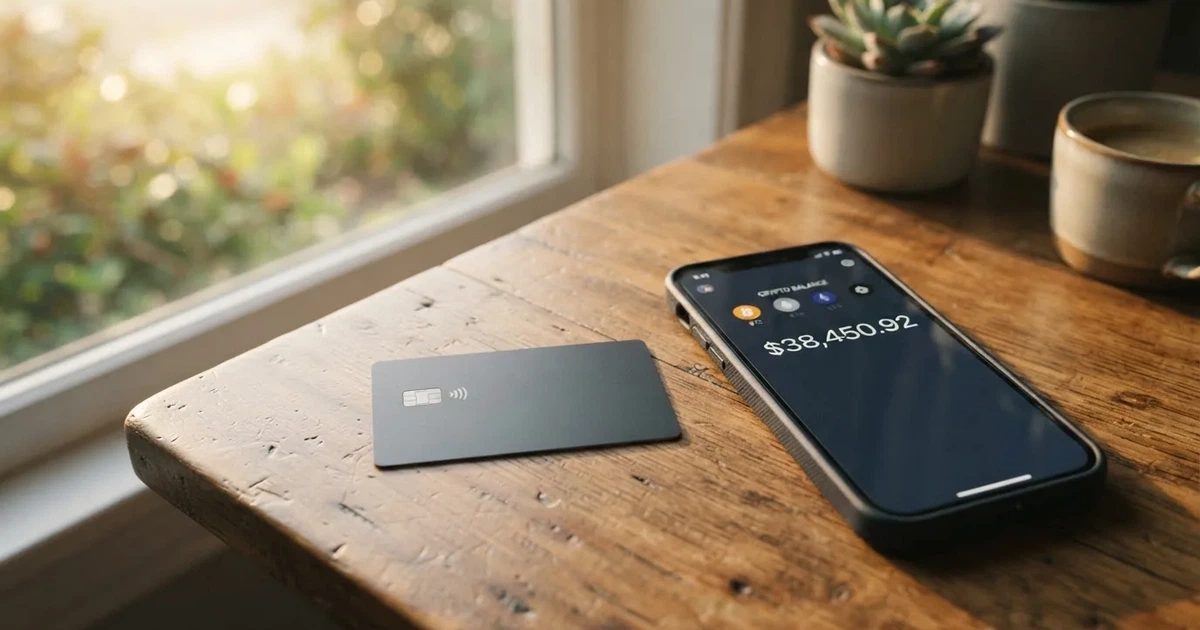
So who is it for? In my reading, the honest answer is a narrow band of people: users who already hold meaningful balances in US dollars, euros or bitcoin, who want one card to spend from all of them, and who value the deposit guarantee and the metal card more than they mind the membership. The audience the card itself points at is premium banking clients holding USD, EUR and Bitcoin. Everyone else — someone who just wants a Visa to buy coffee with a few hundred dollars of stablecoins, or someone in a country with no clear answer on eligibility — should look elsewhere first.
I gave the card 5.8 out of 10. That is not a rejection; it is a card with real strengths that sits behind an unusually large paywall. Let me show you where the marks come from before I take each question in turn.
The conditions described here are current as of October 28, 2026.
| Criterion | Mark | Why |
|---|---|---|
| Who can get it | 7 / 10 | Official list of countries not stated; unofficial sources say 50 countries, including the UK, Canada, Germany, Japan and Singapore, with 28 restricted jurisdictions including the United States |
| Cost | 2 / 10 | Membership USD 1,000 a year with a 30-day full refund; metal card free; “no FX fees and no hidden markups”; ATM 2% of the withdrawal amount above USD 100 a month |
| Top-up options | 6 / 10 | Card spends the Xapo account balance; USDC and USDT convert to USD; SWIFT, ACH, SEPA, Faster Payments, Bitcoin over Lightning |
| Reliability and complaints | 7 / 10 | Xapo Bank in Gibraltar, Gibraltar FSC permission as a credit institution No. 23171; USD deposits covered up to GBP 120,000; Trustpilot 3.9/5 across 1,141 reviews, 31% one-star, with freezes and slow reviews recurring |
| Everyday use | 8 / 10 | Metal, standard and virtual debit cards; ATMs in 100+ countries; Apple Pay and Google Pay not disclosed |
| Total | 5.8 / 10 | Strong product, steep entry cost, and a paper trail of account freezes |
Will they give you the card?
There is no clean answer, and that is the first thing you should know. The Xapo Bank card terms do not publish a country list. The terms document I found is titled “Cards Issued Outside Europe Region”, which tells you the issuer thinks in regional groups rather than a single eligibility table, and nothing more. Whether eligibility runs on citizenship or on residence is not stated on the public pages I could check — and that distinction matters more here than it might elsewhere, because sanctions screening is often applied to citizenship and country of birth as well as to your address.
Two further wrinkles are stated. Xapo may refuse to issue a card at its discretion, so approval is not something you can work towards by tidying up your documents. And users whose access was previously suspended cannot order a card at all.
What circulates outside the card’s own pages is an unofficial list: availability in 50 countries, with the UK, Canada, Germany, Japan and Singapore among them, and 28 restricted countries and jurisdictions including the United States, Russia and Ukraine. Third-party sites also frame eligibility by residence rather than nationality. None of that is confirmed by the card — I am passing it on as third-party information, not as terms. If your country matters, ask Xapo before you pay the membership, because a refusal after payment is the worst of the three possible outcomes.
How to get it
The path is: open a Xapo account first, then order the card, because the card is linked to the account rather than standing on its own. You must be at least 18 to order one.
Verification is the part worth reading twice. You need a valid passport or national ID, personal details that confirm both your identity and your residence, and a real-time photo or short video taken in the app. That last requirement is the one that catches people out — this is not a document-upload-only flow, and there is no obvious workaround if you cannot complete a live video check. The card terms do not state which KYC documents or what proof of address are accepted, nor any tiers, processing times or rejection reasons. In short: the requirements are clear in outline and vague in detail.
One welcome point, given the fee structure below: your first replacement card in a calendar year is free, and further ones cost USD 25. Emergency replacement is listed at USD 100 plus address-dependent shipping on third-party sources, unofficial but consistent with the first-replacement-free line.
Cards are posted only to your verified address. A different address is at your own risk and not guaranteed, so if you move, expect to re-verify before a replacement reaches you. Countries, delivery time and delivery cost are not stated on the pages I read. That is a genuine gap: physical delivery times vary by region according to unofficial sources, and nobody publishes a figure.
Fees and what a payment really costs
The headline is the membership. Membership costs USD 1,000 per year, with a 30-day full-refund window. That is the number that dominates everything else, and it is the reason the cost mark sits at 2 out of 10. Everything below it is comparatively cheap.

| Fee or limit | What the card states |
|---|---|
| Membership | USD 1,000 per year, full refund within 30 days |
| Card issuance | Metal card free to order; standard and virtual cards included with membership |
| Replacement card | Additional replacement in a calendar year USD 25; other lost, stolen or damaged re-issue fees “may apply”, amounts in the Fees Information Sheet |
| Conversion / FX | “No FX fees and no hidden markups”; Bitcoin spending with “no fees and competitive spreads” |
| ATM | 2% of the withdrawal amount above USD 100 per month; first USD 100 a month free; operator fees may apply |
| Limits | Default monthly spending and withdrawal limits, adjustable in the app; amounts not stated |
Two everyday payments, so the shape of the pricing is concrete rather than abstract.
Buying coffee in a country that uses dollars, on a balance you already hold in dollars: no FX fee, no markup, no membership amortisation in the moment. The membership is the only cost.
Buying something priced in a currency you do not hold, say a subscription billed in euros while your balance is in dollars: the card converts and debits your balance at no stated FX fee, and the card explicitly discourages you from accepting the merchant’s dynamic currency conversion — let the card do the conversion at the rate it offers. Again no fee on paper, but you have no visibility into the spread at the moment of payment, which is worth remembering when you next read about a disputed amount.
Third, and this is the one that bites: taking cash out. The first USD 100 a month is free, and everything above that costs 2% of the withdrawal amount. A USD 500 cash withdrawal therefore carries USD 8 in fees before whatever the ATM operator charges. If you expect to use an ATM more than occasionally, this is a card that punishes the habit rather than rewarding it.
One limit deserves flagging in bold: the actual amounts of the monthly spending and withdrawal limits are not stated. The terms call them high and say you can manage them in the app. Some merchant categories are blocked, and recurring pre-authorised payments, self-service petrol pumps and cash-like transactions may be declined — the last of those three will surprise people who assume a card works everywhere a debit card normally does. Unofficial figures circulating elsewhere are USD 50,000 per day in-store and online, USD 2,000 per day at ATMs, with much larger temporary purchases case by case. I would not plan around those numbers.
Top up options
Top-up is straightforward in concept and thin on specifics. The card spends the Xapo account balance and nothing else, so the only question is how you get value into that account.
Fiat comes in over SWIFT, ACH, RTP and FedACH for USD; Faster Payments for GBP; SEPA for EUR. Stablecoins — USDC and USDT — are deposited and automatically converted to USD. Bitcoin arrives over Lightning.
That last part is a limitation worth saying out loud: Lightning only. If you hold bitcoin on-chain and want it on the card, you are looking at moving it through Lightning first, which is a different process from an ordinary on-chain transfer.
The deposit fee and the minimum top-up amount are not stated, and neither are withdrawal fee amounts. Withdrawals go out over SWIFT, ACH, Faster Payments, SEPA and Lightning.
Now the housekeeping point that catches people out: closing the Xapo account cancels the card, though the card can also be cancelled on its own. What happens to a remaining balance on closure is not stated, and Xapo may end the agreement with two months’ written notice. A notice period is a reasonable thing to have; not knowing what a balance does at the end of it is worse. If you are thinking of closing, ask before you close.
Paying with it every day
This is the card’s strongest area, and it is where the 8 out of 10 comes from.
You get three card types with the membership: metal, standard and virtual. The metal card is the premium object and is currently free to order, which is a considerable change of tone from the price of everything else around it. Virtual cards are the practical ones for online spending. Visa terms apply to non-European cards; the network is named as Visa on the card terms, though the Transact page does not spell it out again.
ATM access covers 100+ countries, and as noted the first USD 100 a month is free.
Balances: USD, GBP, EUR and Bitcoin sit in the same account, and each payment can draw from either your USD balance or your Bitcoin balance. That is the genuinely useful bit — paying from bitcoin without a separate conversion step.
Apple Pay and Google Pay are not stated anywhere I could find. That is odd for a card of this vintage, and if tap-to-pay on a phone is how you would use it, ask before you buy the membership. UniFi, further down, does advertise Apple Pay support.
The app is a single iOS and Android app running 24/7, with card freeze and unfreeze built in. Store ratings I did not read.
One promotion is live and narrow: 3% cashback in Bitcoin on rideshares and taxis, from 1 July to 31 October, requiring an active Metal Card, and only on selected spending. There is no general cashback. More broadly, from 1 July 2026 general everyday cashback was replaced by targeted campaigns like this one. There is also an introductory offer of 4.6% p.a. on the first USD 100,000 of USD Savings for 90 days, for members paying between 22 September and 23 November 2026.
Two friction points to plan for. Xapo blocks a list of merchant category codes and does not publish the list. And refunds are “usually up to 10 Business Days” — a refund into an unsupported currency is converted at the payment system’s rate, and Xapo says it is not liable for losses from that.
What can go wrong
Nothing official has gone wrong that I could find. That is worth saying plainly, and it is also worth saying that it is a thinner record than the user reports.
The company is Xapo Bank, incorporated in Gibraltar, Company No. 111928, at 2 Irish Town, Gibraltar GX11 1AA. It is regulated by the Gibraltar Financial Services Commission, with permission as a credit institution under the Financial Services Act 2019, Permission No. 23171. The related VASP entity is Xapo VASP Limited, Permission No. 26061. Support runs through the Xapo app or customersupport.xapo.com, with a dedicated Relationship Manager and a complaint page.
On money, this is a custodial Gibraltar bank. Your crypto is held by them, not by you. USD deposits are covered by the Gibraltar Deposit Guarantee Scheme up to the USD equivalent of GBP 120,000 — that is real, meaningful protection. Bitcoin and other crypto are not covered by it, because it is a deposit scheme and they are not deposits. Certifications listed are PCI DSS, SOC 2 Type II and SOC 3. Card freeze and unfreeze in the app, described as “bank-grade security” with fraud monitoring. Two-factor authentication is not mentioned in the card terms, which is odd for something described that way — so check the app yourself rather than assuming.
The user picture is where the mark comes down. Trustpilot shows Xapo Bank at 3.9/5 from 1,141 reviews as of 20 October 2026, with 31% of them one-star. Support draws praise in some of them; the one-star side includes someone calling the bank fraudulent after a year of failed transactions. Recurring themes: account freezes and closures (November 2025, July and August 2026), inability to withdraw or close, and a USD 1,000 annual fee not refunded in one July 2026 case. Slow compliance reviews appear repeatedly, one reportedly running seven weeks across June to August 2026. High fees and templated support show up in June to September 2026.
Then the outlier. On Reddit r/CryptoHelp in 2025, one user reports an identity verification problem unresolved for more than three years with unresponsive support. One story is not a pattern, but it is exactly the failure mode a 4.6% savings offer or a five-figure account can trigger, and it matches the seven-week review complaints from the Trustpilot side.
Regulatory framing, briefly, because it shapes what happens if something goes wrong. In the EU, if customer due diligence cannot be completed, rules require the institution to refrain from the transaction or relationship and, where necessary, end existing relationships — which is the legal reason accounts get frozen pending documents rather than a quirk of Xapo’s support desk. Nationality is screened separately from residence. And a crypto card of this kind rests on two licences, not one: MiCA covers the crypto side, while the card itself is a payment service under separate e-money and payments law. MiCA’s transitional period ran until 1 July 2026 or until a provider received or was refused authorisation, whichever came first.
Historical note: in 2014 Xapo faced backlash over the fee schedule on its old debit card, blamed its issuer and promised reimbursement. Different product, different decade — but it is a reminder that Xapo has been in this business a long time and that fee changes are a live theme.
What to take instead
None of these are equivalent products, and it would be misleading to present them as substitutes. They are the alternatives that score lower, are cheaper, or answer a different need.
| Card | Score | What it is | Where it differs from Xapo |
|---|---|---|---|
| Whop Cards | 5.2 / 10 | Visa card spending from a Whop balance, backed by stablecoin collateral from a linked wallet | US-focused (31 consumer states, 41 for businesses), “no extra fees”, 5% cashback at select merchants; fees and conversion rates not stated |
| Stella | 6.5 / 10 | Virtual and physical VISA card, works at “over 40 million VISA merchants globally” | Depositing crypto automatically tops up the card; terms bar sanctioned users and route US and European users through affiliates; no official cashback |
| UniFi Card | 4.7 / 10 | Prepaid Debit Visa Card issued by Lead Bank, USD balance | Cheapest and simplest; supports Apple Pay; funded by ACH, wire, SEPA or SPEI, plus a USDC wallet; fees “may apply” and are not stated |
Where Xapo wins, plainly: three card types including a metal card, 100+ countries for ATM use, BTC spending with no stated fees, a named deposit guarantee ceiling, and a multi-currency balance with an actual banking licence behind it.
Where Xapo loses: the USD 1,000 annual membership dwarfs anything the alternatives charge, since none of the three publish a comparable fee — Whop says “no extra fees”, and the other two simply do not state amounts on the pages I read. Xapo’s eligibility is undocumented where Whop’s is at least itemised. And Xapo’s account-freeze pattern is a documented theme where the alternatives have no comparable public record.
Who I would recommend it to
If you hold five figures or more in dollars, euros or bitcoin, you want one card across all three, you live somewhere you have reason to believe you are eligible, and you would rather have a metal card and a deposit guarantee than a lower fee — then yes, this is a coherent product and the 30-day refund makes trying it cheap in relative terms.
If you are anyone else, I would not start here. If you mainly want to spend stablecoins at ordinary merchants, the membership is a thousand dollars for a service you can get for a fraction of that. If you are in the United States, the unofficial restrictions suggest this is not for you. If your priority is tap-to-pay in a phone wallet, Xapo does not say it supports Apple Pay or Google Pay. If your priority is being able to see published limits and fees, this card withholds both.
The two questions I would ask Xapo before paying anything, in this order: whether they will issue to you at all, given where you live and what you hold; and how long a compliance review realistically takes, because the reports suggest that is where the time and the frustration go.
Frequently asked questions
What is the Xapo Bank card?
It is a debit card that spends the balance of a Xapo account rather than a separate bank account. You get metal, standard and virtual cards with the membership, and can pay from a USD balance or a Bitcoin balance. Fiat balances are available in USD, GBP and EUR. Membership costs USD 1,000 a year, with a full refund within 30 days, and the metal card is currently free to order.
Is Xapo Bank actually a bank?
Yes, in the regulatory sense. Xapo Bank is incorporated in Gibraltar, Company No. 111928, and is regulated by the Gibraltar Financial Services Commission as a credit institution under the Financial Services Act 2019, Permission No. 23171. USD deposits are covered by the Gibraltar Deposit Guarantee Scheme up to the USD equivalent of GBP 120,000. Bitcoin and other crypto are not covered by that scheme.
Who can get the card?
The card’s own pages do not state a country list, and they do not say whether eligibility runs on citizenship or residence. Xapo may refuse to issue a card at its discretion, and previously suspended users cannot order. Unofficial sources list 50 supported countries including the UK, Canada, Germany, Japan and Singapore, with 28 restricted jurisdictions including the United States, Russia and Ukraine.
How do I apply?
Open a Xapo account first, then order the card against it. You must be 18 or older. Verification needs a valid passport or national ID, personal details confirming identity and residence, and a real-time photo or short video in the app. Cards ship only to your verified address; delivery countries, times and costs are not stated on the card’s pages.
What does the card cost?
Membership is USD 1,000 per year with a 30-day full refund, and metal card issuance is free. Foreign spending carries “no FX fees and no hidden markups”, and Bitcoin spending has no fees with competitive spreads. ATM withdrawals are free up to USD 100 a month and 2% of the withdrawal amount above that, with operator fees possibly added.
What are the limits?
Default monthly spending and withdrawal limits exist and can be adjusted in the app, but the amounts are not stated in the terms — they are described only as high. Unofficial sources suggest USD 50,000 per day in stores and online, and USD 2,000 per day at ATMs. Some merchant categories are blocked, and recurring pre-authorised payments, self-service petrol pumps and cash-like transactions may be declined.
How do I top it up?
Send fiat over SWIFT, ACH, RTP or FedACH for dollars, Faster Payments for pounds, SEPA for euros, or Lightning for bitcoin. Depositing USDC or USDT converts them to USD automatically. Deposit fees and the minimum top-up amount are not stated. Send tokens only on networks the provider supports — a transfer to an address on the wrong network can be lost with no guarantee of recovery.
Is the card safe to use day to day?
It is a custodial product: Xapo holds your funds, so you depend on them rather than holding keys yourself. Listed certifications are PCI DSS, SOC 2 Type II and SOC 3, with fraud monitoring and instant card freeze in the app. Two-factor authentication is not mentioned in the card terms. Note that freezes are also the main complaint theme on Trustpilot, where the score is 3.9/5 from 1,141 reviews.
Can I use it with Apple Pay?
The card’s pages do not say. Apple Pay and Google Pay are not stated, so do not assume phone-wallet tap-to-pay works — ask support before you buy the membership if that is the way you intend to pay. UniFi, a cheaper alternative, does advertise Apple Pay support, which is a point in its favour for phone-first users.
Is it worth it?
For someone already holding substantial USD, EUR or bitcoin who wants one card across currencies plus a metal card and deposit protection, the 30-day refund makes it a reasonable trial. For everyone else, USD 1,000 a year is a lot to pay for a spending card, and the withdrawal costs, undisclosed limits and reported compliance delays are the parts that push my score down.
App and neobank card options – cryptocardoptions.com
Content created by the «cryptocardoptions.com» team