
Kolan card review for 2026: a sparse public profile, a working USD card, and a few gaps to weigh up
 Available in US
Kolan is a virtual USD card that sits on top of a crypto-funded account. In this review I go through what the company actually publishes about itself, where the public record is thin, and how the product lines up against three alternatives — Cardex, TakeCard and OkiCard. By the end you should know whether the card fits the way you actually pay, and where you would have to take a chance on information that is not on the website.

The conditions described here are current as of October 28, 2026.
Verdict
Kolan scores 5.7 out of 10 in my assessment. The number itself sits in the middle of the pack, but the spread underneath it tells the more useful story: strong on reach (8/10), weak on the everyday details (3/10), and middling on cost (5/10), top-up (5/10) and reliability (6/10). If you are an online-only spender who needs a USD balance and a virtual card in a hurry, the basic shape of the product is reasonable. If you want a full picture — physical card, ATM withdrawals, Apple Pay, transparent fees — you will not find it on Kolan’s pages.
| Criterion | Mark | Why it sits there |
|---|---|---|
| Who can get it | 8 / 10 | The account side claims 100+ countries on Hurupay’s profile; the card is positioned for non-US users in 50+ countries on third-party listings. The card programme itself, however, has no published country list. |
| Cost | 5 / 10 | Kolan does not publish an official fee schedule. Third-party listings describe “no hidden FX fees”, but there is nothing to verify that against. |
| Top-up options | 5 / 10 | Funding works through a Kolan account that holds USDC as collateral and converts to USD for the card. Networks are not stated. |
| Reliability and complaints | 6 / 10 | The operator (Hurupay Inc., DBA Kolan) is US-registered as a money services business and a Circle developer-grant recipient, but the card issuer is not named, there are no Trustpilot reviews, and engineer chatter on Cursor describes prepaid and crypto-funded virtual cards as products that “often have issues”. |
| Everyday use | 3 / 10 | Virtual only, USD only. Apple Pay and Google Pay support is not stated. Card freeze is mentioned. |
| Total | 5.7 / 10 | A workable USD card for online payments in supported regions, weighed down by missing detail on fees, networks and the issuing bank. |
The audience that fits best is what I would call the “online services in USD” user: someone paying for SaaS, hosting, AI tools or domain renewals from a US-dollar balance, and who values a quick virtual card over a fully featured banking product. The reader this card does not suit is anyone who needs a physical card, ATM access, multi-currency balances, or a fee table they can read in advance.
Who can get the Kolan card
The starting position is that Kolan’s parent company, Hurupay, says it offers accounts to people in “more than 100 countries” (that figure is from Hurupay’s own profile, not from a Kolan page; it is about account availability, not card eligibility). The card programme itself, as far as I can see on the public site, does not publish a country list, supported citizenship list or excluded-jurisdiction list — that is the first gap. Third-party listings give a more specific shape: an Alchemy directory entry and an Australian-startups listing, both from 2026, describe Kolan as available to non-US individuals in over 50 countries, which is the figure I would plan around if you are outside the US.
KYC is not described on Kolan’s pages. That does not mean there is no check — for any regulated payments product there is one — but it means the level, the documents asked for, and the time it takes are not stated publicly. Sanctions screening is standard for this category, so if you are a citizen or resident of a sanctioned jurisdiction, expect to be excluded even if the marketing copy does not say so. Age is not stated, but the standard rule for prepaid and debit cards in most markets is 18+; some issuers set it higher.
The bottom line: if you are a non-US individual in a country with reasonable payment infrastructure, you are likely in the candidate set. If you are in a high-risk or sanctioned jurisdiction, you almost certainly are not. The country list is one of the first things I would want to see before signing up, and the absence of one is a real reason to slow down.
How to get it
The application path is not laid out step-by-step on Kolan’s pages, so what follows is the general shape of the product as described in the available material.
Kolan appears to be a virtual-only card. I have not found a physical card option, and the third-party Alchemy listing (2026) describes it as a “USD virtual card for online spending”. The card network is not stated on Kolan’s own materials. Cursor staff, in a public thread from August 2026, speculated that a card like this “could work if it’s a Visa or Mastercard”, but that is not confirmation, and the network determines a lot about which merchants will accept the card.
KYC levels, the documents asked for at sign-up, and the verification time are not stated. Activation steps are not stated either. The first time I went through this kind of signup I expected a short flow — email, phone, ID — and that is a reasonable expectation here, but it is not what the company is telling you to expect.
There is one more wrinkle worth flagging: the card programme has no named issuer in the public material. The card-issuing bank or e-money institution is the entity that actually holds the programme under the network’s licence, sets the BIN, and bears the regulatory duty. With Kolan, that party is not disclosed on the public pages. The operator is Hurupay Inc. (DBA Kolan), which is a US-registered fintech, but the issuer is a separate question. If you cannot find it, that is itself information — and a reason to ask support for the issuer’s name and regulator before you load meaningful funds.
Fees
The honest answer to “what does Kolan cost” is that the company does not publish a fee schedule. There is no public table of issuance, monthly, conversion, FX or ATM fees, and the limits on daily or monthly spending are not stated either. I have to score this section at 5/10 because the absence of published fees is, in itself, a cost — the cost of not knowing what you will pay until you pay it.

What I can tell you is from unofficial third-party descriptions. A directory entry (read 2026-10-22) describes Kolan as having “no hidden FX fees”. That is a positive signal, but it is not a fee table, and it does not tell you what the non-hidden fees are. The card is positioned as a USD product, so the obvious comparison points — cross-border markup, ATM withdrawal fees, inactivity fees, replacement fees, currency conversion — are all unaddressed on the public site.
| Fee or limit | Kolan (official) | Kolan (third-party / context) |
|---|---|---|
| Card issuance | not stated | — |
| Monthly / subscription | not stated | — |
| Crypto-to-fiat conversion | not stated | — |
| FX (cross-border / non-USD) | not stated | “no hidden FX fees” (directory, 2026) |
| ATM withdrawal | not stated | — |
| Daily spending limit | not stated | — |
| Monthly spending limit | not stated | — |
| Card currency | USD (per Alchemy listing) | Hurupay accounts also exist in EUR and GBP |
Let me walk through three everyday payments so you can see the kinds of fee decisions you are flying blind on.
The first is a USD online subscription. You fund the Kolan account, the system converts USDC to USD on the card, and you pay a US merchant. With a USD-on-USD transaction you would expect the FX line to be zero. If Kolan charges a crypto-to-fiat conversion fee, that is the line that matters, and it is not stated. The second is a non-USD online purchase paid in euros. Here, the issuer has to convert USD to EUR. If the cross-border markup is on the card, it shows up here. The third is a small domestic purchase on a US merchant that triggers 3-D Secure. There is no fee to you, but the flow matters: 3-D Secure challenges add friction, and on a virtual card the friction is harder to walk back from if you are mid-checkout.
My practical advice is to test with a small amount first and check your in-app statement for any line items before you commit. If a fee does appear and you cannot get a written schedule that explains it, that is information to use.
Top up
Funding is the part of Kolan that is actually described, and the description lines up with the way most crypto-funded cards work. You deposit crypto into a Kolan account. The account holds the deposit as USDC in a linked wallet as collateral, and converts to USD to load the virtual card. The card itself only ever sees a USD balance; the crypto is on the other side of that conversion.
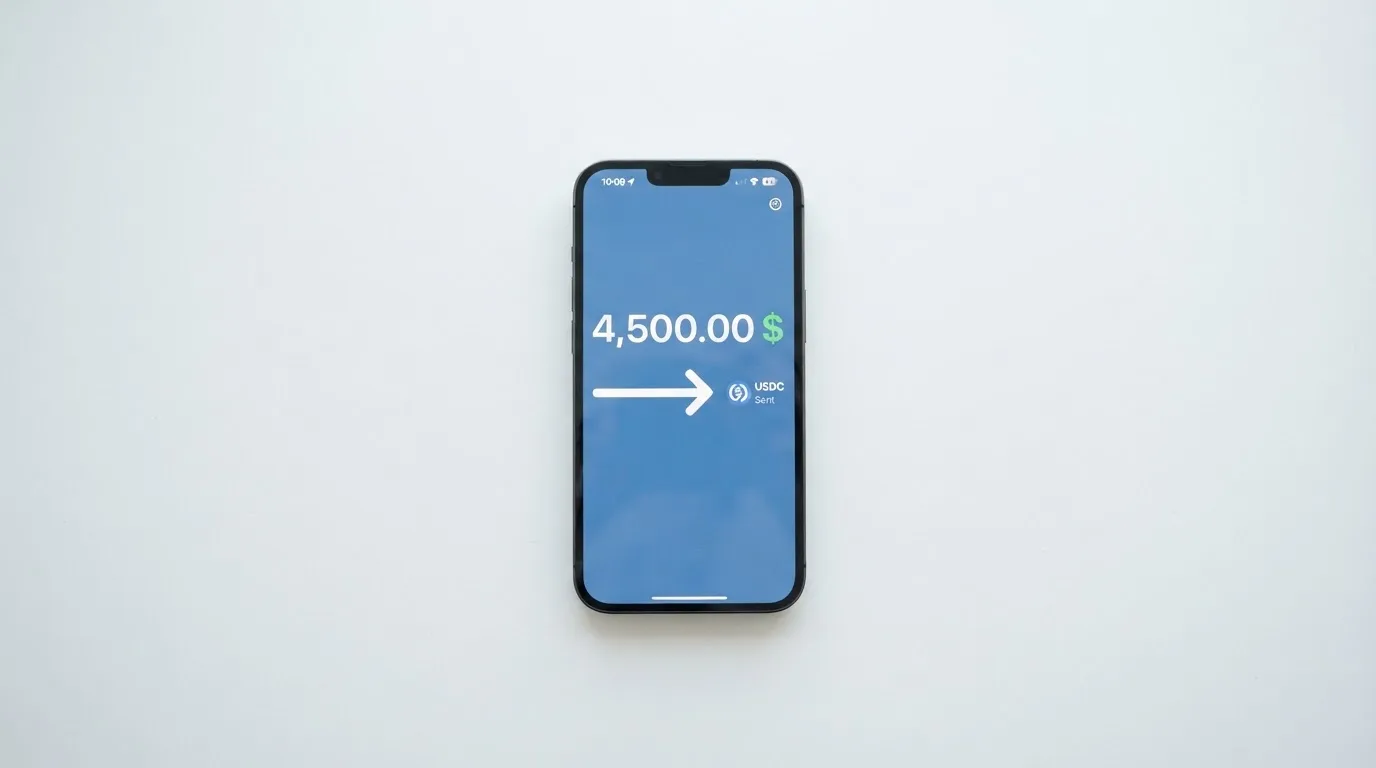
What is not stated is the most important practical detail: which networks you can send on. With USDC specifically, the network question is consequential. USDC exists on dozens of chains, and a USDC transfer sent on the wrong network to a Kolan deposit address is at risk of being lost or stuck in manual recovery, because blockchain transfers are typically irreversible. Circle stopped supporting USDC on Tron in February 2024, so a “USDC over TRC20” deposit is not a native option with Circle, and any platform that asks you to send USDC on Tron is relying on a third-party wrapping arrangement rather than native Circle issuance.
On Kolan’s own pages I do not see a list of supported networks or supported tokens. The general rule of thumb, before you send any meaningful amount, is to use the platform’s test transaction: send a small amount first, see that it credits, see the conversion that applies, and only then send the rest. The on-chain fee (gas, bandwidth or whatever the network charges) is on the blockchain, not on Kolan, so you are paying that either way.
Withdrawal is described at the parent-account level, not the card level. Hurupay accounts, per the Alchemy listing, allow withdrawal to crypto exchanges or local banks. The card itself is a pay-out channel, not a withdrawal channel, so “withdraw from Kolan” usually means: spend down the card balance, or withdraw from the underlying Hurupay account if your region supports it. The supported withdrawal corridors for the card programme are not stated.
Paying with it every day
Kolan is virtual and USD. That is the day-to-day shape of the product, and it is also the ceiling on what you can do with it.
On the supported side: the card is positioned for online spending in USD, which is what virtual USD cards are good at. A directory description mentions spend controls including card freeze, which is the basic safety net you want on a virtual card — the ability to lock the card number in the app if it is compromised or if you have finished a subscription run. Hurupay accounts also exist in EUR and GBP at the account level, but the card is a USD product.
On the unstated side: the card network is not on the public pages, which makes it hard to predict which merchants will accept it cleanly. Apple Pay and Google Pay support is not stated. Cashback, rewards and any spending-based incentives are not stated. The mobile app’s features — push notifications, biometric login, instant statements — are not described. The dispute and chargeback process is not described. That last point matters: a chargeback is the main consumer protection on a card, and the way to file one is usually laid out in the cardholder agreement. If you cannot find a cardholder agreement before you sign up, that is a gap to ask about.
The everyday-use score of 3/10 is a reflection of the gaps, not of any specific failure. A virtual USD card, in principle, is a useful tool. The product is just not telling you, on its own pages, what the everyday experience will be.
What can go wrong
Let me separate the known risks from the open questions.
The known risk is one that applies to the whole category, not to Kolan specifically: prepaid and crypto-funded virtual cards, in the experience of engineers discussing them on the Cursor forum in August 2026, “often have issues” — checkout declines, failed renewals, the kind of soft failure that loses a sale or breaks a subscription at the wrong moment. The thread itself was about a Kolan virtual card for a Cursor Pro+ plan, and Cursor neither supported nor blocked the card, which is itself a useful data point: the card is not on a known blocklist at that merchant.
The open questions are heavier. First, the issuer is not named on the public site. The card-issuing bank or e-money institution is the entity that holds the network licence, the BIN and the regulatory duty, and the absence of that name is not just a marketing gap — it is a question of who you are actually in a contract with. Second, there is no Trustpilot page or Reddit thread that I could find for Kolan or for Hurupay, which makes it hard to triangulate reliability from user reports. Third, custody and 2FA are not stated; the description only mentions spend controls. With a custodial product, that means you are trusting the operator to hold your funds and your card balance, and you are not being told how.
There is a separate reliability vector that comes from the company structure. Hurupay Inc. is US-registered, and is described in third-party listings as MSB-registered, which is the US money-services-business designation under FinCEN. Kolan was in the inaugural Circle Developer Grant Program cohort, which is a useful external signal — Circle worked with Kolan, but it is not a regulatory endorsement. There are no official incidents in the public record as of the date this review was prepared. The lack of an incident is positive, but it is also a function of how new the product is.
A few things to keep in mind that apply across the category. Crypto transfers are typically irreversible, so a deposit to the wrong address or the wrong network is hard to recover. Custodial platforms have failed in the past — Mt. Gox, Coincheck, Ronin Network — and holding a balance with any custodian carries counterparty and hack risk. Stablecoins can lose their peg; USDC and USDT have, in different circumstances, traded off the dollar in stressed conditions. None of these are Kolan-specific, but they are the shape of the risk you are taking on when you hold a card balance with any provider in this space.
What to take instead
Three alternatives, each with a slightly different shape. I picked these because they cover the same online-spending use case but come from different angles: Cardex for geographic reach, TakeCard for the Latin American market, OkiCard for the more transparent fee structure.
Cardex — 5.6 / 10. Cardex is positioned for breadth: “one crypto card, 200+ countries”. It supports both virtual and physical cards on the VERVE, VISA, Mastercard and UnionPay networks, which is unusual breadth. The catch is the App Store listing, which is Naira-focused — the card currency is Naira in that listing — so the day-to-day experience is likely tuned to Nigerian spending. Costs are not stated. Fees are described in the abstract: an “AI-Powered Conversion Rate” that scans global exchanges at the moment of payment, with no fee percentage stated. If you are outside Nigeria and outside the 200-country marketing claim’s practical reality, Cardex is hard to evaluate.
TakeCard — 5.5 / 10. TakeCard is the more grounded of the three. Virtual card is USD 5, available immediately; physical card is Bolivia-only and is listed as USD 20 issuance + USD 20 shipping in one article, USD 10 in another — there is a conflict. The card is prepaid, USD-denominated (USD payments 1:1), issued in the United States, and uses the Visa network per the article I read. The fee structure is clearer than Kolan’s: 1% commission per purchase, USD payments 1:1 with no currency adjustment, other currencies at the official Visa rate of the day. Funding is from a Takenos account balance, with starting data suggesting USDC/USDT via Polygon, BNB Chain, Tron or Ethereum. The catch is geographic: the physical card is Bolivia-only, and the virtual card’s full country list is “not listed in the help articles” — though starting data puts it in Argentina, Bolivia, Peru, Chile, Paraguay, Colombia, Ecuador, the US, Spain and Italy.
OkiCard — 6.0 / 10. OkiCard is the most transparent of the three on fees. Pricing page: issuance USD 0, monthly USD 0, starting price USD 15 for the virtual card; the FAQ also mentions a one-time issuance fee, and the two pages disagree. There is a 100 USDT initial deposit, a 3% load fee, and a 0% transaction fee for USD payments. “No hidden exchange spreads” is on the page. Funding is wider than Kolan’s: USDT on BSC (BEP-20), Ethereum (ERC-20), Tron (TRC-20), Solana (SPL), with USDC “soon” and BTC and altcoins “coming soon”. The card is virtual (a physical card is mentioned without details), the network is “Visa/Mastercard” not specified, and the card currency is pegged to USD or EUR. The catch is the issuer’s framing: “no geo-blocking based on your passport”, but users must confirm they are not in a sanctioned jurisdiction — that is a narrower promise than it sounds.
If you want the clearest fee picture of the three, OkiCard is the place to start, with the note that you should still read the small print. If you are in Bolivia or in the broader LatAm starting-data list and you want a card that is explicit about its 1% commission, TakeCard is the better match. If you are outside both of those and you care about the broadest published country list, Cardex is the more interesting option, but you will have less to verify against.
Who I would recommend it to
The reader I would point at Kolan is the one I described in the verdict: someone paying for online services in USD, who values a virtual card and a quick signup, who is comfortable with the fact that the fee schedule is not on the page, and who is not expecting a physical card, an ATM, a multi-currency balance or rich in-app controls. The card shape fits that use case. The published detail does not, and that is where the 5.7/10 comes from.
The reader I would not point at Kolan is anyone who needs to know, in advance, what they will pay for a card, a withdrawal or a cross-border transaction. Anyone who needs a physical card for in-store payments, anyone whose spending relies on Apple Pay or Google Pay, anyone who plans to dispute a charge and wants to see a clear chargeback process in writing, anyone who needs an ATM. For those readers the gaps in the public material are not just inconvenient — they are the reason to use a different product.
A last practical point. Before you load meaningful funds, I would test with a small amount, see the conversion that applies, check the in-app statement for any line items, and ask support for the issuer’s name and regulator, the supported deposit networks, the fee schedule, and the dispute process. If the answers to those questions are not in writing, that is information to use, and the next section answers some of the most common variants of those questions.
Frequently asked questions
What is Kolan card?
Kolan is a virtual USD card built by Hurupay Inc. (DBA Kolan), a US-registered fintech. You fund a Kolan account with crypto, the account holds the balance as USDC in a linked wallet, and the card is loaded in USD for online spending. The product is positioned for non-US users in 50+ countries on third-party listings, with the broader Hurupay account available in 100+ countries.
How does Kolan card work?
You deposit crypto into a Kolan account, the system holds it as USDC as collateral, and converts to USD to load the virtual card. The card itself is a USD balance, so online purchases in USD do not need a cross-border conversion. Spend controls including card freeze are mentioned in the public material; reward programmes, the app’s full feature set and the dispute process are not described.
Is Kolan a bank?
No. Kolan is operated by Hurupay Inc. (DBA Kolan), a US-registered fintech described in third-party listings as MSB-registered. The card-issuing bank or e-money institution is not named on the public pages, and the operator does not appear to be a chartered bank or a licensed e-money institution in the way those terms are usually meant.
Who owns Kolan?
Hurupay Inc. owns and operates Kolan (DBA). Hurupay is described in third-party listings as a US-based, MSB-registered fintech and as a participant in the inaugural Circle Developer Grant Program cohort. The card-issuing bank is not named.
Is Kolan card available in my country?
The starting data is that Hurupay offers accounts in “more than 100 countries” (account availability, not card eligibility). Third-party listings describe Kolan as available to non-US individuals in over 50 countries. Kolan’s own pages do not publish a country list, an exclusion list or a supported-currency list, so the practical answer is: probably, if you are a non-US individual in a country with reasonable payment infrastructure, and almost certainly not if you are in a sanctioned jurisdiction.
How do I get a Kolan card?
The application path is not laid out step-by-step on Kolan’s pages. The general shape is: sign up for a Kolan account, complete the KYC check (the level and documents are not stated), get a virtual card. The card is virtual-only; no physical card option is published.
Does Kolan card require KYC?
The level and the documents are not stated on Kolan’s public pages. For any regulated payments product there is a check, and sanctions screening is standard, so the practical answer is yes — but the specifics are not on the site, and you should expect to be asked for ID before the card becomes usable.
How do I top up Kolan card?
You deposit crypto into the Kolan account; the system holds it as USDC in a linked wallet and converts to USD to load the card. The supported networks and supported tokens are not stated on Kolan’s pages, so the practical advice is to send a small test amount first, see that it credits and how the conversion applies, then send the rest. Blockchain transfers are typically irreversible, so a wrong-network deposit is hard to recover.
Is Kolan card free?
Kolan does not publish a fee schedule. Issuance, monthly, conversion, FX and ATM fees are not stated, and daily or monthly limits are not stated either. A directory description says “no hidden FX fees”, which is positive but is not a fee table. Treat the card as having costs you have not yet seen, and test with a small amount first.
Is Kolan card safe?
Spend controls including card freeze are mentioned, and Hurupay is described in third-party listings as MSB-registered, with Kolan in the inaugural Circle Developer Grant Program cohort. Beyond that, custody and 2FA are not stated, the issuer is not named, and there is no Trustpilot page or Reddit thread for Kolan or Hurupay. The category-level risks — custodial failure, stablecoin depeg, irreversible transfers — apply here as they do to any product of this type.
Virtual card options – cryptocardoptions.com
Content created by the «cryptocardoptions.com» team