
Reading the Stella card's terms closely: a prepaid Visa with strong top-up support and thin published costs
 Available in US
Some cards exist to earn points. Some exist to sit in a drawer until the airport. Stella is neither: it is a prepaid Visa card that spends a balance you load from crypto, and on paper it does two things well — it accepts a wide range of coins across several networks, and it works in the places people actually shop. On the other hand, the card’s own public pages tell you almost nothing about what it costs, and the company behind it is not named in a way that makes an easy check.

Conditions are current as of October 28, 2026.
I have read the Stella card’s terms and the pages around it, and here is my honest reading of who this fits, where it falls short, and what to verify yourself before you put money in.
My score: 6.5 out of 10.
| Criterion | Mark | Why |
|---|---|---|
| Who can get it | 7 / 10 | The card’s own pages never name the countries; unofficial sources say 57 countries are supported and 49 restricted |
| Cost | 5 / 10 | No fees are published on the official pages; what circulates is a no-annual-fee picture with an application fee for the virtual card |
| Top-up options | 9 / 10 | BTC, ETH, USDT and USDC across six networks, per unofficial sources, and crypto deposits top the card up automatically |
| Reliability and complaints | 4 / 10 | Issuer and licences unnamed; complaints of account freezes with funds not returned; one Trustpilot rating of 3.2 |
| Everyday use | 9 / 10 | Virtual and physical Visa, ATMs, Google Pay, Alipay and WeChat Pay |
Here is who I think the card suits. It suits someone who already holds crypto, mainly in stablecoins, and wants a Visa that spends it directly without a separate exchange step. It suits someone travelling or living across regions where they want to tap and pay, and possibly a wallet link, without juggling several banking relationships. The audience Stella is aimed at, as far as the material goes, is crypto holders who want a Visa with ATM and Alipay support — a specific combination that few mainstream cards deliver.
And here is who I think it does not suit. It does not suit anyone who needs published, itemised costs, because the card does not publish them. It does not suit anyone whose income or savings depend on a deposit guarantee, because this is not a bank deposit and I found nothing suggesting it is covered by one. It does not suit someone who cannot tolerate the possibility that their balance is frozen for weeks with no clear timeline — that risk is not hypothetical here, there are user reports of exactly that. And it does not suit a person whose country is not on the unofficial support list, because the official pages will not tell them.
Will They Give You the Card
Short answer: probably, if your country and your documents are in order, but the card will not tell you plainly where it operates.
The official site does not name any countries at all. What the terms do say is that users are barred from participating under economic sanctions programmes, and that US and European users are routed through affiliates rather than through one global entity. That routing detail matters more than it first sounds: it means that if you are in the US or Europe, the party you are contracting with is not the same party as for someone in, say, Singapore. That is normal in this category, and it is also something a reader has no way of checking from a webpage.
The unofficial picture, which comes from third-party review sites rather than from Stella itself, is that the card is available in 57 countries including the United States, the United Kingdom, Singapore and India, and restricted in 49 others including Russia, Belarus, Ukraine, Iran, Iraq, Syria, North Korea, Cuba, Venezuela and South Africa. I would not treat that as settled: the list was last confirmed against Stella documents dated 6 September 2024, according to one third-party site reporting in August 2026. That is a fourteen-month-old snapshot of a list the card does not publish.
So how do you answer this for yourself? Ask support directly, with your country of residence and your citizenship, before you upload anything. And treat this question as separate from a second one that people often merge into it: *can I use the card in country X* is not the same as *can I sign up while living in country X*. The card’s terms restrict US and European users by route, not by eligibility, and an eligibility list that a site publishes may lag the internal screening rules.
One more thing the card does not state: how many verification tiers there are. If you have seen cards described as having a “tiered” verification system, that is not in Stella’s public materials.
How to Get It
Short answer: it is an ordinary identity-check application followed by delivery or immediate digital use, and the check is thorough enough to involve tax ID and bank details.
The card’s own page promises a “quick and easy verification process, with immediate card usage after approval.” The User Agreement is more specific about what you hand over: name, address, date of birth, tax ID, government ID and bank details, with biometric data possible to request. Minimum age is 18.
That list of documents is worth reading twice, because it is longer than the marketing sentence suggests. Tax ID is the item that catches people out — in some jurisdictions you simply do not have one, and there is no obvious place on the form to say so. Bank details, likewise, are not something every person in the world has. If you are in that position, ask support before you start rather than after your application stalls. And the “immediate card usage after approval” applies to the virtual card, not to a plastic one arriving in the post.
What you get is a virtual and a physical card, both Visa, working at what the card describes as over 40 million Visa merchants globally. Unofficial sources describe it as a Visa credit card with USD as the only base currency, where the starting credit limit is zero and rises as crypto collateral goes in. I would hold that loosely: “credit card” language varies between providers, and a card whose limit is a function of your own crypto is not a conventional credit product.
On delivery, the card’s public pages say nothing. Unofficial sources say the physical card is free after a top-up of USD 20,000 and otherwise carries a delivery fee. That threshold is high enough that most people should assume they pay something for the plastic. If the physical card matters to you, get the amount confirmed in writing before you start.
Timing is unofficial: third-party sites describe full e-KYC taking typically one to two business days, with many applications auto-approved in minutes. Read that as a range between “quick” and “not today”, not a promise.
Fees: What It Really Costs
Short answer: the card’s own pages disclose no amounts at all, and the useful numbers all come from unofficial sources — which is itself the most important thing to know about this section.

Here is what is published and what is not.
| Item | Official statement | Unofficial picture |
|---|---|---|
| Issuance | not stated | No annual fee; virtual card described as pay-as-you-go with an application fee shown in-app only — one user complaint cites USD 30 |
| Monthly fee | not stated | None reported |
| Delivery, physical card | not stated | Free after a USD 20,000 top-up, otherwise a delivery fee |
| Crypto deposit fee | not stated | 0%, blockchain gas only |
| Conversion and FX | not stated | Conversion at interbank rates shown in-app; purchase fees and FX or top-up spreads not itemised |
| ATM | Fee and allowance not stated | Fees in-app only |
| ATM limits | not stated | USD 2,000 daily, USD 10,000 monthly; up to 3 withdrawals a day, 30 a month |
| Daily spending limit | not stated | USD 100,000 for regular accounts |
| Card currency | not stated | USD only |
| Tiers | none listed | none reported |
Let me walk through three ordinary payments, because the fee table above is abstract and these are not.
Paying for a coffee in a currency other than dollars. You buy something priced, say, in euros. What happens is a conversion, and the card’s own pages do not say what margin applies. Unofficial sources say conversion happens at interbank rates displayed in the app, with purchase fees and FX or top-up spreads not broken down. An interbank rate is a reference rate, not a promise of what you get — the gap between the two, plus any spread, is what costs you money. If you travel or shop in a second currency often, ask what the all-in rate looks like before you rely on it.
Paying for something priced in dollars, in the US. This is where the card is closest to unremarkable, and where the remaining question is simple: what does the merchant’s own payment processing cost, which is not the card’s fee. One practical note from the general mechanics of card payments: a merchant can look up the issuing country from the card’s first digits and may apply extra scrutiny if it differs from your billing address. That is not a Stella problem specifically — it applies to any card issued in one country and used in another — but it is more likely to bite a card issued outside the country you are standing in.
Taking cash out of an ATM. The card states you can withdraw cash from ATMs around the world, and specifically from ATMs that accept Visa. What it does not state is the fee or the allowance. Unofficial sources put the daily limit at USD 2,000 and the monthly at USD 10,000, with up to 3 withdrawals a day and 30 a month, and fees visible only in-app. On unofficial numbers, three withdrawals a month is not much — that is one a week. If cash is part of how you plan to live, check the allowance before you count on it.
What is not stated anywhere official on cost: the annual fee position, the issuance fee, the ATM fee, the conversion margin, and the physical card delivery charge. The card says fees are “described under this User Agreement and/or on the App”. In practice, that means the App is the price list. That is workable — but only if you go and look, and only with the understanding that what you see can differ from what the next user sees.
Spending limits are another area of silence with a workable side: the card says top-up limits can be set according to your risk preference and that its terms allow further spending limits under underwriting criteria. The amounts are not stated. Unofficial sources give USD 100,000 a day for regular accounts. That is a ceiling, not an entitlement.
Top Up Options and How to Top Up
Short answer: this is the card’s best feature. You send crypto to the card’s wallet, and the balance tops up the card automatically — no manual “convert to fiat and wait” step.
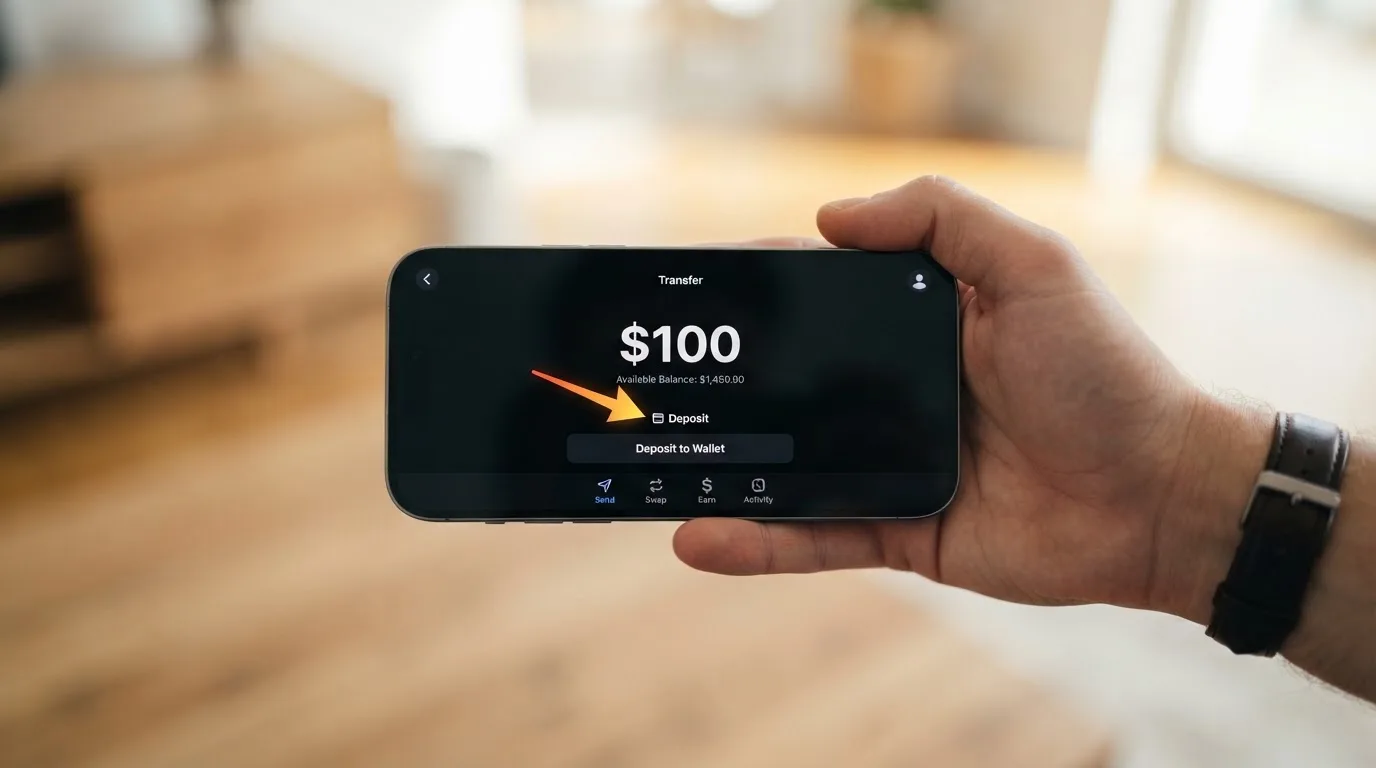
The official mechanism is straightforward: you deposit crypto into the account, and that automatically tops up the card. The in-app wallet is custodial, which I come back to in the risks section because it is the single most consequential word in this paragraph.
What you can send, per unofficial sources: BTC, ETH, USDT and USDC, on ERC-20, TRON, BNB Smart Chain, Polygon, Arbitrum One and Optimism. Fees are reported as 0% on the deposit, with the blockchain’s own gas paid by you. That means a small ETH balance is required to move anything on Ethereum — a wallet holding USDT and no ETH cannot send it. Worth knowing before your first transfer rather than after.
Now the part that deserves real care: network choice is not a detail you can correct later. Blockchain transfers are irreversible. If you send on a network the provider does not support, or to an address belonging to a different network, the funds can be lost or need manual support recovery with no guarantee. Circle also stopped supporting USDC on Tron in February 2024, which is a reminder that support lists change under you. Copy the address and network from the app, not from an old note or a previous transaction, and send a small test amount first if the sum is large.
Getting money back out, officially: after account closure, users may transfer digital assets out within a reasonable period unless legally prohibited, and after paying amounts owed. “Reasonable period” and “unless legally prohibited” are doing real work in that sentence. Unofficial sources put crypto withdrawal fees starting at USD 1, with exact amounts in-app.
The contrast with Renegade’s structure, in the alternatives section below, is instructive: there, card spending runs off a virtual IBAN. Here, spending runs off a converted crypto balance. The second model gives you fewer account-number headaches and, as the numbers suggest, a better top-up score; the first gives you a bank account you can receive a salary into.
Paying With It Every Day
Short answer: as a payment instrument this is a well-equipped card. Virtual and physical Visa, ATM withdrawals, Google Pay, Alipay and WeChat Pay, and unofficial sources add Apple Pay.
The wallet links are the reason this card scores well on everyday use. Google Pay, Alipay and WeChat Pay are not gimmicks here — they are exactly the payment rails people who travel or transact across borders run into. Adding Apple Pay, if your unofficial source is right, completes the set. Google Play has a button on the cards page; the download page exists but the platforms and store ratings are not stated on the pages I read. Unofficial sources describe iOS, Android and a Telegram Mini App, with an App Store rating of 5.0 from five ratings — which is five ratings, and I would not read much into it.
What is not stated: blocked merchant categories. That matters more than it sounds. Gambling is classified under a specific merchant category code, and many issuers block it by policy rather than by law, with the blocked list differing from issuer to issuer. If gambling or another category is something you rely on, ask. Neither the card’s page nor the terms give me a list.
On rewards: the official card page states no cashback. There is a separate Earn product, which is a yield product and not the same thing as paying you for spending. Unofficial sources say no cashback on the main card, and a referral programme paying up to 40% of card fees. Read that referral figure carefully — a share of fees is a cost to the fee-payer, and a percentage of an itemised fee schedule that does not exist is difficult to value.
If something goes wrong with a payment, the official route is email: unauthorised transactions and errors go to [email protected]. Partner disputes are settled directly with the partner, not by Stella. And any dispute that reaches litigation goes to the courts of the Republic of Seychelles under Seychelles law. That last fact is not a complaint; it is the standard structure for this category. But you should read it as a practical warning about cost and time: a small disputed payment is very unlikely to be worth pursuing internationally, whatever your rights are on paper.
Time frames for raising a dispute are not stated. That is the kind of detail that matters when a merchant holds a payment for weeks, so ask support what window applies.
What Can Go Wrong
Short answer: the biggest risks are not card fraud. They are custody, freezing, and silence from the company.
Let me take them in order of how much I would worry about them.
Who holds your money. The card’s own words: assets in the app wallet are custodial assets held for your benefit, pooled in omnibus accounts, with title staying with the user. Read that as: the provider holds the keys, and your balance sits in an account shared with other customers. Control of crypto belongs to whoever holds the private key or seed phrase, and with a custodial wallet you must trust the provider completely. On the other side of that ledger: blockchain transfers are typically irreversible, and a stolen private key has no built-in recovery — the network cannot freeze or return funds. Custodial platforms have a real history: Mt. Gox, about US$350 million reported stolen between 2011 and 2014; Coincheck, about US$400 million in 2018; Ronin Network, US$625 million in 2022. Self-custody flips the risk to you — key loss, phishing, malware that swaps a copied address — but it removes the counterparty.
Freezes, and getting your money back. The card publishes no incidents of its own, which is a statement about disclosure rather than about operations. Against that: a user report from August 2026 describes an account freeze with funds not returned after transfer proof was provided. The same report mentions the virtual card’s cost, limited crypto support and occasional failed transactions. I treat a single user report as weak evidence, and I treat it as strong evidence that the failure mode exists — because the mechanics make it ordinary. If due diligence cannot be completed, EU rules require the institution to refrain from the transaction or relationship and, where necessary, end existing relationships. That is why accounts close or freeze pending documents. It is not misconduct; it is the law working as designed, and it can still cost you months.
The company. Stella Global Services Limited is incorporated in the British Virgin Islands. The card is issued by an unnamed licensed “Partner Issuer”. The Apple App Store developer is shown as Flashwire Inc. Licences: not stated. I checked for a named issuer with a licence I could verify and did not find one in the public material. That is a gap, not a red flag on its own — but it means the counterparty you would face in a dispute is the one named on page one, in a jurisdiction most readers will never visit. Trustpilot shows 3.2 out of 5 from one rating. One rating is not a track record; I mention it only so you do not mistake its absence for approval.
Support. There is a Help Center, a Contact Us page and a Telegram channel. Hours are not stated. The language selector shows only English, which tells you something about where the support capacity sits. Unofficial sources mention Zendesk tickets and no live chat. If your card is frozen and the only channel is a ticket queue in a language you do not read fluently, that is a bad afternoon.
Two-factor authentication and instant freeze — the safeguards you would want — are not stated. The usual toolkit for this category is app-based 2FA, instant card freeze, spending limits, 3-D Secure confirmation and tokenised mobile wallets. I could not confirm which of these Stella actually implements. That is the first thing to ask support.
Declines and holds. Some merchants decline prepaid or foreign-issued cards because the BIN lookup reveals card type and issuer country. Declined authorisations may leave a hold that can sit for several days. And address verification, which compares the numeric parts of your billing address against issuer records, is generally unavailable for foreign-issued cards — a plausible cause of a decline that has nothing to do with you.
Blocked merchant categories. As with the question of fees, the official terms do not list which categories (such as gambling or specific payment types) are restricted. This is a common practice among issuers who set their own internal policies on blocked merchant category codes. If you rely on a specific category, check with support before funding your account.
Stability of the balance itself. Stablecoins aim to hold a stable value, but despite the name they are not necessarily stable: TerraUSD collapsed in May 2022, and USDC temporarily lost its peg in March 2023 during the US banking crisis. Tether also says it disables tokens in wallets on the OFAC sanctions list and has frozen funds tied to illicit activity — so stablecoins are not censorship-proof either.
Programme risk. Card programmes do close. Visa terminated its global agreements with FTX on 13 November 2022 and the FTX US debit card was wound down by its issuer. WaveCrest, a Visa issuer that supplied crypto card brands, was suspended by Visa in Europe in 2018, closing all its Visa programmes. Closures typically run in a sequence: notice, then loading and spending stop, then a request to withdraw remaining balances.
Regulation is tightening around you. MiCA, the EU’s markets-in-crypto regulation, took legal effect in June 2023; its rules on e-money tokens applied from 30 June 2024 and the remaining provisions, including crypto-asset service provider rules, from 30 December 2024. The transitional period lets providers operating under national law continue only until 1 July 2026 or until they are authorised or refused, whichever comes first. Under MiCA, e-money tokens may be issued only by a credit institution or an electronic money institution. A CASP authorised in one member state can serve the whole EU. Note the structure: the card itself is a payment service regulated separately, so a crypto card often depends on two licences. ESMA keeps an interim register of authorised CASPs and white papers — a place to look for a provider. In the US, FinCEN guidance treats administrators and exchangers of convertible virtual currency as money transmitters, while ordinary users buying things are not.
I am not going to tell you how to get around any of this. Sanctions screening, identity checks and country restrictions exist because regulated businesses are required to operate them, and a provider that markets a way around them is a provider you should not hand your money to.
Taxes, briefly and without advice. In the US the IRS treats digital assets as property, so exchanging them for goods, services, dollars or other digital assets generally produces a taxable gain or loss; for personal holdings the result is a capital gain or loss, short-term if held a year or less; and gain is measured in local fiat currency at fair market value on the date of the transaction — which means each card payment funded from crypto can be a separate disposal. Other countries differ. I am not qualified to advise you and this is not advice; treat it as a reason to keep records, and take your own advice from someone qualified in your jurisdiction.
Alternatives Worth Comparing
Brief answer: the three I looked at all score below Stella, and each fails differently — two mainly on eligibility and disclosure, one mainly on cost.
| Alternative | Score | Card | Cost position | Top-up and rewards |
|---|---|---|---|---|
| Stella | 6.5 / 10 | Virtual and physical Visa, USD | Undisclosed; unofficial: no annual fee, in-app virtual card application fee | BTC, ETH, USDT, USDC on six networks; no cashback on the main card |
| Whop Cards | 5.2 / 10 | Visa; type and currency not stated | “No extra fees”; no amounts listed | Spends a Whop balance, backed by stablecoin collateral from a linked wallet; 5% cashback at select merchants, currently Uber |
| UniFi Card | 4.7 / 10 | Prepaid Debit Visa, issued by Lead Bank, USD | “Fees may apply”; nothing listed | ACH, wire, SEPA, SPEI; paid to a USDC wallet; “3% rewards on balances” |
| Renegade | 4.1 / 10 | Virtual Visa, no plastic, currency not stated | Pioneer 9.90 EUR monthly, Voyager 19.90 EUR, Vanguard 29.90 EUR; crypto/fiat exchange 1.6% | Crypto vIBAN via Striga; 3% rewards in RNG on all three tiers |
Whop Cards is the strongest of the three, and its problem is eligibility, not product. It covers consumers in 31 US states — Alabama, Alaska, Arkansas, California, Colorado, Connecticut, Florida, Hawaii, Illinois, Indiana, Iowa, Kansas, Kentucky, Maine, Massachusetts, Michigan, Minnesota, Montana, Nebraska, New Hampshire, New Jersey, New York, North Carolina, Oklahoma, Pennsylvania, South Carolina, Texas, Utah, Virginia, West Virginia, Wyoming — and businesses in 41. Consumer countries not supported include Belarus, China (Mainland), Cuba, Hong Kong, India, Iran, Iraq, Israel, Myanmar, Nepal, Nicaragua, North Korea, Russia, Syria, Turkey, Ukraine, Venezuela and Vietnam. That list alone disqualifies it for most readers outside the US, and I note the basis — citizenship or residence — is not stated. The upside is real: 5% cashback at select merchants, currently Uber.
UniFi Card has the clearest issuer, Lead Bank, which is more than Stella offers, and a prepaid debit Visa card in USD. But I could not confirm supported countries from official pages, and the app routes in the listing point to the Philippines, Mexico and the eurozone with release notes mentioning Colombia, Brazil and the UK. Rewards are listed as 3% on balances, which is a different thing from card cashback. Costs are “may apply”.
Renegade is the one with published prices, and they are real monthly fees: 9.90, 19.90 and 29.90 EUR, lower if you pay in its own RNG token. It charges 1.6% on crypto/fiat exchange and says no other fees are collected, with 30 days’ notice before new ones. It gives you a virtual IBAN, so you can receive money — only customers in the European Economic Area can use it for euro deposits and withdrawals. Its rewards are 3% in RNG on all three tiers, with monthly caps listed on the page in a garbled form. For a euro-area reader who wants a bank account shape and published fees, that is a coherent product. Its 4.1 is mostly about how little its public pages confirm about eligibility.
The pattern across all four: none of them publish the thing you most want. And every one of them is custodial to some degree, because that is how the model works.
Who I Would Recommend It To
I would recommend Stella to three kinds of person. First, someone who already sits in stablecoins — mostly USDT or USDC — on a network they understand, and who wants them spendable without an exchange account in between. The 0% deposit fee and automatic top-up make that genuinely pleasant, and the six supported networks are generous. Second, someone who travels or operates across regions and values a Visa that links to Google Pay, Alipay and WeChat Pay; very few mainstream cards do that. Third, someone comfortable treating the balance as spendable money rather than savings, and who would not be ruined by a freeze lasting weeks.
I would not recommend it as a first crypto product. Not because it looks dishonest, but because you will not be able to check it. A card that names no issuer, no licence, no fee schedule and no country list asks you to take its word for its structural fundamentals. That is a lot of word to take from an entity in the British Virgin Islands.
And I would not recommend it to anyone saving in it, or anyone for whom a frozen balance would be a crisis. If your money has to still be there in a month, keep it somewhere with a published safeguarding or deposit arrangement. Regulated e-money institutions must safeguard customer funds by segregating them in dedicated accounts or insuring them, and even then such funds are not the same as bank deposits and may not be covered by deposit guarantee schemes.
If you do go ahead, four things first, in this order. Ask support to confirm your country and your currency situation, and ask for the physical card delivery charge in writing. Read the in-app fee schedule before your first transaction, not after, and screenshot it. Send a small test deposit before a large one, on the network the app shows you. And ask which safeguards are actually live — 2FA, instant freeze, 3-D Secure — because the public pages do not say.
Frequently asked questions
What is the Stella card?
Stella is a prepaid Visa card that spends a balance you load from crypto rather than from a bank account. You hold both a virtual and a physical card, and depositing crypto into the in-app wallet tops the card up automatically. The wallet is custodial, meaning Stella holds the credentials, and USD is reportedly the only base currency.
How does the Stella card work in practice?
You sign up, complete identity verification, and receive a virtual card you can use straight away. You then deposit crypto, which converts into a spendable balance, and pay with the card at Visa merchants, at ATMs, or through linked wallets. The mechanics are those of a prepaid card, so the balance cannot be overdrawn.
Is Stella a bank?
Not on the evidence available, and I would not treat it as one. The operator is Stella Global Services Limited, incorporated in the British Virgin Islands, and the card is issued by an unnamed licensed “Partner Issuer”. No banking licence is named in the public material, so any safeguarding or deposit guarantee I might assume from a bank should be assumed away.
Who owns Stella?
Stella Global Services Limited is the named company, and the Apple App Store developer is shown as Flashwire Inc. The terms also state that US and European users are routed through affiliates. The card’s own pages do not name any licences, which is the part a reader most wants and gets least.
Does Stella require KYC, and what documents?
Yes. The User Agreement lists name, address, date of birth, tax ID, government ID and bank details, with biometric data possibly requested, and a minimum age of 18. Unofficial sources describe full e-KYC taking one to two business days, with many applications auto-approved in minutes. Tax ID and bank details are the two items worth confirming you can supply.
Which countries is the Stella card available in?
The official site does not name any. Unofficial sources say 57 countries are supported, including the United States, United Kingdom, Singapore and India, and 49 are restricted, including Russia, Belarus, Ukraine, Iran, Iraq, Syria, North Korea, Cuba, Venezuela and South Africa. That list was last confirmed against Stella documents dated 6 September 2024, so ask support about your country.
How do I top up the Stella card?
You send crypto to the address the app shows you, and the balance tops the card up automatically. Unofficial sources list BTC, ETH, USDT and USDC on ERC-20, TRON, BNB Smart Chain, Polygon, Arbitrum One and Optimism, at 0% deposit fee with you paying the network’s gas. Send a small test first: blockchain transfers are irreversible.
Is the Stella card free?
Nobody can tell you from the official pages, which list no amounts at all. Unofficial sources say there is no annual fee, that the virtual card is pay-as-you-go with an application fee visible only in-app — one user complaint cites USD 30 — and that the physical card is free only after a USD 20,000 top-up. The App is effectively the price list.
Can I add the Stella card to Apple Wallet?
Unofficial sources list Apple Pay alongside the officially stated Google Pay, Alipay and WeChat Pay. Apple’s mechanism replaces the card number with a device-specific number stored in the Secure Element, never on Apple servers, with a fresh security code per payment. I would confirm Apple Pay support in the app before planning a trip around it.
Is the Stella card safe, and what about my crypto?
I would not call it unsafe, but I would call it opaque, and custody is the crux. Your balance is custodial, pooled in omnibus accounts, so it carries counterparty risk, and there is a user report from August 2026 describing an account freeze with funds not returned. Two-factor authentication and instant freeze are not stated, and Visa terminated its agreements with FTX in November 2022 when that programme failed.
Where can I actually use the Stella card?
Anywhere Visa is accepted, which the card puts at over 40 million merchants globally, plus compatible ATMs worldwide. Two caveats you will not read on the card’s page: some merchants decline prepaid or foreign-issued cards after checking the issuing country, and blocked merchant categories are not stated — gambling is commonly blocked by policy, though the list varies by issuer.
App and neobank card options – cryptocardoptions.com
Content created by the «cryptocardoptions.com» team