
MSX card review
 Available in US
I went through the public material on the MSX card, cross-checked the official pages against two third-party articles (one sponsored write-up in Odaily and a launch piece in cryptonews.net, both from June 2026), and then sat with the gap between what the card says itself and what outside sources say. That gap matters here, because the MSX card is a recent product and the issuer’s own documentation is thin. What follows is what I found, what I couldn’t find, and who I think the card actually suits.

The information below is current as of October 28, 2026. Conditions on a new card can change quickly, and several details that are clear from third-party sources are simply not stated on the official pages, so the table of “what I couldn’t confirm” is part of the review rather than an afterthought.
Verdict
MSX scores 6.4 out of 10 in my reckoning. The number reflects a product that does some things well and several things where the deal is unclear from official material. The card is a physical Visa that you fund from crypto sitting on the MSX platform; it works in shops and online, supports Google Pay for contactless, and has no annual fee, no top-up fee and no payment fee during a promotional period. Those are genuine strengths. The weaknesses come with a new programme from a smaller issuer: the card’s currency, the foreign-exchange markup, the KYC steps, and the ATM fee and allowance are all unlisted, and the card-issuing bank is not named on the official site. The platform is registered as a money services business in the US (FinCEN) and in Canada, and the wider MSX platform excludes US, Canada and Hong Kong residents under its terms of service. That combination — attractive headline fees, but a real wall of missing detail on everything else — is what keeps the score in the middle of the range.
The card is for a fairly specific reader. If you already use the MSX platform, hold a balance there, and want a Visa debit card to spend that balance in the real world, the card is built for that and the headline fees are good. If you are choosing a crypto card for the first time and want full, plain-English disclosure of conversion fees, FX markup, ATM fees and dispute rights, MSX is not where I would start.
| Criterion | Mark | Why |
|---|---|---|
| Who can get it | 8 / 10 | Global footprint with ATM access in several countries and regions; platform excludes US, Canada and Hong Kong |
| Cost | 7 / 10 | Zero annual fee, zero top-up fee, zero payment fee in the promo period; FX and post-promo fees not disclosed |
| Top-up options | 5 / 10 | Spends from crypto on the MSX platform; stablecoins USDT and USDC from the MSX account, networks not stated |
| Reliability and complaints | 5 / 10 | Issuer and programme manager not named on official pages; no user complaints surfaced in my search |
| Everyday use | 6 / 10 | Physical Visa, online and in-store, Google Pay contactless; Apple Pay not confirmed |
Will they give you the card
Whether you can have an MSX card depends on two things the issuer and the platform each control, and both have to be in your favour.
On the card side, the information I could find is third-party rather than official. According to the Odaily article, the card is offered globally, with ATM withdrawals supported in several countries and regions, except Mainland China and areas under OFAC sanctions. The MSX platform’s own terms of service add another layer: residents of the United States, Canada and Hong Kong are not eligible to use the platform, which by extension means they cannot hold the platform balance that funds the card. There is no official page spelling this out for the card specifically, so treat the geography as a starting position rather than a guarantee. If you sit in a country not on either list — say, a European country, the UK, Singapore, Brazil or the UAE — the card side is unlikely to be the obstacle. Your obstacle, if any, will be on the platform side.
On the eligibility side, age and identity checks are not described on the card’s official material. The Odaily write-up says MSX operates under applicable KYC, AML and transaction-monitoring rules, but it does not say which documents the card programme asks for, what age the cardholder has to be, or how the card-specific identity check relates to the platform’s own onboarding. I could not find a separate card onboarding flow in the public material, which is a real gap. The general background I checked elsewhere is that prepaid and debit cards are usually 18-plus, and regulated card programmes have to verify identity under their jurisdiction’s rules. For MSX, you should expect to complete identity verification on the platform, but I cannot tell you from an official source what the card’s own additional checks are.
A practical note on country rules: even where the card is offered, the issuing bank’s policy may exclude your citizenship, and the BIN of the card (the first six or eight digits) can make a foreign card look foreign to merchants. That is a category-wide issue, not a MSX-specific one, but it is worth keeping in mind if you travel.
How to get it
The application process is another place where the official material is thin. From the third-party sources, you apply through the MSX platform and are issued a physical Visa card usable online and in store. The Odaily article does not say whether a virtual card is available, and the cryptonews.net piece describes a physical card without mentioning a virtual twin. Whether a virtual card exists, what currency the card is denominated in, and what the delivery time looks like are unclear from the official pages.
A sensible reader’s path looks like this. First, complete platform onboarding and KYC, because the card is funded from the platform balance and you cannot have one without the other. Second, request the card from within the platform. Third, wait for delivery to a supported country and region, and activate it on receipt. I cannot give you step-by-step timings because they are not published. Before you start, check the current list of supported countries on the platform’s own pages — the card side and the platform side can each refuse you, and you want to find that out before you upload documents.
If the platform onboarding rejects you for residency in an excluded country, there is no way around that on the card side. A sponsored article cannot override the platform’s own terms of service. If you are accepted, keep your KYC documents ready, because card-issuing banks routinely re-check identity before activating a card and may ask for proof of address as well.
Fees
This is the section where MSX looks strongest on paper and where I want to be most careful about the actual coverage. During an initial promotional period, the card has no annual fee, no top-up fee and no payment fee. The promotional framing matters: those fees are waived for now, but the costs that will apply afterwards are not disclosed. The foreign-exchange markup, the ATM fee, the ATM withdrawal allowance, and any per-transaction fee after the promo are also missing from the official pages.

Two things follow. First, “no fees” in the promo period is genuinely good if you spend within the promo window and you do not need to do anything that triggers an undisclosed fee. A coffee, a train ticket, an online subscription in your billing currency — those are the cases the zero-fee claim comfortably covers. Second, the moment you step outside the promo, the picture changes, and you cannot tell from public material what that picture looks like. I would treat the published zero-fees as a starting point, not a permanent feature.
The following list summarises the cost situation.
| Fee or limit | Value |
|---|---|
| Card issuance | Not stated |
| Annual fee | None during the promotional period; later fees not disclosed |
| Top-up fee | None during the promotional period |
| Payment / transaction fee | None during the promotional period |
| FX / conversion fee | Not stated |
| ATM fee | Not stated |
| ATM allowance | Not stated |
| Daily spending limit | Not stated |
| Monthly spending limit | Up to $1,000,000 (per third-party source) |
Three everyday scenarios make the gap concrete. If you pay for a coffee in your card’s billing currency, you pay no fee during the promo — the only cost is the on-chain network fee when you top up from your external wallet, which is paid to the blockchain rather than to MSX. If you pay for an online subscription priced in euros while the card settles in US dollars, you do not know the FX markup. If you take cash out at an ATM abroad, you do not know the fee or how much of the monthly allowance is left after each withdrawal. These are not edge cases — for many cardholders they are the most common cases. The right question to ask before relying on this card is whether the post-promo fees and the FX markup are acceptable, and on the current public material that question does not have an answer.
Top up
The card is funded from the crypto assets held on the MSX platform. To top up, you move crypto from your external wallet to your MSX account, and the card spends against that balance. The starting data describes stablecoin top-ups in USDT and USDC from the MSX account, with conversion to the card’s spending currency happening at the point of sale. The supported transfer networks (such as Ethereum, Tron, Solana, or Polygon) are not specified on the official pages, which is an important detail for a top-up flow where sending on the wrong network can lead to lost funds.
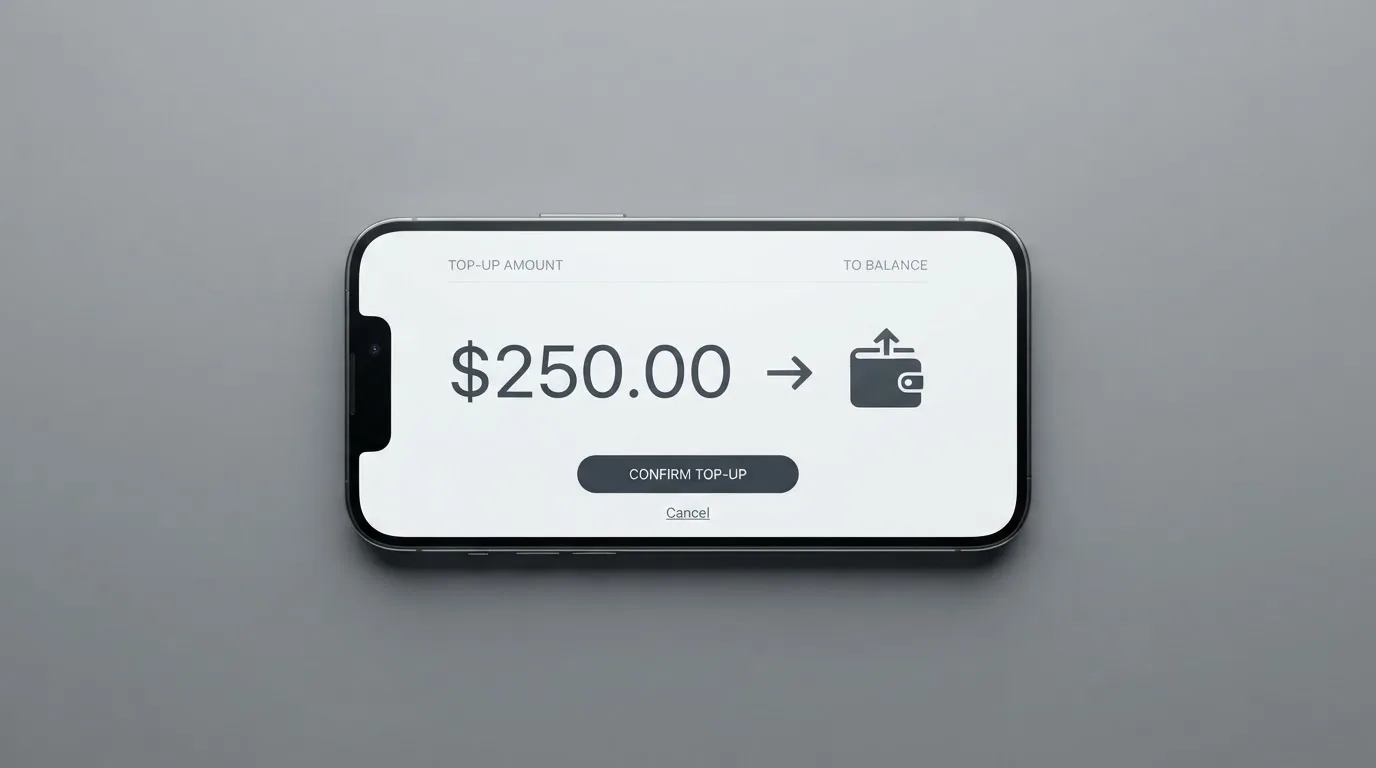
A few practical things fall out of this. The card behaves like a prepaid card: it cannot overdraw, and the balance you have on the platform is the balance you can spend. The conversion from crypto to the card’s spending currency happens at the point of sale, which means the rate you get is whatever the platform sets at that moment, and you do not have a separate “load in fiat” step to lock in. USDT and USDC are the two stablecoins named; if you hold BTC, ETH or anything else, the implication is that you convert it to a supported stablecoin on the platform first and then top up the card.
A top-up starts on your external wallet. You send the supported stablecoin from your own wallet to the deposit address MSX shows you for that asset and network. Two checks before you confirm. The first is the network: if the address is on Ethereum (ERC-20), do not send on Tron (TRC-20) or Solana; the funds will not arrive, and a blockchain transfer is irreversible. The second is that you need the gas token for the network you are using. On Ethereum that means holding some ETH to pay the gas fee; sending USDT without ETH will not work. The on-chain fee for the top-up itself is paid to the blockchain, not to MSX, so its size depends on the network you pick rather than on the card programme.
After the deposit, the funds appear on the platform and the card can spend against them. There is no separate withdrawal flow described in the official material, because the card’s job is to spend the platform balance, not to pull funds back out to your bank.
Paying with it every day
In day-to-day use, the card is a physical Visa that works online and in store. The cryptonews.net article confirms contactless payments through Google Pay; whether Apple Pay is supported is not stated, which is unusual for a card launched in 2026 and worth checking on the platform before you assume. The card currency, the merchant categories that are blocked, and the in-app controls (instant freeze, spend limits, online-only mode) are not described on the official pages I could read.
What I can reasonably infer. The card should work at any merchant that accepts Visa, which is most online shops and most physical retailers in countries where Visa is dominant. The card will not be a credit card, so “buy now, pay later” instalments are unlikely to be available; that is a category-wide point for prepaid crypto cards. Online merchants in some regions may use Address Verification Service to compare numeric parts of your billing address with the issuer’s records, and that service is generally unavailable for foreign-issued cards, so a card that looks foreign to the merchant’s BIN lookup can be declined for reasons that have nothing to do with your balance.
There is no cashback or reward programme described in the public material. The third-party write-up mentions exclusive subscription rights to MSX pre-IPO offerings as a cardholder benefit, but that is an investment opportunity rather than a spending reward, and it is not a discount or cashback. I would not weigh it against the cashback programmes of cards that do offer them.
For online use, expect 3-D Secure prompts (Visa Secure) on riskier checkouts, and have your authentication app or one-time-code method ready. For in-store use, contactless via Google Pay works on any terminal that supports it; physical card insertion or swipe works everywhere else. Keep an eye on the merchant category codes your transactions are running against, because issuers can block specific MCCs (gambling, for example) by policy rather than by law, and the blocked list for MSX is not published.
What can go wrong
The product is new, the issuer is not named on the official pages, and several categories of risk apply to any crypto card. They apply here too.
The platform side carries the most weight. MSX is described by Odaily as a real-world-asset tokenisation platform, with money services business registrations in the US (FinCEN) and Canada. The company behind it, in the starting data I saw, is named as Mystonks Holding LTD. The card-issuing bank is not stated in the public material I could read, which means the institution that actually holds the regulatory licence to issue Visa cards is not disclosed in the places I checked. A licensed issuer behind the card is a positive sign when it is visible; a card programme where the issuer is opaque is harder to evaluate. The platform’s ToS excludes US, Canada and Hong Kong residents, which is a real restriction for those readers.
The custodian question. Because the card spends from a balance held on the MSX platform, the crypto that funds it sits in a custodial wallet, not in your own. The general lesson from the category is that custodial platforms have failed before — Mt. Gox, Coincheck, the Ronin Network hack — and that when a custodian fails, the user can lose the funds they had on the platform. MSX is a regulated money services business, but no regulation removes custody risk. If the platform pauses withdrawals, the card stops working, because the balance that funds the card lives on the platform.
The stability of the value. Spending from a USDT or USDC balance keeps the value stable in dollar terms, but stablecoins are not necessarily stable. USDT and USDC have both held their peg through difficult periods, and Circle publishes monthly reserve attestations, but the category has shown that a depeg is possible. If the stablecoin you hold loses its peg before you spend, the card payment goes through at the lower value.
The sanctions and compliance side. Tether has publicly said it disables tokens in wallets on the OFAC sanctions list and has frozen funds tied to illicit activity, so stablecoins are not censorship-proof, and the card sits inside a compliance perimeter that the issuer applies. Card-issuing banks also screen customers against sanctions lists and can close accounts that fail screening. None of this is unique to MSX; it is the environment any regulated card operates in.
The risk of a programme closure. Card programmes can be closed. The category has examples: Visa’s 2018 suspension of WaveCrest shut down several crypto card programmes in Europe, and in 2022 Visa terminated its global agreements with FTX. When a programme closes, the usual pattern is a notice period, then new loads stop, then spending stops, then a deadline to withdraw the remaining balance. I did not find any announcement that MSX is closing, and the card is recent, but the structural risk applies.
The complaint picture. I searched for MSX X Card reviews on Trustpilot and Reddit and did not find a Trustpilot page or a substantive Reddit thread. What came back was launch coverage and promotional material. That is unsurprising for a new card, and it means you cannot lean on user reviews to calibrate your expectations; you have to read the small print yourself.
What to take instead
If MSX does not quite fit, the comparison set covers most of the things a reader in this category actually weighs: where the card works, what it costs in the small print, what you fund it with, and what you get back. The three I have data for are Bybit Card, MEXC and Pionex, each at a different point on the cost-versus-disclosure spectrum.
Bybit Card scores 6.0 out of 10 and is the most disclosed of the three. It is offered across a specific set of regions — Argentina, AIFC (Kazakhstan), Georgia, Kazakhstan, Australia, Mexico, Brazil, Peru and Asia Pacific — and is explicitly not meant for European Economic Area customers. It offers both virtual and physical cards on Mastercard or Visa depending on the region, with issuance fees that are zero for virtual and a small amount in USD or USDT for physical cards in most places. The crypto conversion fee is 0.9% over the One-Click Sell rate in most regions, the FX fee is 2% on top of the network rate in several regions, and the rewards programme is tiered from 2% to 10% cashback for crypto-funded spending, with the higher tiers tied to monthly spend. The card draws on the Bybit Funding Account and Flexible Easy Earn balance, and the default top-up order is USDT, USDC, GRAM, BTC, ETH, XRP, which you can reorder. If you want a card with a published fee schedule and a cashback programme, Bybit is the one to look at first.
MEXC scores 5.6 out of 10 and is virtual-only at the moment, with an issuance fee of around 20 USD on the page (a discounted 0 USD price also appears, and the relationship between them is not clear from the public material). Top-up is by transferring USDT to a Fiat account, with networks not stated. Cashback is paid by the 15th of the next month on an M-Score tier system from 4% at Standard to 10% at Elite. The card’s fees beyond issuance are not described on the page, so this is a card to read the linked guide on before relying on the headline.
Pionex scores 4.8 out of 10 and is the simplest of the three. It is virtual-only, holds USDT only, and bills in USD or USDT at a 1:1 rate. There is no annual fee, no inactivity fee and no issuance fee on either network. The Visa transaction fee is 1%, the Mastercard transaction fee is up to 3.5%, and there is 1% cashback on local-currency and general USD purchases plus 5% APY on the card’s USDT balance. The card’s eligibility is tied to your KYC country, with Belarus-verified applicants now offered Mastercard after Visa applications stopped on 14 August 2026. The simplicity of “USDT in, 1% fee, 1% cashback” is the appeal; the trade-off is that you only spend stablecoin, and Mastercard converts non-USD at its own rate without a separate disclosed FX markup.
The rough pattern across the three is that more disclosure comes with a more complex fee structure (Bybit) and more simplicity comes with a thinner feature set (Pionex). MSX sits closer to the simplicity end on the surface, but with several categories of fee not disclosed at all, so the comparison is hard to make cleanly.
Who I would recommend it to
I would recommend the MSX card to a fairly narrow reader. If you already have an MSX platform account, hold a balance there, and want a Visa debit card to spend that balance in shops and online, the card is built for that use case and the headline fees are good. The promotional period matters: if you can do most of your spending within that window, the zero-fee payments are a genuine benefit. If you also use Google Pay on Android for contactless, the daily-use story holds together.
I would not recommend the MSX card as a first crypto card for a reader who is choosing between programmes on the merits. The reason is not the platform or the company; the reason is the disclosure. The FX markup, post-promo fees, ATM fee and allowance, card currency, supported top-up networks, KYC steps for the card, and the card-issuing bank are not specified on the official pages. For a card that scores 6.4 out of 10 with the parts that are disclosed being mostly the good parts, the right move is to wait for the gaps to be filled in, or to choose a card where the same gaps are smaller.
A short list of the things to check before you commit. Confirm your country is supported both by the platform and by the card. Confirm the card’s currency and the FX markup. Confirm the networks supported for your top-up stablecoin, and double-check the deposit address before you send anything from your own wallet. Confirm the post-promo fee schedule. Confirm the ATM fee and the daily and monthly limits — the monthly limit of $1,000,000 is reported by third-party sources and is not confirmed by the card programme itself — and that your expected monthly spend sits well within it. Confirm Google Pay works on your Android device, and that Apple Pay is or is not supported before you assume. If you can answer all of those, the card is a reasonable choice. If you cannot, it is not.
Frequently asked questions
What is the MSX card?
The MSX card is a physical Visa payment card that lets you spend the crypto balance held on the MSX platform in shops and online. It is described in third-party coverage as a launch by MSX (Maitong), a real-world-asset tokenisation platform with money services business registrations in the US and Canada.
How does the MSX card work?
You hold crypto on the MSX platform, and the card spends against that balance. At the point of sale, the platform converts the supported stablecoin (USDT or USDC) into the card’s spending currency and the payment goes through Visa’s network. The card cannot overdraw because it draws only on the balance you have on the platform.
Is MSX a bank?
No, MSX is not a bank. The card programme is run by MSX (Maitong), described as a tokenisation platform, and the actual card-issuing bank is not named in the official material I could read. The platform itself is registered as a money services business in the US (FinCEN) and in Canada.
Who owns MSX?
The platform behind the card is Mystonks Holding LTD, operating under the MSX brand. The card-issuing bank is not named on the official pages.
Is the MSX card available in my country?
The card is described as available globally, with ATM access in several countries and regions, except Mainland China and OFAC-sanctioned areas. The MSX platform’s terms of service additionally exclude residents of the United States, Canada and Hong Kong. For a specific country, the platform’s own supported-country list is the source to check before applying.
How do I get the MSX card?
You apply through the MSX platform, complete the platform’s KYC, and request the card from inside the platform. The card is then delivered as a physical Visa. Detailed step-by-step instructions and the delivery time are not published in the official material I could read.
Does the MSX card require KYC?
Yes, the card is funded from a platform balance, and the platform operates under KYC, AML and transaction-monitoring rules. The exact documents and the card-specific checks are not stated in the public material; expect a standard identity verification flow on the platform before the card can be used.
How do I top up the MSX card?
You top up by transferring USDT or USDC from your own wallet to your MSX account, then the card spends against that balance. The supported networks for the transfer are not stated on the official pages, so check the deposit screen carefully and never send on a network the address does not match.
Is the MSX card free?
During the current promotional period, the card has no annual fee, no top-up fee and no payment fee. The fees that will apply after the promotional period ends are not disclosed. Foreign-exchange markup, ATM fees and post-promo transaction fees are likewise not public.
Is the MSX card safe?
The card is built on the Visa network, which sets baseline security and dispute standards, and the platform holds money services business registrations in the US and Canada. The risks to weigh are the usual ones for a custodial crypto card: the platform holds your balance rather than you holding the keys, the card-issuing bank is not named, and the FX and post-promo fees are not disclosed. Treat the card as a spending product, not as a place to keep funds you cannot afford to lose.
Exchange card options – cryptocardoptions.com
Content created by the «cryptocardoptions.com» team