
ZAZO card — a USDC spending card for people ordinary banks don't serve
 Available in US
I went through ZAZO’s public pages to see what the card actually offers and where the gaps are. The headline is simple: a USDC-denominated card that accepts top-ups from non-custodial wallets, gives 1% cashback in USDC, and claims to work in 170+ countries. Several important details — the issuer, the card network, the issuance fee, the ATM terms, the limits — are not stated on the public material I read, and I flag those clearly so you can check them yourself before you sign up. The score at the end of this review sums up what is and isn’t yet knowable.
The information here is current as of October 28, 2026.
Verdict
ZAZO scores 6.8 out of 10 in my reading of the card, a middling-to-good result that reflects real strengths and real gaps. The strongest pillar is reach: 170+ countries and the option to use a non-custodial wallet for top-ups are unusually broad for a USDC card. Cost is also a clear plus, with “No Off-Ramp Fee” and “0 FX Spread” stated on the public pages. Where the card loses points is on the everyday details that decide whether a card is actually pleasant to use: issuance fees, ATM rules, daily and monthly limits, supported wallets, dispute and support channels, and the basic question of who actually issues the card are all “not stated” in the materials I could check.
The audience ZAZO speaks to, judging by its own marketing, is a person who already holds crypto — specifically USDC — and who finds it hard to get a normal bank card. If that is you, and especially if you want to keep your funds in your own wallet until the moment you spend, ZAZO is worth a serious look. If you want the comfort of a fully disclosed, well-known issuer with a published fee schedule, an app you can compare to a mainstream neobank, and a public track record of customer support, the picture is thinner, and you may want to wait or look at the alternatives I discuss further down.
| Criterion | Mark | Why |
|---|---|---|
| Who can get it | 9 / 10 | 170+ countries; the country list itself is not published |
| Cost | 8 / 10 | “No Off-Ramp Fee” and “0 FX Spread” stated; issuance fee not stated |
| Top-up options | 5 / 10 | USDC top-up and non-custodial wallet support stated; fees and minimums not stated |
| Reliability and complaints | 5 / 10 | Issuer and parent company not stated; no public complaint record found; custodial status of the card balance not stated |
| Everyday use | 5 / 10 | USDC card, “50M+ merchants”; virtual/physical form, network and ATM rules not stated |
| Total | 6.8 / 10 |
Who will they give you the card
ZAZO says the card is available in 170+ countries, which is an unusually wide footprint for a USDC card. If you live in a country where ordinary bank cards are hard to obtain — for example, because of sanctions affecting banks, because you are an expatriate in a market where local issuers refuse non-citizens, or because local documentation rules make it difficult to open a fiat account — that headline reach is the single most relevant fact about the card. It is also a fact you have to take on trust, because the company does not publish a country list. The phrase “170+ countries” is in their own marketing; the actual list of supported and excluded jurisdictions is not stated in the public material I read.
Two practical questions follow. First, the rule may be by residence, by citizenship, or both. ZAZO does not say. Many card programmes in this category treat these differently, so if your situation crosses borders — for example, you are a citizen of one country living in another — that distinction will matter, and the only way to find out is to start the sign-up flow and see what the app tells you. Second, the 170+ figure is about where the card is sold, not necessarily about where the card works. Whether you can use a ZAZO card at a terminal in any specific country is a separate question; the card is denominated in USDC, so the merchant’s experience is that of a card, but merchant acceptance and any local restrictions still depend on the underlying network, which ZAZO does not state.
The card itself is a USDC card, and ZAZO says it works at “50M+ merchants”. The card network (Visa or Mastercard) and whether the card is virtual, physical, or both are not stated on the public pages I read. In the rest of this review I refer to it as “the card” rather than naming a network, because the public material does not let me do that honestly.
How to get it
The sign-up flow described on ZAZO’s public material is two-step. You start with email registration, then go through KYC (know-your-customer identity verification). A USD ACH account is offered, with the marketing line “No SSN required” for the US case, which suggests the card is positioned partly at people who do not have — or do not want to use — a US Social Security number. ACH is the US bank-to-bank transfer system, so the “USD ACH account” line means a US dollar receiving account you can give to an employer, a client, or a platform to receive USD payments, separate from the card itself.
The KYC documents you will be asked for are not stated. As a rule of thumb in this category, you should expect a government-issued photo ID, a proof of address, and a selfie or liveness check; but the exact list is set by the issuer, and the issuer here is itself not stated in the public material I read. That is the single biggest “I don’t know” about ZAZO, and it is worth pausing on, because the issuer is the entity that holds your KYC data, decides your limits, and is responsible if something goes wrong.
The card itself is described as a USDC card accepted at “50M+ merchants”. The network (Visa or Mastercard), the form factor (virtual, physical, or both), and any delivery or shipping cost are not stated. The KYC tiers — whether a fuller verification unlocks higher limits — are also not stated. My honest summary: you can sign up by email and expect to verify your identity, the form of the card and the limits depend on what the app asks you next, and only the sign-up step itself is documented in the public material I read.
What it really costs: Fees and limits
The single best thing about ZAZO’s pricing, on the public material, is what isn’t there. ZAZO states “No Off-Ramp Fee” and “0 FX Spread”. An off-ramp fee is what you normally pay when converting crypto to spendable currency at the moment of payment; a FX spread is the markup the card provider adds on top of the wholesale exchange rate. If those statements hold in practice, they remove the two charges that most often surprise users of crypto cards.
What is not stated is also worth listing clearly, because it is what you have to ask before you commit any meaningful balance:
- Issuance or activation fee for the card itself
- A monthly or annual account fee
- ATM withdrawal fees and any ATM limits
- Daily, monthly, and per-transaction spending limits
- Tiered pricing (whether any plan changes the fees)
- The full list of supported card currencies; the card is USDC, and a USD ACH account is mentioned, but no further currency list is stated
| Fee or limit | Stated value | What I read into it |
|---|---|---|
| Issuance / activation | not stated | The public pages do not name a one-off fee to issue the card |
| Monthly or annual fee | not stated | No recurring fee is named |
| Crypto off-ramp fee | “No Off-Ramp Fee” | No charge stated for converting USDC at the moment of payment |
| FX spread | “0 FX Spread” | The wholesale FX rate is what you get, in the provider’s stated terms |
| ATM withdrawal | not stated | Fees and limits are not stated on the public material |
| Daily / monthly limits | not stated | Caps on spending or top-up are not stated |
To make that abstract, here is how the stated rules apply to three everyday situations. First, paying a coffee in a non-USD country: with “0 FX Spread” stated, the conversion from USDC to the merchant’s local currency is at the wholesale rate ZAZO uses, with no spread markup; there is no off-ramp fee stated. Second, paying a subscription in USD: the merchant is paid in USD, no FX is involved, and you only need to check whether your card balance has the USDC to cover it. Third, an online purchase in a foreign currency: the same logic as the coffee, with the addition of any 3-D Secure step the merchant’s bank requires; the cost line is still the conversion plus any network fee, both of which ZAZO states as zero or not applicable.
What this also means is that the cost of using ZAZO is, in the public material, a function of what is not listed rather than what is. The card is not “free” in the sense of “no charges exist”; it is “free” in the sense of “the only fees the public material names are zero”. The practical question — what does the app show you when you actually try a transaction — is something only the app itself can answer.
How to top it up: Top up the ZAZO card
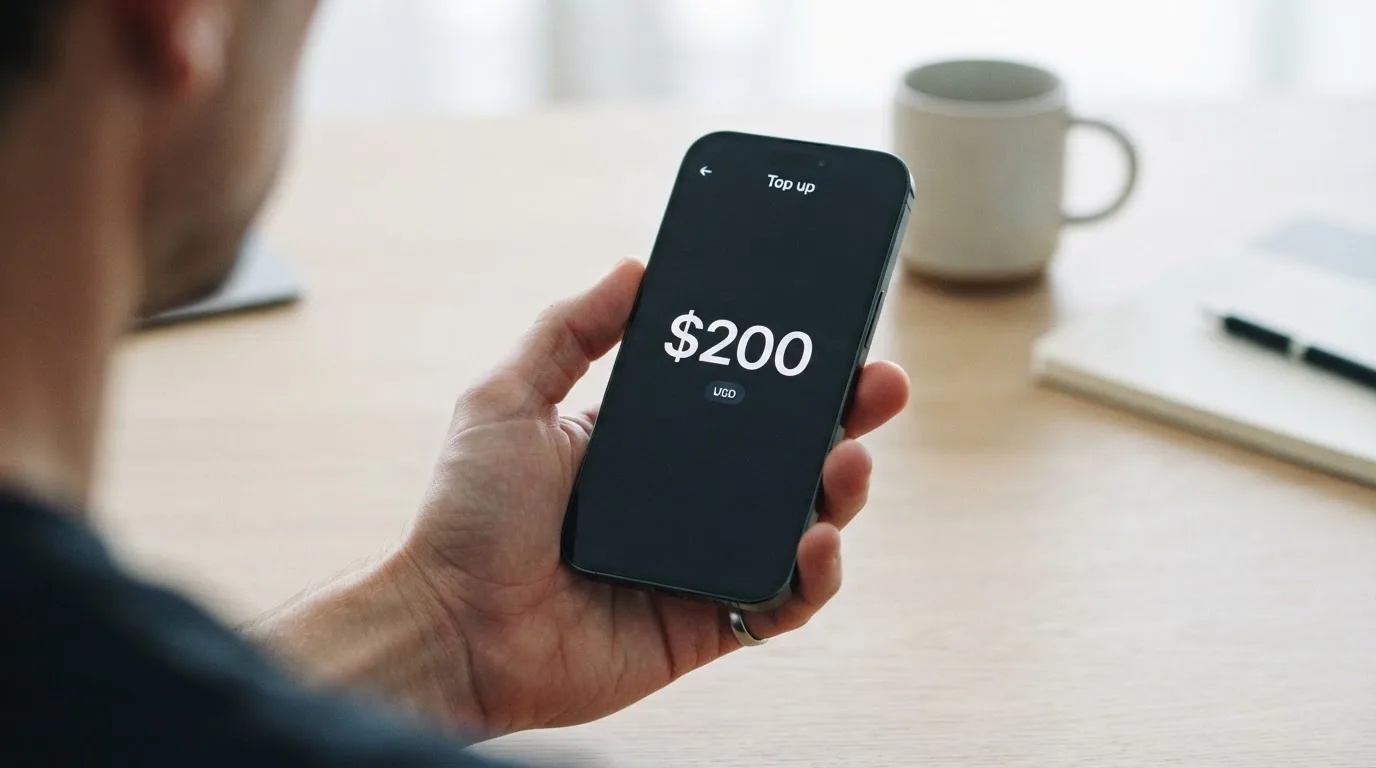
ZAZO’s top-up model is built around USDC, the US-dollar-pegged stablecoin issued by Circle, and around the option to connect a non-custodial wallet. A non-custodial wallet is one where you, not the provider, hold the private keys; sending from such a wallet means you keep custody of your funds until the moment you transfer them. That is a meaningful difference from cards that ask you to deposit crypto into the provider’s own balance first: with a ZAZO-style non-custodial flow, the funds stay in your wallet until you initiate a top-up.
The USD ACH account — the “No SSN required” detail I mentioned earlier — is a separate account feature, not a card top-up method. ACH is a US bank-transfer system, so the account gives you a US dollar receiving endpoint; how that ACH balance then moves to the card is not disclosed, as I noted regarding the country list.
What is not stated on the funding side is as important as what is:
- The exact list of supported networks (Ethereum, Solana, Base, Arbitrum, Polygon, etc.) for the USDC top-up
- The minimum top-up amount
- The fees, if any, charged by ZAZO on top-up (distinct from the on-chain network fee)
- Whether you can top up from a centralised exchange directly, or only from a self-custody wallet
- The on-chain network fee (gas or bandwidth) is charged by the blockchain, not by ZAZO, so sending USDC will cost whatever the network charges; that is a property of the network, not the card
The two practical points I would check first before any large top-up are the network and the address. Sending USDC on a network the card does not support, or to an address of a different network, is a common way to lose funds in this category, and once a blockchain transfer is sent, it is generally not reversible. The right network and the right address are details only the ZAZO app or support can give you, and the public pages I read do not list them.
For withdrawals, ZAZO states “No Off-Ramp Fee”. The withdrawal method and the rule for closing the account or moving the remaining balance are not stated. In this category, that usually means an in-app flow to a USDC address, but the public material does not confirm it.
Paying with it every day
The card is denominated in USDC, and ZAZO says it works at “50M+ merchants”. The merchant-acceptance line is the card-network’s claim — Visa and Mastercard both use “tens of millions” in their marketing — so the practical effect is that you can use ZAZO wherever the underlying network is accepted, which is essentially anywhere cards of that network are taken. The 50M+ figure is therefore a useful upper bound on where you can pay, not a guarantee that any specific shop will take it.
The cashback structure is the part of everyday use that is most concretely stated. ZAZO offers 1% cashback in USDC, plus up to 3% in “network earnings” — its term for a share of the spending of people you invite. The 1% in USDC is straightforward: spend, get 1% back, paid in the same stablecoin you spent. The 3% in network earnings is a referral-style reward: you invite someone, they use the card, and you receive a share of their spending, up to 3% on top of the 1% base. The exact mechanics — how the share is calculated, who counts as an invitee, when the earnings become withdrawable — are not stated in the public material I read, and the cap “up to 3%” suggests the actual rate is tiered.
What is not stated on the daily-use side:
- Supported wallets (Apple Pay, Google Pay, Samsung Wallet, Garmin Pay) and whether the card can be tokenised for contactless phone payments
- The mobile app’s feature set: spending analytics, instant card freeze, in-app 2FA, virtual card numbers for online use
- The dispute process for a transaction that goes wrong
- Customer support channels and response times
- Whether the card balance is custodial (held by ZAZO or its issuer) or non-custodial (held by you in your own wallet until the moment of payment)
The “non-custodial wallet support” line for top-ups, combined with the absence of a statement on whether the card balance is itself custodial, is a small but important ambiguity. You can top up from your own wallet — that is the non-custodial bit. Whether the funds then sit in a ZAZO-controlled balance until you spend, or stay in some form of user-controlled escrow, is not something the public material I read makes clear. In practice, almost all cards of this type operate a custodial balance, because the card network needs a single balance to draw from, but you should not assume this without checking in the app.
A separate point on everyday use is the merchant experience. With cards denominated in stablecoins and issued by lesser-known programmes, some merchants and payment processors apply extra scrutiny. This is a category-wide reality rather than a ZAZO-specific issue, and it is worth being aware of: a declined transaction is not always a balance problem, and a hold on a pending transaction can persist for several days.
What can go wrong
The honest version of the risks section is that several foundational questions have no public answer, and that is itself a risk. Let me list them plainly.
- The parent company behind ZAZO is not stated. “Who is behind this card” is the question a regulator, a tax authority, or a customer with a problem will eventually ask, and the public material I read does not answer it.
- The card issuer (the licensed bank or e-money institution that actually issues the card under the network’s licence) is not stated. This matters because the issuer, not the brand, is the entity responsible for safeguarding your funds, complying with sanctions rules, and dealing with disputes.
- Whether the card balance is custodial is not stated. If the balance is custodial, the funds sit with the provider until you spend, and the provider’s failure becomes your loss; if it is non-custodial, the risk is on you to keep your keys safe.
- Customer support channels and response times are not stated. With crypto cards, support quality is often the single largest determinant of user experience, and the absence of any statement is a yellow flag rather than a green one.
- The recent news record is similarly undisclosed. I did not find a Trustpilot page for ZAZO, and I did not find complaint threads on the public sources I checked; that does not mean complaints do not exist, only that they are not surfaced in the places I looked.
- The complaint record in public sources is “none found”. A clean public record is reassuring; a thin one is simply thin.
Beyond these transparency gaps, there are category risks that apply to any card of this type and that ZAZO inherits. The first is the stablecoin risk: USDC aims to hold a 1:1 peg to the US dollar, but the word “stablecoin” is a description of intent, not a guarantee. USDC has held its peg through stress events in the past, but there is no public commitment that it always will, and a depeg event — like the short-lived USDC depeg in March 2023 during the US banking crisis — would translate directly into a loss of value on your card balance. The second is the network risk: sending USDC on a network the card does not support, or to an address of a different network, is a common way to lose funds, because blockchain transfers are generally irreversible. The third is the platform risk: even when the balance is non-custodial, the top-up, the FX conversion, and the card payment each go through infrastructure that can fail, get hacked, or get shut down by a network or regulator.
A specific risk worth naming: card programme closures. The crypto card category has seen several. In November 2022, Visa said it had terminated its global agreements with FTX after FTX’s collapse, and the FTX US debit card programme was wound down by its issuer. In 2018, Visa suspended WaveCrest, the issuer that supplied several crypto card brands, and all WaveCrest-issued Visa programmes were closed. In each case, customers were given a notice period, then lost the ability to spend, then had to withdraw remaining balances. If ZAZO’s issuer or programme were to be suspended, the same pattern would apply, and the speed at which you could move your balance out would matter.
The safety features ZAZO does state are minimal but real. The card supports top-up from a non-custodial wallet, which means you can keep the bulk of your funds in your own wallet and only move what you intend to spend. For everything else — 2FA, card freeze, spending limits, tokenised mobile wallet support, dispute process — the public material is silent, and the app is the only place to confirm.
What to take instead
If the gaps above matter to you, the alternatives below are cards I would consider. Each one is rated on the same 6.8-point scale so the comparison is fair, and the notes below are only about what each card’s public material says. None of them is a perfect match for ZAZO; the point is to give you a set of trade-offs.
| Card | Score | Country reach | Card currency and form | Headline pricing | Top-up model |
|---|---|---|---|---|---|
| ZAZO | 6.8 | 170+ countries (list not stated) | USDC; network and form not stated | “No Off-Ramp Fee”, “0 FX Spread” | USDC; non-custodial wallet support |
| BloFin Wallet Card | 6.9 | 35 countries (list in app; not on page) | Visa Platinum; virtual/physical not stated | Spend fee 1.00% to 0.00% by VIP tier; activation, annual, dormancy, cancellation $0.00 | USDT and USDC on Arbitrum and Base |
| Decaf | 6.2 | Excludes Belarus, China, DPRK, India, Iran, Iraq, Israel, Myanmar, Nepal, Russia, Syria, Turkey, Cuba, Ukraine, Venezuela, Vietnam, Nicaragua, Puerto Rico, Nigeria; US states AZ, DE, GA, ID, LA, MD, MT, OH, OR, RI, WA, WI | Visa, virtual or physical (physical via tracked delivery) | Activation: virtual $5, physical $10 in the US, $90 rest of world; no annual/monthly fee; no added FX fee | Card, bank transfer or USDC; runs on Solana and Stellar |
| SafePal | 6.2 | “Citizens of supported regions who live in supported areas”; list empty when fetched | Virtual Mastercard debit; physical not stated | No account/management fees; Mastercard non-USD settlement 1% FX; swaps include a spread; refund processing 1 USD/EUR/CHF/7 CNH | Crypto from 40+ blockchains, converted to USDC or fiat; transactions on Arbitrum |
A few notes to make that table useful. BloFin scores slightly higher than ZAZO (6.9 vs 6.8) and is the closest in spirit: a card for crypto holders, with a clear fee schedule (a tiered spend fee rather than zero fees, but at least a schedule), and a defined top-up model on two named networks. The trade-off is country reach: 35 countries versus ZAZO’s 170+. If your country is on BloFin’s list and ZAZO’s 170+ matters less to you than a published fee, BloFin is worth a look.
Decaf is the most rule-transparent of the three alternatives: it publishes a long list of excluded countries and a published activation fee by region. The trade-off is the explicit country exclusions and a higher cost for a physical card outside the US ($90 versus the unstated ZAZO cost). The Decaf FX is the one Visa offers, with no added Decaf fee, which is the cleanest of the FX statements in this set.
SafePal is the most generalist: 40+ blockchains for top-up is the broadest, and the card uses a Swiss Fiat24 account with EUR-denominated limits. The trade-off is the thinnest public information about which countries are supported (the public list was empty when I checked), and a 1% FX fee on Mastercard non-USD settlement plus a swap spread.
The honest summary: ZAZO wins on reach and on the stated absence of off-ramp and FX fees, and loses on the absence of an issuer name, a country list, a fee schedule, and a public support track record. The alternatives are more forthcoming on rules but narrower on country reach. Which trade-off you prefer depends on which missing piece would hurt you more.
Who I would recommend it to
If you live in a country where an ordinary Visa or Mastercard debit card is hard to get, if you already hold USDC in your own wallet, if you value the option of keeping your funds in self-custody until the moment you spend, and if you are comfortable with a card programme whose issuer name, full fee schedule, and support channels are not stated on the public material, ZAZO is a serious candidate. The 1% USDC cashback is straightforward, the “up to 3%” network earnings is a referral upside, and the stated absence of off-ramp and FX-spread fees is unusually clean for the category.
If any of those conditions is not met, my recommendation is to wait or to use one of the alternatives. Specifically:
- If the card issuer and parent company being public matters to you, wait for ZAZO to publish that information, or use a card from a brand that already does.
- If you need a published fee schedule, a published country list, and a published support channel before you put a meaningful balance on a card, use BloFin, Decaf, or SafePal on the basis of their published rules.
- If your main goal is to spend USDT rather than USDC, BloFin is the only one of the four that explicitly names USDT as a top-up token, alongside USDC.
- If you need a card that you can use in the US with no SSN and a USD receiving account, ZAZO’s “No SSN required” line is the most explicit of the four; Decaf requires more geographic exclusion-checking; SafePal’s country list was empty when I checked.
For my own decision, I would treat ZAZO as a card to test with a small balance first: top up a small amount of USDC, run a few payments, confirm the in-app fees, confirm the support channel, confirm the issuer name in the cardholder agreement, and only then move a larger balance. The structure of the card — non-custodial top-ups, USDC denomination, cashback in USDC — is well-suited to that small-balance-first approach, because you can hold the bulk of your USDC in your own wallet and only top up what you intend to spend.
Frequently asked questions
What is the ZAZO card?
ZAZO is a USDC-denominated payment card that lets you spend a USDC balance at merchants, with cashback paid in USDC. It supports top-ups from non-custodial wallets, and ZAZO says the card is available in 170+ countries and accepted at 50M+ merchants.
How does the ZAZO card work?
You register by email, complete KYC identity verification, top up the card with USDC (from your own wallet or another source ZAZO supports), and then spend at merchants that take the underlying card network. The card converts USDC to the merchant’s currency at the moment of payment, with no stated off-ramp fee and no stated FX spread.
Is ZAZO a bank?
The public material I read does not say. The card’s issuer — the licensed bank or e-money institution that actually issues the card under the network’s licence — is not stated on the pages I checked, so I cannot confirm whether ZAZO or its issuer holds a banking licence.
Who owns ZAZO?
The parent company behind ZAZO is not identified. The brand, the card programme, and the issuer are three separate roles, and the public pages I checked did not name any of the three explicitly.
Is the ZAZO card available in my country?
ZAZO says 170+ countries are supported, but the public pages do not list which ones. The only reliable way to confirm availability in your specific country is to start the sign-up flow in the app and see what your address is accepted for. The rule may be by residence, by citizenship, or both; the public material does not say.
Does the ZAZO card require KYC?
Yes. The sign-up flow described on the public material is email registration first and KYC second. The specific KYC documents are not stated; in this category you should expect a government photo ID, a proof of address, and a liveness or selfie check, but the exact list is set by the issuer.
How do I top up the ZAZO card?
The stated method is a USDC top-up, with support for non-custodial wallets. The supported networks, the minimum top-up, and any fee charged by ZAZO on top-up are not stated on the public material I read. The on-chain network fee is paid to the blockchain, not to ZAZO, and depends on the network you use.
Is the ZAZO card free?
The public material states “No Off-Ramp Fee” and “0 FX Spread”. The issuance or activation fee, any monthly or annual fee, ATM fees, and spending limits are not stated, so the all-in cost of using the card can only be confirmed in the app itself.
Is the ZAZO card safe?
The public material states non-custodial wallet support for top-ups, which lets you keep the bulk of your funds in your own wallet. Other safety features — 2FA, card freeze, dispute process, customer support channels — are not stated. The category-level risks (stablecoin depeg, network and address errors, issuer or programme closure) apply to ZAZO as they do to any card of this type.
Is the ZAZO card worth it?
If you hold USDC, value non-custodial top-ups, and live somewhere an ordinary bank card is hard to get, the structure of the card is a good fit. If you need a published issuer, a published fee schedule, a published country list, and a public support track record before you commit, the picture is thinner, and one of the alternatives (BloFin, Decaf, SafePal) is the more transparent choice.
Wallet card options – cryptocardoptions.com
Content created by the «cryptocardoptions.com» team