
Renegade review: a virtual card, an EEA-only euro IBAN, and a lot of "not stated"
 Available in US
Renegade is the kind of product page that reads cleanly in the first thirty seconds and starts to fray once you try to plan around it. You get a virtual card, a euro-denominated IBAN through a partner, and a three-tier subscription, all in a single app. You also get a terms page that contradicts itself about who actually issues the card, no list of supported countries, no public figures for FX or ATM costs, and only one Trustpilot review to go on. I read through the card page, the terms, the Striga partnership notes, the App Store listing, and every public post I could find, and I’ll walk you through what is solid, what is missing, and where I think the risk really sits.
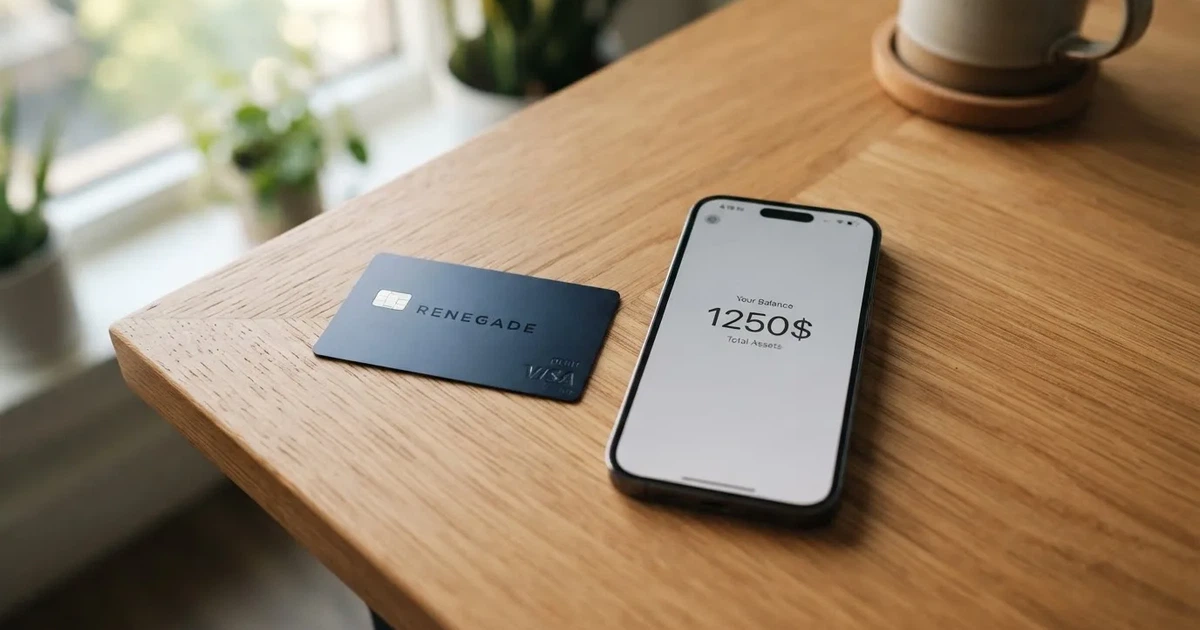
The conditions in this review are current as of October 28, 2026.
Verdict
Renegade scores 4.1 out of 10. That isn’t a number I’m pulling out of the air: it reflects a product that does one real thing — a euro IBAN with an instantly issued virtual Visa — and not much else you can confirm. The card is virtual only, the company is upfront that it is “NOT a bank” and has no licences yet, and the only public customer review I found is a one-star complaint about undelivered roadmap items and a refused refund. The euro IBAN is a real feature for the European Economic Area, but the wider “crypto card” promise is harder to pin down because the coins, networks, FX and ATM costs are not stated on the public page.
I would consider this card if you live in the EEA, you specifically want a euro IBAN you can receive salary or rent into, and you understand that you’re signing up to a product that is still completing its feature set. I would not consider it if you live outside the EEA, if you need a physical card, if you want to spend USDC, BTC or ETH from a self-custody wallet, or if “regulated and licensed” is on your shortlist.
Score table
| Criterion | Mark | Why |
|---|---|---|
| Who can get it | 5 / 10 | No published list of supported or excluded countries; the euro IBAN is EEA-only by the terms. |
| Cost | 4 / 10 | Monthly fee ranges from 9.90 to 29.90 EUR; crypto-to-fiat conversion is 1.6%; everything else is “no other fees” or “not stated”. |
| Top-up options | 5 / 10 | Crypto via a Striga virtual IBAN and a normal IBAN; the coins and networks on the card page are not named. |
| Reliability and complaints | 3 / 10 | No licences held, the company says it is “not a bank”, the issuer name is contradictory, and the single Trustpilot review is a refund dispute. |
| Everyday use | 3 / 10 | Virtual only, no plastic; Google Pay appears only in a site testimonial; Apple Pay and ATM use are not addressed. |
The intended audience, in the card’s own framing, is the person inside the EEA who wants a euro IBAN alongside a virtual card. For everyone else, the gap between the marketing and the verified product is the whole story.
Will they give you the card
Renegade does not publish a list of supported or excluded countries on the card page, and that is the first thing I look for. If you can’t tell from the marketing whether your country is in or out, you have to read the terms carefully to get an answer, and even then you only get half of it. The terms state, in section 1.2, that only customers in the European Economic Area can use the virtual IBAN for euro deposits and withdrawals. The wider card service — virtual card issuance, the app, the subscription — does not get the same geographic fence in writing. The practical reading is that the IBAN is gated to the EEA, and the rest of the product is open in principle but unsupported in any listable sense.
There is no statement about age, no list of excluded nationalities, and no residency-versus-citizenship clarification. That matters because sanctions screening and issuer risk policy are often applied to citizenship and country of birth as well as the country of address, and a card that says nothing about either will give you an awkward surprise at KYC if you happen to fall outside an unscreened norm.
The KYC process itself is described on the card page in a single sentence: download the app, enter your personal information, and verify your identity through a secure in-app chat that “only takes a few minutes”. What that chat asks for, which documents count, and whether proof of address is needed are not stated. The terms don’t list KYC tiers either, so you can’t tell up front whether higher subscription tiers come with stronger checks or whether the same onboarding applies to all three.
The honest summary is: if you live in the EEA, you should be able to get the card and use the euro IBAN. If you don’t, the card page won’t say no, but it also won’t say yes, and the only way to find out is to start the process. That is a poor position to put a prospective customer in.
How to get it
The signup path is short because the card itself is short: there is no plastic to ship and no waiting list to sit on. You download the app, fill in your personal details, complete identity verification inside the app, and the virtual card appears “instantly”. The card page makes a point of saying “No plastic. No waiting.” and that is the literal truth of it. The card lives in your phone and presumably in the card network’s tokenisation system for mobile wallets once you add it.
The card page mentions “VISA integration” and references the standard network behaviour, but the precise wording on which entity issued the card is inconsistent across the company’s own documents. The terms name Zypto as a card service provider in section 10, while section 11 of the same terms describes an unnamed licensed card issuer operating on Striga’s infrastructure. I treat that as an unresolved question about the programme, not as a fact either way. The card currency is not stated on the public page either, although the existence of a euro IBAN account makes euro a likely working currency at minimum.
What you do not get in the signup path is any explicit list of documents to have ready, any statement about how long the chat-based KYC takes in real-world terms beyond “a few minutes”, and any confirmation that you’ll see a soft credit check or a hard one. If you have a name change, a recent move, or a residency document that doesn’t match your address exactly, the in-app chat is the place where that will surface.
What it really costs: Fees
The headline cost is the monthly subscription, and there are three of them. Pioneer is 9.90 EUR per month, Voyager is 19.90 EUR per month, and Vanguard is 29.90 EUR per month. The card page offers a discount if you pay the same monthly fee in RNG, the project’s own token: 4.90, 14.90, and 24.90 EUR respectively. Whether paying in RNG makes sense is a separate question — RNG’s price moves with the rest of the market — and the card page does not give you a fixed RNG amount, only the discounted euro equivalent, so the actual token amount you pay will move with the price.

Beyond the subscription, the card page states a 1.6% fee for the crypto-to-fiat exchange, and then says “No other fees are collected by Renegade”. It also commits to at least 30 days’ notice before introducing any new fee. That is helpful as a promise but it doesn’t tell you what the third parties along the chain charge: the card network for foreign currency transactions, the ATM operator for cash withdrawals, or the blockchain for any crypto deposit. The card page doesn’t publish an FX fee, doesn’t publish an ATM fee, and doesn’t publish issuance, deposit, or withdrawal fees. Issuance is not stated as a separate line item, which is a small mercy if the card is free to issue, but a frustrating gap if it isn’t.
Limits are equally thin. The card page says Voyager offers “Higher limits” and Vanguard offers “maximum limits” without publishing any numbers, and Pioneer offers “2 benefits” that are not enumerated. The Pioneer monthly reward cap is 2,500 EUR, while Voyager and Vanguard caps are not clearly stated on the card page. I am flagging these as the page’s own numbers, not as a correction.
| Fee or limit | Pioneer | Voyager | Vanguard |
|---|---|---|---|
| Monthly fee | 9.90 EUR (4.90 in RNG) | 19.90 EUR (14.90 in RNG) | 29.90 EUR (24.90 in RNG) |
| Issuance fee | not stated | not stated | not stated |
| Crypto-to-fiat exchange | 1.6% | 1.6% | 1.6% |
| FX fee | not stated | not stated | not stated |
| ATM fee | not stated | not stated | not stated |
| Spending limits | not stated | “Higher limits” | “Maximum limits” |
| Rewards rate | 3% in RNG | 3% in RNG | 3% in RNG |
| Monthly reward cap | 2,500 EUR | Not stated | Not stated |
To make this concrete, walk through three everyday payments with me.
You buy a 50 EUR train ticket on a Portuguese rail site from a Portuguese IP, paying in euro, with euro already loaded on the card. What you pay: the 50 EUR ticket plus the monthly subscription that you’ve already paid. There is no FX conversion because both sides are in euro, and the crypto-to-fiat exchange fee of 1.6% has already been taken on the day you topped up the euro balance from crypto. If you topped up via SEPA from a regular bank account, the 1.6% may not apply at all — Renegade’s published fee is for the crypto-to-fiat leg — but the terms are not explicit on this.
You pay a 30 USD subscription to a US streaming service from a French IP, paying in US dollars. What you pay: 30 USD plus whatever FX markup the card network or programme applies. Renegade’s public page does not state an FX fee. If the underlying programme uses Visa’s standard cross-border rate with a programme margin, you’d see that on the transaction; if it uses the scheme rate with no margin, the cost would be near the interbank mid-market. The card page’s “No other fees are collected by Renegade” promise is not the same as “no FX margin”, so this is a place to check your statement.
You buy 100 EUR of crypto on an exchange, send it to your Renegade crypto vIBAN, and then spend it over the following week. What you pay: the exchange’s trading spread, the blockchain network fee on the transfer, the 1.6% crypto-to-fiat exchange fee at Renegade’s end, and any FX fee if you spend in a currency other than euro. The blockchain fee is not collected by Renegade, but it is collected by the network, and it can be material on Ethereum mainnet during busy periods. If the source exchange is the bottleneck, you also bear its withdrawal fee.
The pattern I want you to take away is that the “1.6% plus subscription” headline is the floor, not the ceiling, of what you actually pay to use this card. Anything involving a network, an FX conversion, an ATM, or a non-euro merchant sits outside that floor and is not documented on the card page.
How to top it up: Top up
The funding path is the part of Renegade that I had to read three times to get straight, because the card page and the earlier reporting don’t quite match.
The current card page describes two ways to put money on the card. The first is a “crypto vIBAN” — a virtual International Bank Account Number that is paired with a Striga-powered account inside the app. You get euro-denominated bank details; when euro arrives, it loads the card. The second is a regular IBAN account, which suggests you can also treat Renegade as a current account and receive euros from a normal bank transfer. The euro withdrawal side is symmetric: you send euros out from the same virtual IBAN. The terms confirm that you can terminate at any time free of charge, that Renegade may close the relationship with two months’ notice, and that accounts inactive for over six months may be closed.
What is not on the current card page is a list of supported coins or networks. Earlier coverage described Renegade as a non-custodial wallet with USDC, BTC and ETH; that product description doesn’t appear on the current public card page. A deposit fee, a minimum top-up, and the policy on network fees are not stated either. If you are sending crypto, the practical risks to know are general to the category, not specific to Renegade: an address or network mismatch can mean a permanent loss of funds, the network fee is not refundable, and a stablecoin sent over a network Renegade doesn’t watch for can sit uncredited until you raise a support ticket. Circle, for example, stopped supporting USDC on Tron in February 2024, so “USDC over TRC20” is not a generic option.
For euro funding from a regular bank, SEPA into the virtual IBAN is the most likely rail. SEPA is cheap or free inside the EEA for euro transfers, and instant SEPA exists at most banks now. For non-EEA readers, the virtual IBAN’s EEA-only restriction is a hard wall: there is no documented way for a non-EEA resident to receive euros into a Renegade IBAN under the current terms.
Paying with it every day
In day-to-day use, Renegade gives you a virtual Visa, an app, and not much else. There is no physical card and the page makes a point of “No plastic”. That is fine for online shopping and for adding the card to a mobile wallet — and the card page’s “VISA integration” suggests tokenisation is supported — but it is a constraint if you want to tap a card at a turnstile or hand a card to a shop that needs to swipe.
Mobile wallet support is patchy in the public material. Apple Pay is not mentioned on the card page. Google Pay appears only in a customer testimonial on the website, where a “Web3card” was added to Google Pay, which is not a confirmation of first-party support. If the card does tokenise into Apple Pay and Google Pay, that will show up in the wallets themselves; if it doesn’t, the “no plastic” model is also a “no contactless” model in physical terms.
The rewards proposition is the same across all three tiers: 3% paid in RNG, the project’s own token. The page calls it cashback, and the per-tier monthly caps apply (with the caveat that the Vanguard figure is garbled on the page). Rewards paid in a token you didn’t choose introduce price risk: if RNG falls, your real return is lower. The card page doesn’t address this and doesn’t let you opt out of RNG-denominated rewards for a fiat alternative.
The app itself is published as “Renegade” by Renegade GmbH on the iOS App Store, and on Google Play under net.myrenegade.main. As of the read date for this review, the iOS listing had not received enough ratings for a public score. That doesn’t tell you much about the quality of the app, only that the install base is small.
For disputes, the terms assign liability to the seller for faulty goods (section 2.3), route complaints first to Customer Support, then to a formal in-writing complaint, and finally to the EU’s online dispute resolution platform. Chargebacks in the card-network sense are not mentioned. That gap is worth pausing on: most regulated card programmes give you a chargeback right on top of the seller-liability rules, and “the merchant is liable” is not the same as “your card issuer will reverse the charge for you”.
What can go wrong
This is the section I’d ask you to read first if you only have time for one.
The most uncomfortable thing about Renegade is the licence posture. The company says in plain language on its site that it is “NOT a bank” and that it does not yet provide regulated services, and that it will apply for licences first. There is no entry for Renegade on ESMA’s interim register of authorised crypto-asset service providers as of this review, and there is no banking or e-money licence disclosed in the terms. That is consistent with the company’s own statement, but it means the euro IBAN, the card programme, and the crypto side all sit on top of partners’ licences rather than Renegade’s own.
Speaking of partners, the terms are internally inconsistent. Section 10 names Zypto as the card service provider. Section 11 of the same document describes an unnamed licensed card issuer operating on Striga’s infrastructure. Striga Technology OÜ, an Estonian company, is named in the partnership material as the vIBAN provider. The corporate entity behind the app is MYRENEGADE, UNIPESSOAL LDA, registered in Lisbon, Portugal (company number 517780801), and the App Store lists Renegade GmbH as the developer. None of this is necessarily wrong, but having the issuer of the card be the thing I can’t pin down from the issuer’s own terms is not a small thing. The card page itself uses the language “VISA integration” rather than naming the issuer.
Custody is the next concern. The card page describes the user interface as “user-interface only” and says Striga helps keep money “in a safe manner”. The terms do not clearly address who holds the euro balance and who holds the crypto, and the multi-factor authentication mentioned in the terms (section 9.1) is an app-level control, not a custody arrangement. Until Renegade publishes where customer funds sit, who has segregation in place, and under whose licence they sit, the safer assumption is that you are exposed to partner-level counterparty risk on top of Renegade-level execution risk.
The customer-feedback picture is thin but unfavourable. Trustpilot shows 3.2 out of 5 across a single review, read on 2026-10-21. That single review, dated 7 April 2026, says the Q1 2026 roadmap items — app, crypto wallet, card — were not delivered, and that support refused a refund by calling the payment a “startup investment”. One review is not a track record, and the absence of a review wall is itself a signal: a product at this subscription level should have a few more voices by now. There are no other official incident reports I could find, and I am not aware of a regulator action against the company.
A sponsored article on btc-echo.de from 30 January 2024 (updated 31 July 2025) describes Renegade as a euro IBAN and Visa debit card app that was live at the time, with an IBAN waitlist and crypto features still being integrated. It also mentions a Founder card limited to 555 units with up to 9% rewards, and Carbon and Black NFT cards with 5% and 3% rewards in RNG. Sponsored content is not independent, and the rewards rates mentioned there are not what the current card page shows, so treat the historical rewards figure as context rather than a current promise.
A few other things deserve your attention. RNG-denominated rewards are exposed to token-price moves. The 30-day notice for new fees is a one-way door: fees can go up, not down, with notice. The inactivity clause closes accounts dormant for more than six months, which is a real risk if you sign up and forget. And finally, the “user-interface only” framing is consistent with a model in which Renegade is the brand and the partner licences are the substance, which is the normal way these products are built but is also the model that failed when, for example, Visa terminated its global agreements with FTX in November 2022 and the FTX US debit card was wound down by its issuer, or when WaveCrest was suspended by Visa in Europe in 2018 and all of its programmes were closed. Network action against a partner is a tail risk for any branded card, and the more of the stack that sits with a partner, the larger that tail.
What to take instead
If Renegade is not the right fit, three alternatives cover the main use cases the card targets, and I want to walk through each so you can pick by the criterion that matters most to you.
Whop Cards is the option with the clearest geographic and product picture. The published list names 31 US states that can get a consumer card, with Alabama, Alaska, Arkansas, California, Colorado, Connecticut, Florida, Hawaii, Illinois, Indiana, Iowa, Kansas, Kentucky, Maine, Massachusetts, Michigan, Minnesota, Montana, Nebraska, New Hampshire, New Jersey, New York, North Carolina, Oklahoma, Pennsylvania, South Carolina, Texas, Utah, Virginia, West Virginia and Wyoming. A separate route is open for businesses in 41 states. Unsupported consumer countries include Belarus, China (Mainland), Cuba, Hong Kong, India, Iran, Iraq, Israel, Myanmar, Nepal, Nicaragua, North Korea, Russia, Syria, Turkey, Ukraine, Venezuela and Vietnam, and the corporate list is at least as restrictive. The card is a Visa that works online and in stores; the page says “No extra fees” but doesn’t list an issuance or monthly amount. Spending is from a Whop balance backed by stablecoin collateral from a linked wallet, with the specific coins and networks not stated, and there is a 5% cashback programme at selected merchants, currently Uber, with more planned. Whop’s score is 5.2 out of 10, and the case for it is clarity: a real country list, a published fee policy, and a clear spending model.
Stella is the option if you want a card that explicitly says “both virtual and physical” and a Visa that “works at over 40 million VISA merchants globally”. The official site doesn’t state a country list, but the terms bar users under economic sanctions programmes and route US and European customers through affiliates, so geography is handled by the affiliate rather than by Stella directly. Fees are not stated officially; the user agreement and the app are where you look. Funding is custodial: you deposit crypto into the in-app wallet, which automatically tops up the card. The card page does not state a cashback rate; the Earn product is a separate yield. Stella’s score is 6.5 out of 10, and the case for it is product shape: virtual and physical, a Visa under your own name, and a custodial model that is easy to understand.
UniFi Card is the option if you want a prepaid Visa debit card issued by Lead Bank with Apple Pay support and a USD spending balance. The app lists send-money routes to the Philippines (PHP), Mexico (MXN), the eurozone (EUR) and, in recent release notes, Colombia, Brazil (PIX) and the UK (GBP), and you can fund by ACH, wire, SEPA or SPEI, or get paid to a USDC wallet. The coins and networks beyond USDC are not stated on the listing. The fees line is “Fees may apply. See UniFi website for more details” and the cashback rate on the listing is “3% rewards on balances” without further detail. UniFi’s score is 4.7 out of 10, and the case for it is the rails: a real US-issued Visa with a US bank, multiple regional send routes, and a stablecoin funding path that doesn’t require you to convert before you receive.
| Card | Score | Where it works | Form | Funding | Rewards | Why pick it |
|---|---|---|---|---|---|---|
| Renegade | 4.1 / 10 | EEA for the IBAN; not stated for the wider card | Virtual only | Crypto vIBAN via Striga, euro IBAN | 3% in RNG | Euro IBAN with a virtual card in one app |
| Whop Cards | 5.2 / 10 | 31 US states consumer, 41 states business; broad sanctions list | Not stated (online and in-store Visa) | Whop balance backed by stablecoin collateral | 5% at selected merchants (Uber and more planned) | Transparent geography and fee policy |
| Stella | 6.5 / 10 | Not stated; sanctions-barred; affiliates for US/EEA | Virtual and physical | Custodial in-app wallet, deposit crypto to top up | Not stated on card page | Both virtual and physical Visa, custodial model |
| UniFi Card | 4.7 / 10 | Not confirmed; multi-region send routes | Prepaid Visa, virtual and physical, Apple Pay | ACH, wire, SEPA, SPEI, USDC wallet | “3% rewards on balances” (listing) | US-issued Visa debit with multiple send routes |
Who I would recommend it to
If you are inside the EEA, you specifically want a euro IBAN you can give to an employer or a tenant, and you are comfortable with a virtual-only card and a subscription in the 9.90 to 29.90 EUR range, Renegade is a reasonable thing to try. The IBAN is the strongest part of the offer, and the in-app chat KYC is the fastest onboarding in this comparison if it lives up to the “few minutes” claim. You should not treat it as a regulated banking product, and you should not park a salary’s worth of euro in it until you’ve seen a statement cycle and a withdrawal succeed.
If you are outside the EEA, the IBAN is unavailable to you, and the wider card product is too underspecified to commit to. The cost line is reasonable for what you get, but the FX fee, the ATM fee, the limits, the supported coins and the supported networks are all “not stated”. I would wait for the card page to publish at least the FX fee, the ATM fee, the spending limits per tier, and a country list. I would also wait for the terms to converge on a single named card issuer. Until that happens, the alternative I would look at first is Whop Cards if you are in a US consumer state, Stella if you want a virtual and physical Visa with a custodial model, or UniFi Card if you need a US-issued Visa with regional send routes.
If you are the kind of person who reads the licence section first, the right move is to wait. Renegade’s own statement that it is “NOT a bank” and that it has not yet applied for licences is honest, and the right response to that honesty is to give the company time to land the licences before you commit a meaningful balance.
Frequently asked questions
What is the Renegade card?
The Renegade card is a virtual Visa tied to a euro-denominated virtual IBAN inside a mobile app published by Renegade, with a three-tier subscription (Pioneer, Voyager, Vanguard) and a 1.6% crypto-to-fiat exchange fee. It is virtual only, with no plastic card, and the company says on its own site that it is “NOT a bank” and is not yet a regulated financial services provider.
How does the Renegade card work?
You download the app, verify your identity through an in-app chat, receive a virtual card instantly, and fund the card with euros through the virtual IBAN or by transferring crypto through Renegade’s Striga-powered crypto account. When you spend, the card draws on the euro balance and Renegade converts any crypto top-up to euro at a 1.6% fee.
Is Renegade a bank?
No. The company states on its own site that it is “NOT a bank” and that it does not yet provide regulated services, and that it will apply for licences before doing so. The euro IBAN is provided by Striga, an Estonian partner, and the card programme is described inconsistently across the company’s own documents, with one section naming Zypto and another describing an unnamed licensed card issuer on Striga infrastructure.
Who owns Renegade?
The company behind the app is MYRENEGADE, UNIPESSOAL LDA, registered in Lisbon, Portugal (company number 517780801). The App Store lists Renegade GmbH as the developer, and the card programme’s IBAN side is run with Striga Technology OÜ in Tallinn, Estonia. The terms name Zypto as a card service provider in one section and an unnamed licensed card issuer on Striga infrastructure in another, so the owner of the card programme is not a single, consistent answer in the company’s own documents.
Is the Renegade card available in my country?
The card page does not publish a list of supported or excluded countries. The terms restrict the use of the virtual IBAN for euro deposits and withdrawals to customers in the European Economic Area. The wider card product is not gated by name in the terms, but the IBAN — which is the most useful feature — is EEA-only.
How do I get the Renegade card?
You download the Renegade app, enter your personal details, and verify your identity in an in-app chat. The card page says this “only takes a few minutes” and that the virtual card is issued instantly. The card is virtual only, so there is no plastic to ship and no waiting list to clear.
How do I top up the Renegade card?
You fund the card by sending euros to the virtual IBAN inside the app, or by transferring crypto to the crypto account that the app links to the card. The card page does not list the supported coins or networks, the deposit fee, the minimum top-up, or the network fees that the blockchain itself charges.
How do I add the Renegade card to Apple Wallet or Google Pay?
The card page does not mention Apple Pay. Google Pay appears only in a customer testimonial on the website, in which a “Web3card” was added to Google Pay; this is not a confirmation of first-party support. The only reliable way to check is to add the virtual card from inside your phone’s wallet app and see whether the tokenisation succeeds.
Is the Renegade card safe?
The company says it is “NOT a bank” and that it has no licences yet, and the terms describe the app as “user-interface only” while custody is provided by Striga. There is no published segregation or safeguarding statement for customer funds on the card page. The single public Trustpilot review, dated April 2026, is a one-star complaint about undelivered roadmap items and a refused refund, and the overall Trustpilot score is 3.2 across that one review. Treat the product as a brand-and-interface layer over partner licences rather than as a regulated financial services product.
How do I delete my Renegade account?
The terms say you may terminate the relationship at any time free of charge and that Renegade may close the relationship with two months’ notice, and they flag that accounts inactive for more than six months may be closed. The practical steps to delete the account, withdraw remaining euro from the virtual IBAN, and remove your data are not described in detail on the card page, so the safest sequence is to withdraw your balance first, then ask Customer Support (live chat in the app 24/7, or [email protected]) to close the account and confirm the closure in writing.
App and neobank card options – cryptocardoptions.com
Content created by the «cryptocardoptions.com» team