
A crypto-funded Visa from Hong Kong that scores 6.4 out of 10
 Available in US
The Fizen card is a Visa prepaid card tied to a stablecoin balance, issued by a Hong Kong company and marketed at people in countries where getting a normal bank card is hard. After going through the card’s own pages and terms, plus third-party reports, I scored it 6.4 out of 10. That is not a bad score for a product in this corner of the market, but it is also not one I would hand to my own family without reading the small print first.

The headline I keep coming back to is this: the Fizen card is genuinely useful for the narrow job it is built for, which is letting you spend USDT at a Visa terminal. It is less useful once you step outside that job, and a few of the things that look like plain benefits (low fees, high bonuses, a Tether investment on the homepage) come with enough asterisks that you have to read the fine print to know whether you actually get them.
Conditions are current as of October 28, 2026.
Verdict: 6.4 out of 10
The total score is 6.4 out of 10. I arrived at it by weighting six categories the way a person comparing crypto cards actually weighs them: who can get one, what it costs, how flexible the top-up is, how reliable the company is, how it works day to day, and whether the audience is well matched to the product.
The card is best suited to someone who already holds USDT, lives in or moves through a country that is neither in the restricted 43 nor in a blanket-sanctioned jurisdiction, and wants to spend that USDT at a real-world Visa terminal without going through a normal bank. If that is you, the Fizen card does the job at a reasonable price. If you want a card you can fund from your salary, a card that earns you meaningful cashback, or a card with a long public track record, this is not the one.
Score breakdown
| Criterion | Mark | Reason |
|---|---|---|
| Who can get it | 8 / 10 | Used in 160+ countries but not available in 43, including Russia, Belarus, Serbia, India, China, Iran and Ukraine |
| Cost | 6 / 10 | $9.99 to issue, $0 monthly if you spend $500, 1% FX, 0.5% crypto conversion, $2 to close, $2 + 1.5% at ATMs |
| Top-up options | 6 / 10 | USDT only, sent to a Fizen-controlled wallet; QR Pay takes USDT on Solana or BNB Chain; fiat through Transak |
| Reliability and complaints | 6 / 10 | Fizen Limited in Hong Kong, not a bank or licensed payments institution; Tether investment announced July 2026; Trustpilot 4.1 out of 5 |
| Everyday use | 5 / 10 | Virtual Visa straight away, Apple Pay and Google Pay; physical metal cards still listed as “coming soon” |
| Total | 6.4 / 10 |
I will explain each row as we go through the rest of the page. The total does not add up from the rows on purpose: it is a weighted average where the audience fit and the cost have more weight than, say, rewards.
Who will they give you the card
The first thing the card page brags about is that it works in 160+ countries. The first thing the fine print does is narrow that back down. According to the card’s own restricted-country list, Fizen is not available in 43 jurisdictions, including the Russian Federation, Belarus, Serbia, India, China (Mainland), Croatia, Slovenia, Montenegro, North Macedonia, Bosnia and Herzegovina, Iran, Ukraine and Venezuela. That is a long list, and it covers most of Eastern Europe and several of the larger Asian markets, so it is worth checking before you sign up.
The Master Terms add another layer on top. They bar users who are citizens, residents or located in any jurisdiction where the service is prohibited or subject to comprehensive sanctions, and they require Fizen to recheck eligibility on an ongoing basis using KYC, IP, device and location data. There is also a useful wrinkle: if you are a citizen of a restricted country but you currently live somewhere the card is supported, you may still be eligible. I have not read the full exceptions page, so I would not assume that without contacting support.
A handful of countries people ask about are not on the restricted list. Georgia, Turkey, Kazakhstan, Armenia and the UAE, for example, do not appear there, which is why you will see a lot of Fizen reviewers in those places. That is unofficial information from third-party tracking sites, not confirmed by the card itself. Treat it as a starting point and confirm with Fizen support before you spend money on KYC.
What is not stated publicly is the full list of supporting documents, the age requirement, and the exact KYC tiers. The terms say identity checks are done “at the level each Service requires” and that eligibility is rechecked over time, but they do not publish the documents, the processing time, or the reasons a check might be rejected. If you need to plan around a tight deadline, ask.
How to get the card
There are three steps on the card page: download the Fizen Super App, set up a wallet, then apply for a card. The application itself takes about 5 minutes, and the virtual card is issued instantly.
You will need to pass KYC. The terms say it is verified once at setup, “like any regulated payment app”, and that the level of scrutiny depends on the service you are using. The card is one of the higher-level services, so expect a government ID and a selfie at minimum, and possibly proof of address depending on your country.
There are three card tiers. Adventure ($9.99) is open now and gives you a virtual card. Pioneer ($999.99) and Frontier ($9,999) are listed as “coming soon” and “Get info” respectively, and both promise a physical metal card plus higher cashback and APR bonuses. The card currency and the network on the public card page are not stated clearly, but the card terms title it “USD Visa Prepaid Card” and the issuer is a regulated institution operating “under licence from Visa”. The actual issuer’s name is in the Issuer Cardholder Agreement, which I have not read, and that is something to look at before you put a large balance on the card.
The physical Pioneer and Frontier cards have not launched. Delivery countries, delivery time, and replacement cost are not stated, so I would not plan around them yet.
Fees: what it really costs
The headline numbers on the card page are friendly: “$0 crypto-to-fiat conversion fees” and “$0 top-up fees within plan limits” for the Adventure tier. The official fee table is a different story. Here is what the docs actually say.

Costs at a glance
| Fee or limit | Amount |
|---|---|
| Virtual card issuance (Adventure) | $9.99 (free for pre-registered users) |
| Monthly maintenance | $0 if you spend ≥ $500, $1.50 if you spend less (first month free) |
| Close card fee | $2.00 |
| FX fee (non-USD payments) | 1% |
| Crypto-to-fiat conversion | 0.5% (standard; the Adventure marketing line says 0%) |
| Small transaction fee (under $50) | $0.50 |
| ATM withdrawal (physical card) | $2 + 1.5%, first withdrawal up to $200/month free |
| ATM limits | $100,000/day, $200,000/month, 3 per day, 30 per month |
| Per-transaction spend cap | $150,000 |
| Daily spending | $1,000,000 |
| Monthly spending | $1,000,000 |
A few things stand out when you read that table the way a real person would. The “0% conversion” line on the Adventure page is the marketing version; the docs put the standard rate at 0.5%. Either is competitive for a crypto card, but do not assume the marketing copy is what your transaction will be billed at. The small-transaction fee of $0.50 on purchases under $50 is the kind of charge you only notice when you buy a coffee every morning and the math stops working out. The monthly maintenance fee of $1.50 only kicks in if you spend less than $500 in a calendar month, so a light spender effectively pays $18 a year for the privilege of holding the card.
Three everyday payments and what they cost
To make the table less abstract, here is what a few common payments actually cost on the Adventure tier.
A $4 coffee paid in USD at a New York café costs you the $0.50 small-transaction fee, the 0.5% crypto-to-fiat conversion (about $0.02 on a $4 charge), and the network fee you paid to move the USDT into Fizen. Total Fizen-side cost: roughly $0.55, which is a meaningful percentage of such a small purchase. That is the worst-case scenario for the card, and the reason a $9.99 issuance fee does not really hurt a heavy spender but does hurt someone who uses the card for small daily items.
A $120 dinner paid in euros while you are travelling costs you 0.5% conversion ($0.60), 1% FX ($1.20), and the small-transaction fee does not apply. That is $1.80 in Fizen fees, or 1.5% of the bill. That is roughly what most travel cards charge for foreign currency, so the Fizen card is competitive in this scenario.
A $300 cash withdrawal from an ATM in Mexico costs you the $2 + 1.5%, but the first withdrawal of the month up to $200 is free, so on a single withdrawal of $200 or less the fee is $0. On a $300 withdrawal that does not qualify for the free quota, you would pay $2 + 1.5% of the total. If you need cash often, that is a meaningful charge.
Top up: how to fund the card
There is no bank transfer, no direct debit, no salary loading. The card is funded by sending USDT to a Fizen-controlled wallet, and that is the only direct way to put money on the card. USDT is a dollar-pegged stablecoin, so one USDT is intended to be worth one US dollar, and Fizen’s terms treat it that way for the card’s USD balance.
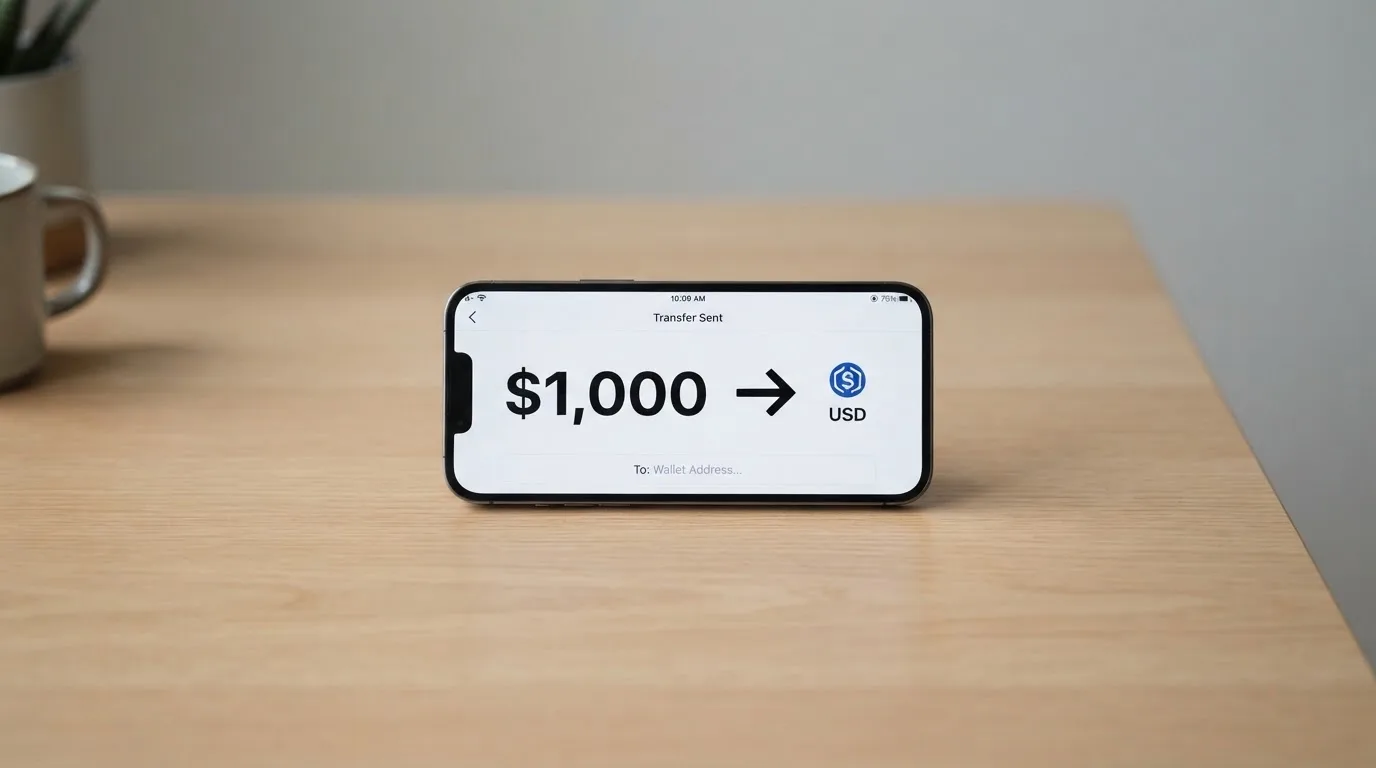
The QR Pay feature is narrower: it can only be funded with USDT on the Solana or BNB Chain networks. If you send USDT on Ethereum, Tron, Polygon or any other chain to that QR Pay balance, the terms are explicit that those assets “may be permanently lost”. I would underline that sentence before you send anything.
If you want to fund the card from a bank account rather than from crypto, the route is through a third-party on-ramp. The terms name Transak as one of the fiat on-ramps. Transak charges its own fees, and the network fee for the on-chain leg of the transfer is paid to the blockchain validators, not to Fizen. The fee schedule on the card’s own docs does not have a top-up fee line, which is consistent with the “0 top-up fees within plan limits” line on the card page.
A few practical points. The minimum top-up amount is not stated. Network fees for sending USDT vary a lot by chain: Solana and Tron are typically a few cents, Ethereum mainnet can be several dollars during busy periods, so if you are topping up small amounts, send on a cheap network. And because USDT is the only funding token, your exposure is the risk of USDT itself, not the wider crypto market, but also not a diversified portfolio.
Paying with the card every day
Once the card is loaded, the everyday experience is closer to a normal prepaid Visa than to anything crypto-specific. The virtual card is accepted anywhere Visa online, and you can add it to Apple Pay or Google Pay, both of which have their logos on the Fizen site. The QR Scan-to-Pay feature is available in countries including Brazil, Argentina, Peru, Vietnam and the Philippines, and it works as a separate balance, not as the main card.
The physical metal card (Pioneer, Frontier) is the part that still feels like a beta product. It is listed as “coming soon” and there is no delivery country, ETA or replacement-cost information. If you want a card that sits in your wallet, you cannot actually get one yet, which is one of the reasons the everyday-use score is only 5.
The rewards you actually get depend on which tier you are on. Adventure gives you discounts and cashback on eSIMs, hotels and flights, “FiPoint cashback” (the rate is not stated), and a 5% APR bonus on a USDT Vault. Pioneer raises the APR bonus to 10% and adds higher FiPoint cashback and VIP support. Frontier raises it to 20%, again with higher FiPoint cashback. The blog has also run promotions like “up to 10% cashback + FiPoints on every spend” and a $10 eSIM credit on 19 August 2026, but those are time-limited and the T&Cs apply.
Merchant category blocks are not stated in the terms I read. The terms do prohibit use for illegal gambling and other illegal activity, which is a wide net, and the ATM section implies gambling or adult entertainment could be in the blocked list. If your main use case is one of those, ask before you load the card.
Disputes and chargebacks are the part that worries me most on the everyday-use side. The terms say you send a written Notice of Dispute to [email protected], give 60 days for good-faith resolution, then go to SIAC arbitration in Singapore, with class actions waived and a one-year claim window. Chargebacks are not addressed in the Master Terms; the Cardholder Agreement and the FAQ would have the detail, and I have not read those. For a card with a Visa logo, that is an unusually restrictive dispute path.
What can go wrong
This is the section I would read twice if I were you. Crypto cards combine the failure modes of two industries, and the Fizen card is no exception.
The company behind the card
Fizen Limited is a Hong Kong company (company number 77059696, registered at Unit 1411, 14/F, Cosco Tower, Queen’s Road Central). The terms are explicit that it is not a bank, an e-money institution or a licensed payment institution. The card itself is issued by a separate regulated institution under licence from Visa, and the issuer’s name is in the Issuer Cardholder Agreement. The site also advertises a strategic investment from Tether dated 30 July 2026, which is a positive signal for the company’s runway but does not change who regulates the card.
Custody and security
The custody model is split across products and that matters. The Fizen Wallet and Swap products are non-custodial: the private key is generated on your device, encrypted locally, and Fizen cannot recover it. The Fizen Card is custodial: when you load the card, your USDT moves onto Fizen’s internal ledger, where it sits in a pooled balance rather than segregated accounts. QR Pay is also custodial, and the terms are unusually direct that ownership of accepted assets passes to Fizen and is not segregated.
Practically, that means the part of the Fizen system you want to trust is the part you have to trust most. Two-factor authentication is required where offered, and the terms give you 72 hours to report unauthorised access to [email protected]. There is a card management page with freeze and control features, but I have not read it in detail. Insurance is not stated.
Trust signals from outside
User-reported trust signals are limited. Trustpilot shows 4.1 out of 5, with the visible reviews all five-star between 21 April and 3 June 2026, and Fizen has replied to each one. One reviewer calls the app “a bit buggy” sometimes. Trustpilot also flags that the company “may be associated with high-risk investments”, which is a standard automated warning rather than a finding. I could not find any Reddit threads specifically about the Fizen card. That thin public footprint is part of the reason the reliability score sits at 6 rather than higher.
Things that have changed recently
The Master Terms took effect on 5 June 2026, with a 30-day notice period for material changes. The Tether strategic investment was announced on 30 July 2026, the eSIM credit offer ran on 19 August 2026, and a Fizen x Ondo Finance tokenised US stocks tie-up has been mentioned. A $FIZEN token had not launched as of June 2026. The Master Terms version date and the Tether news are the only “news” signals I would weigh in your decision; the rest are product updates.
Operational risks you should know about
Three risks are worth raising by name. First, sanctions risk: the terms let Fizen block users from sanctioned jurisdictions, and stablecoin issuers like Tether have publicly frozen funds tied to sanctioned addresses, so censorship resistance is not a property of this stack. Second, programme risk: the history of crypto cards includes Visa terminating FTX’s global agreements in November 2022 and WaveCrest’s programmes being shut down in Europe in 2018, so a card programme can stop working even when the crypto side is fine. Third, depeg risk: stablecoins have failed before, notably TerraUSD in May 2022 and USDC in March 2023, and Fizen’s card balance depends on USDT holding its peg.
What to take instead
Three cards I would compare Fizen against, with their own caveats.
Whop Cards — 5.2 / 10
Whop Cards is a Visa programme that spends from a Whop balance, with no extra fees advertised on the card page. Consumers can sign up in 31 US states, businesses in 41, and the unsupported-country list includes Belarus, China (Mainland), Cuba, Hong Kong, India, Iran, Iraq, Israel, Myanmar, Nepal, Nicaragua, North Korea, Russia, Syria, Turkey, Ukraine, Venezuela and Vietnam. So it is much more US-centric than Fizen. It advertises 5% cashback at select merchants (currently Uber), and the underlying balance is backed by stablecoin collateral, but the conversion and FX fees are not stated publicly. If you live in a US state where it is available, it is a simpler product; if you do not, Fizen has a real geographic advantage.
Stella — 6.5 / 10
Stella is a higher-scoring card at 6.5 out of 10. It offers virtual and physical Visa cards accepted at “over 40 million VISA merchants globally”. The official site does not list supported countries, but the terms bar users under economic sanctions programmes and route US and European users through affiliates. The card is funded by depositing crypto into a custodial in-app wallet, which automatically tops up the card. Fees are not stated publicly; the User Agreement and the app are the only sources. Cashback is not advertised; Stella’s earn product is a separate yield, not a card reward. The closer match if you want a custodial crypto-funded Visa without the $9.99 issuance fee, but with less visibility on the numbers.
UniFi Card — 4.7 / 10
UniFi Card is a US-dollar prepaid debit Visa issued by Lead Bank, with Apple Pay support and spends from a USD balance. The cheapest option for sending money to the Philippines, Mexico, the eurozone, Colombia, Brazil and the UK. Funding comes in via ACH, wire, SEPA or SPEI, or you can get paid into a USDC wallet, but the coins and networks beyond USDC are not stated on the listing. The listing claims “3% rewards on balances”, but card fees and cashback are not stated. UniFi scores lower partly because the official fee information is sparse, and partly because the supported funding routes and corridors are narrower than Fizen’s USDT-only flow.
Picking between them
If your priority is the widest geographic reach, Fizen has the edge. If your priority is a known issuer and US regulation, the Whop or UniFi cards in a US state are safer on the regulatory side, though narrower on geography. If your priority is a custodial crypto card with no issuance fee, Stella is the closer fit. None of the three I looked at publish their full fee tables as clearly as Fizen does, which is itself worth something.
Who I would recommend it to
I would recommend the Fizen card to a fairly specific kind of reader. If you already hold USDT in a self-custody wallet, live in a country that is neither in the restricted 43 nor under comprehensive sanctions, and want to spend that USDT at a Visa terminal or via Apple Pay without first cashing out to a bank account, the card does the job. The $9.99 issuance fee is recoverable inside a few months of normal spending, the FX fee is competitive, and the daily and monthly limits are high enough that you are unlikely to hit them for personal use.
I would not recommend the card to a few kinds of readers. If your primary need is a salary-loaded debit card, this is not it: there is no direct debit, no salary loading, and the funding path is on-chain USDT. If you need a physical card in your wallet today, the only available tier is the virtual Adventure card, and the metal Pioneer and Frontier cards are “coming soon” with no date. If you want a card with a long public track record, a regulator name on the front, and a clear chargeback path in the public terms, this is also not the card, because the issuer is named only in an agreement I have not read and chargebacks are not in the Master Terms. And if you are a citizen of a restricted country but live in a supported one, the terms suggest you may still be eligible, but the exceptions page has not been read in this review, so I would confirm with support before you put money in.
The honest summary is that the Fizen card is a competent tool for a specific problem. It is not a general-purpose replacement for a bank card, and it is not the cheapest crypto-funded Visa on the market. It is, however, one of the clearer ones to evaluate, because the fee table is published and the restrictions are stated. Read the small print, especially on the issuer and the dispute path, and you will know whether it is the right card for you.
Frequently asked questions
What is the Fizen card?
The Fizen card is a USD Visa prepaid card funded from a USDT stablecoin balance, run by Fizen Limited in Hong Kong under a strategic investment from Tether announced on 30 July 2026. It comes as a virtual card on the $9.99 Adventure tier, with metal Pioneer and Frontier tiers listed as coming soon.
How does the Fizen card work?
You send USDT to a Fizen-controlled wallet, the card’s USD balance is topped up from that pool, and you spend that balance at any Visa-accepting merchant or via Apple Pay or Google Pay. A separate QR Pay balance can only be funded with USDT on the Solana or BNB Chain networks, and assets on other chains may be permanently lost.
Is Fizen a bank?
No. Fizen Limited states in its terms that it is not a bank, an e-money institution or a licensed payment institution. The card itself is issued by a separate regulated institution operating under licence from Visa, and the issuer’s name appears in the Issuer Cardholder Agreement, which I have not read.
Who owns Fizen?
Fizen Limited is a Hong Kong company (registration 77059696) registered at Unit 1411, 14/F, Cosco Tower, Queen’s Road Central. Tether announced a strategic investment in Fizen on 30 July 2026, although the amount was not disclosed and the issuer of the Visa card is named only in the Issuer Cardholder Agreement.
Is the Fizen card available in my country?
The card is used in 160+ countries, but not available in 43 jurisdictions, including the Russian Federation, Belarus, Serbia, India, China (Mainland), Croatia, Slovenia, Montenegro, North Macedonia, Bosnia and Herzegovina, Iran, Ukraine and Venezuela. The terms also bar users from sanctioned jurisdictions. Countries not on the restricted list, like Georgia, Turkey, Kazakhstan, Armenia and the UAE, are not officially confirmed as supported and should be checked with Fizen directly.
Does the Fizen card require KYC?
Yes. The terms require KYC at the level each service needs, verified at onboarding and rechecked on an ongoing basis using KYC, IP, device and location data. The exact documents, processing time and rejection reasons are not stated publicly, but expect a government ID and a selfie at minimum, and possibly proof of address.
How do I top up the Fizen card?
Send USDT to the Fizen-controlled wallet address for the card. Fiat on-ramps go through third parties such as Transak, and QR Pay can only be funded with USDT on Solana or BNB Chain. Network fees go to the blockchain validators, not to Fizen, and the minimum top-up amount is not stated.
How do I add the Fizen card to Apple Wallet?
The card page shows Apple Pay and Google Pay logos, and the virtual card is issued instantly on approval, so you can add it to Apple Wallet the same way you would add any other Visa. Card management features (freeze, controls) are described as available in the app but were not read in detail for this review.
Is the Fizen card safe?
The Fizen Wallet and Swap products are non-custodial with keys generated on your device, but the Fizen Card balance and QR Pay balance are custodial and pooled on Fizen’s internal ledger, not segregated. Two-factor authentication is required where offered, you have 72 hours to report unauthorised access to [email protected], and insurance is not stated. Trustpilot shows 4.1 out of 5 with the visible reviews all five-star.
How do I delete my Fizen account?
The Master Terms address account closure indirectly through the close card fee ($2.00) and the requirement to provide “a reasonable method” for withdrawal of QR Pay balance, which may include identity verification, source-of-funds checks and a verified destination address. Wallet assets stay on-chain after you stop using the platform, but the specific in-app steps to delete an account are not described in the public documents I read.
App and neobank card options – cryptocardoptions.com
Content created by the «cryptocardoptions.com» team