
A young crypto card with a Visa label, real everyday features, and a great deal left unsaid
 Available in US
The SpotPay Calypso card keeps surfacing in searches by people who cannot get an ordinary bank card, or who want to spend a crypto balance directly. On paper it does several of the right things: a virtual and a physical Visa, one PIN shared between them, Apple Pay and Google Wallet, and a rating of 4.2 out of 5 on the App Store across 41 ratings. That is a respectable foundation for day-to-day spending.
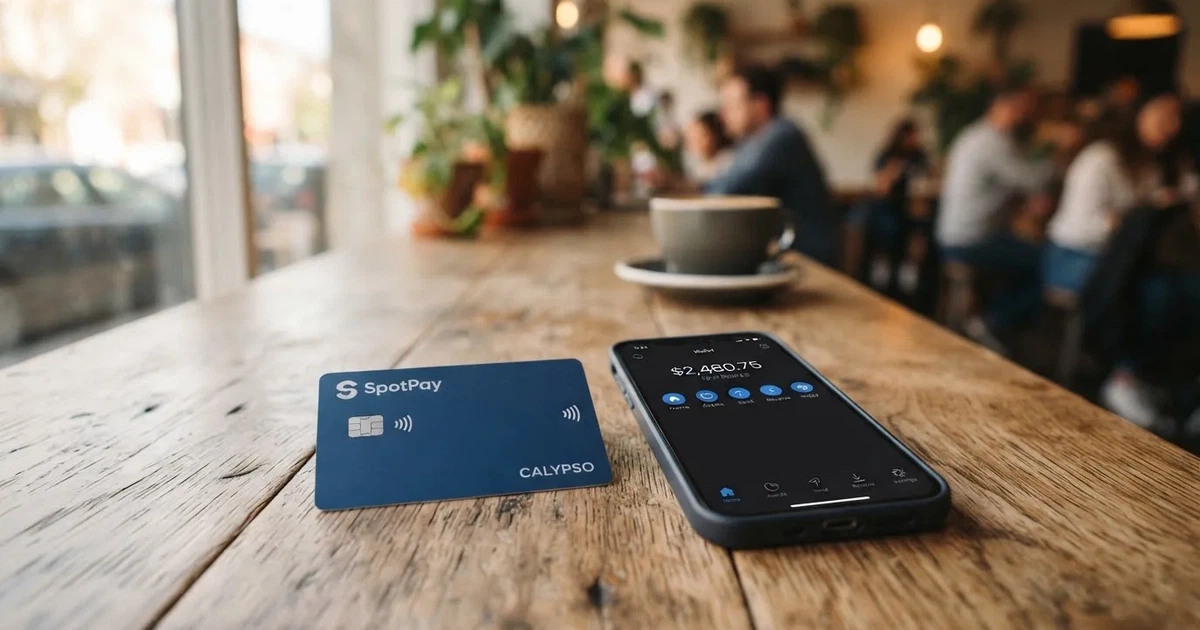
Then you start looking for the details that actually decide whether a card is usable: what it costs to open, what the monthly fee is, what happens when the card converts one currency into another, which coins and networks you can send to it, which countries it opens accounts in, and who stands behind the money. On the pages I could read, none of that is published. Not hidden behind a login — simply not stated. The company’s own site says the card spends “worldwide” and that transfers have “clear fees”, and then stops.
So this is a card I would watch rather than adopt. If you already hold it and it works for you, nothing here disturbs that. If you are considering it, the honest answer is that the product surface is genuinely good and the disclosure is not, and you should decide knowing that.
The conditions described here are current as of October 28, 2026.
Verdict
My score for the SpotPay Calypso card is 6.5 out of 10.
That number is not a complaint about the product. It is a complaint about what a reader can find out before committing money to it. The card’s everyday mechanics score well because they are clear and sensible; its cost and funding sections score badly because the published material does not cover them at all.
| Criterion | Mark | Why |
|---|---|---|
| Who can get it | 7 / 10 | The site says spend “worldwide” and publishes no exclusion list; earlier material describes 40+ countries with separate US and international programmes and sanctioned countries excluded, but that is unverified |
| Cost | 5 / 10 | Issuance and fee amounts are not disclosed; the site only mentions “clear fees” for transfers |
| Top-up options | 5 / 10 | The card spends from the SpotPay wallet balance, but no coins or networks are named |
| Reliability and complaints | 7 / 10 | SpotPay, Inc. is a registered MSB with FinCEN and says it is “not a bank”; the issuer is unnamed; no complaints found; App Store 4.2 across 41 ratings |
| Everyday use | 9 / 10 | Virtual and physical Visa, one ATM PIN shared between them, Apple Pay and Google Wallet |
The audience note that comes with these marks is simple: this is a card for app users who want a Visa, in both virtual and physical form. If that is you and the missing details turn out to be fine for you personally, the fit is good. If you are choosing on price, on country eligibility, or on how you will get money in and out, you are choosing blind.
Who they will give you the card
The short answer: on the evidence available, the company does not publish a country list, so there is no way to know from the public pages whether your country qualifies.
The site says you can spend “worldwide”, and there is no country list or set of exclusions on the pages I read. That is a strong claim with no detail attached to it. Earlier material — from a starting point I did not verify against the company’s own pages — describes 40 or more countries, with separate United States and international programmes and sanctioned countries closed. Treat that as background rather than as fact you can rely on.
What this means for you in practice: the countries people search about most, with and without the words “is SpotPay Calypso available in”, cannot be answered from what the company publishes. You are left with two possibilities — the programme is genuinely broad, or the real list lives behind the signup flow and is narrower. Both are common in this category. A site that says “worldwide” and lists nothing is not promising you eligibility; it is simply not telling you.
One structural detail does help you read the company for yourself, and it belongs here rather than later: SpotPay, Inc. describes itself as “a financial services platform, not a bank” and is registered as a Money Services Business with FinCEN in the United States. The card issuer is not named. That combination is normal for this kind of product, but it tells you the entity receiving your money is not a deposit-taking bank, so any balance you hold is not a bank deposit.
How to get it
The signup is described as a “guided setup” that takes minutes. That is the whole of what is published about applying.
Specifically not stated anywhere I looked: which documents you will need, whether proof of address is required, what age you must be, how many identity checks there are and what level you are placed at, and how long physical card delivery takes. If a physical card is the reason you are here, delivery time is not something I can tell you.
There is a general point worth having in your head, because it applies to every card in this category and comes up constantly in the questions people search for. Identity checks are not a formality to be talked around; they are a legal obligation on the company, and the answers are dictated by law and by the issuer’s own risk policy, not by how badly you want the card. In the EU, customer due diligence covers name, address, date of birth, nationality, identity documentation, a sanctions check, the purpose of the relationship, and whether you are politically exposed. In the US, the customer identification programme requires name, date of birth, address and an identification number. Nationality is checked separately from address, because sanctions screening is often applied to citizenship and country of birth. If due diligence cannot be completed, EU rules require the institution to decline the transaction or relationship, and to end the relationship where needed — which is why accounts get frozen pending documents. Prepaid and debit cards are generally for adults, 18 and over.
So the sensible posture is: expect to verify your identity, expect the checks to be repeated if circumstances change, and do not treat a closed or frozen account as a bad omen — it is frequently the system working.
Fees and what a payment really costs
This is the weakest part of the card’s public profile, and I want to be blunt about it: the SpotPay Calypso card does not publish its costs.

Not stated: the issuance cost. Not stated: any monthly fee. Not stated: the conversion fee or the foreign exchange fee. Not stated: the ATM fee or an ATM allowance. Not stated: daily limits or monthly limits. Not stated: any tier structure. The only thing the site says is that transfers have “clear fees”, which is a description of a quality rather than a number.
| Fee or limit | What the card states |
|---|---|
| Issuance | Not stated |
| Monthly fee | Not stated |
| Conversion fee | Not stated |
| Foreign exchange fee | Not stated |
| ATM fee and allowance | Not stated (ATM use implied; the two cards share one PIN) |
| Daily limit | Not stated |
| Monthly limit | Not stated |
| Card currency | Not stated |
| Tiers | Not stated |
To show you what that means concretely, here are three ordinary payments and where the missing numbers would have landed.
A coffee in your own city. This is the cheapest case. If the card’s balance is already in the currency the shop charges, the conversion fee should not be in play at all — you are just spending a loaded balance. But whether there is a fee for issuing the card in the first place, or a monthly fee that has to be paid regardless, is unknown, and if either exists it eats a small purchase. This is the payment where an unknown monthly fee hurts most, because the amounts involved are tiny.
A subscription in a currency your balance does not hold. Now the conversion question becomes the whole transaction. The card draws on a stored balance rather than asking your bank to pull funds from an account, which means the money has to be converted or already loaded in the right currency. Without a published conversion rate and fee, you cannot know what fraction of the payment is lost to the provider. Two numbers matter here and neither is given: what rate is applied, and what fee sits on top of it. This is the payment most likely to cost you something you did not anticipate.
A foreign trip, or an online merchant that treats the card as foreign. Foreign exchange fees are separately unstated, and there is a second, subtler cost that has nothing to do with fees at all. The card’s BIN — the 6 or 8 digit issuer identification number at the start of the card number — tells a merchant which institution and which country issued it. When that country differs from your billing address, some merchants apply extra scrutiny or decline outright. Address Verification Service, which compares the numeric parts of your billing address against issuer records, is mainly offered in the US, Canada and the UK and is generally unavailable for foreign-issued cards, which can itself cause declines. So the real cost of an abroad payment can be a failed authorisation and an attempt another day, not a percentage.
One more charge that is not a fee but behaves like one: a declined authorisation can leave a hold on funds that stays for several days, typically up to 7. If you do not know your limits, you cannot know how much of your balance could be frozen by one unlucky tap.
My judgement: this section alone is why the card cannot score above the middle. I would not put recurring subscriptions on a card whose conversion terms are unpublished.
How to top it up
The mechanism is clear. The card spends from the SpotPay wallet balance; you add funds to the wallet, and the wallet can receive payments. That is the shape of it.
The specifics are not published. Which coins you can send, which networks you can send them on, how to withdraw money back out, and the minimum or maximum per top-up are all unstated. The wallet profile wording says it supports local and international transfers and multi-currency, which tells you transfers exist and can cross currencies — it does not tell you what you can send.
Starting material describes the card as backed by stablecoin collateral from a self-custodied wallet. That is not confirmed on the pages I read, and the difference matters more than usual here, so it is worth setting out why.
Control of crypto belongs to whoever holds the private key or the seed phrase. With a custodial wallet, the provider holds the credentials and you must trust them completely. A seed phrase is typically 12 to 24 words and unencrypted; anyone who obtains it can restore the wallet and spend the funds. Transfers are typically irreversible, and a stolen key has no built-in recovery — the network cannot freeze or return anything. Custodial platforms have a real record of failure: Mt. Gox, about US$350 million reported stolen between 2011 and 2014; Coincheck, about US$400 million in 2018; Ronin Network, US$625 million in 2022. With a self-custody-linked card, your funds stay in your own wallet until the moment of payment, but you carry sole responsibility for key loss, phishing, and clipboard-hijacking malware that silently swaps a copied address.
Whichever model SpotPay uses, and it does not say, one thing is certain and it is outside the provider’s control: a deposit sent on a network the provider does not support, or to an address belonging to a different network, can be lost or need manual recovery with no guarantee. That is why the network list is the single most important thing for you to establish before sending anything, and why you should not guess it from a tutorial written by someone else.
If your money arrives by bank transfer or by card payment rather than on-chain, note that on-chain network fees for your deposit are charged by the blockchain, not by the card provider — you pay them even when the provider takes nothing.
Paying with it every day
This is where the card is strongest, and it is why it scores 9 out of 10 on everyday use.
You get a virtual card and a physical card. The App Store listing states that both share a single ATM PIN, and that a name can appear on the card — small things, but they are the details that separate a card designed to be used from a card that is technically present. It is a Visa, accepted “anywhere Visa is accepted”, which covers online and in stores. Apple Pay and Google Wallet are supported anywhere Visa is accepted.
The smartphone-wallet support is worth more than it sounds. When you add a card to Apple Pay, the card number is replaced by a device-specific Device Account Number held in the Secure Element, never on Apple’s servers, and each payment carries a one-time dynamic security code. The issuer can also restrict the tokenised number — blocking it on magnetic stripe, phone or website use — which is a control you do not have on a physical card but which exists here.
What you do not know about daily use: the blocked merchant categories, whether there are cash withdrawals in practice, and how disputes work if a payment goes wrong. Not stated, all three. Merchant category codes are the mechanism that matters here — a four-digit number classifying a business under ISO 18245, assigned when a business starts accepting cards. MCC 7995 covers gambling, and many issuers block it by policy rather than by law, with the blocked list varying by issuer. So whether you can spend on travel, on gift cards, on crypto-adjacent merchants, or at a betting site depends on a list the card has not published.
On the app itself: iPhone through the App Store and Android through Google Play. The iOS listing is “SpotPay: Global Wallet”, 4.2 out of 5 from 41 ratings, age 4 and up, developer SpotPay, Inc., version 1.4.12. I did not read the Google Play rating. A 4.2 across 41 ratings is decent but thin — it is a small sample, and a young product, not a track record.
What can go wrong
I found no complaints, and I want to be honest about what that does and does not mean.
The official record shows no published incidents. Two searches on 2026-10-21 turned up no user reports and no news coverage; the few App Store reviews that exist read positive. No Trustpilot or Reddit pages were found. For a company founded in 2025, that is exactly what a clean-but-young profile looks like — absence of complaints from very few customers is not evidence of a good track record.
The risks I can actually point at are structural.
Programme closure. A Visa programme can end. Visa and Mastercard do not issue crypto cards to consumers themselves; they license issuers, and they can suspend a programme. The FTX card is the precedent everyone knows: Visa said in November 2022 that it had terminated its global agreements with FTX, and the US debit card programme was wound down by its issuer. WaveCrest, a Visa issuer that supplied crypto card brands, was suspended by Visa in Europe in 2018, closing all its Visa programmes. Closures tend to follow a shape: a notice period, then loading and spending stop, then you are asked to withdraw remaining balances. A 2026 closure reported by a secondary source had new loads ending 8 July 2026 and spending stopping 8 August 2026 — single source, unconfirmed, but it shows the timetable is measured in weeks. If the issuer here is not named and the funds are not a bank deposit, plan for the possibility that this card’s existence is shorter than you assume.
“Not a bank” means the balance is not a deposit. SpotPay, Inc. says outright that it is not a bank. In the EU, e-money institutions must safeguard customer funds by segregating them in dedicated accounts or insuring them — but those funds are not the same as bank deposits and may not sit under a deposit guarantee scheme. A crypto card often depends on two licences: the card itself is a payment service under e-money or payment-services law, while MiCA covers the crypto side of custody, exchange and transfer. If one of the two is thin, the balance you are spending is thinner than it looks.
Regulatory ground is still moving. MiCA, Regulation (EU) 2023/1114, took legal effect in June 2023; its rules on stablecoins applied from 30 June 2024 and the remaining provisions, including crypto-asset service provider rules, from 30 December 2024. E-money tokens may be issued only by a credit institution or an electronic money institution. Transitional arrangements for providers already operating under national law run until 1 July 2026, or until a MiCA authorisation is granted or refused. A company operating under a grandfathered arrangement has, by definition, a deadline.
Stablecoins are not stable. That is not a slogan, it is a property. TerraUSD collapsed in May 2022; USDC temporarily lost its peg in March 2023 during the US banking crisis. If your balance holds a stablecoin, its value at the moment of payment is not the value you saw when you loaded it.
No stated dispute process. If a chargeback is your remedy, that is a refund ordered by the card issuer with reason codes such as fraud, duplicate billing or goods not received — and the route to it runs through the issuer. Prepaid-card coverage varies and should not be assumed. US debit reversal rights come from Regulation E and credit card rights from Regulation Z. The card does not state how disputes work here.
And one more that is easy to forget. Tether says it disables tokens in wallets on the OFAC sanctions list and has frozen funds tied to illicit activity. Stablecoins are not censorship-proof. Anyone who tells you an on-chain balance is beyond reach of anyone is describing a technical property, not a practical guarantee.
On the positive side, the site does cite industry-standard fund protection, secure authentication that locks the account to the owner, and real-time monitoring for unauthorised activity. Whether the arrangement is custodial or self-custody is not stated — this is the single most consequential unanswered question about this card, as discussed in “How to top it up”.
What to take instead
None of these is a recommendation, and all of them have the same fundamental uncertainty as the SpotPay Calypso card: they are young, and their published information is thin. I am comparing them because that is what a reader choosing a card has to do.
| SpotPay Calypso | Whop Cards | Stella | UniFi Card | |
|---|---|---|---|---|
| My score | 6.5 / 10 | 5.2 / 10 | 6.5 / 10 | 4.7 / 10 |
| Card | Virtual and physical Visa | Visa; virtual/physical not stated | Virtual and physical VISA | Prepaid Debit Visa, issued by Lead Bank |
| Where it is offered | “Worldwide”; no list published | 31 US states for consumers, 41 for businesses | Not stated; terms bar users under sanctions programmes and route US and European users through affiliates | Not confirmed from official pages |
| Upfront or monthly fees | Not stated | “No extra fees”; no amounts listed | Not stated | Not stated; “Fees may apply” |
| How it is funded | Spends from the SpotPay wallet balance | Spends from a Whop balance | Deposit crypto into the account, which tops up the card | ACH, wire, SEPA, SPEI; paid out to a USDC wallet |
| Perks | Not stated | 5% cashback at select merchants, currently Uber | No cashback stated on the card | “3% rewards on balances” claimed in the listing |
A few of the differences are worth pulling out.
Eligibility is published here. Whop’s supported geography is the most specific of the four: consumers in 31 US states — Alabama, Alaska, Arkansas, California, Colorado, Connecticut, Florida, Hawaii, Illinois, Indiana, Iowa, Kansas, Kentucky, Maine, Massachusetts, Michigan, Minnesota, Montana, Nebraska, New Hampshire, New Jersey, New York, North Carolina, Oklahoma, Pennsylvania, South Carolina, Texas, Utah, Virginia, West Virginia and Wyoming — and businesses in 41 states. Consumer countries that are not supported include Belarus, China (Mainland), Cuba, Hong Kong, India, Iran, Iraq, Israel, Myanmar, Nepal, Nicaragua, North Korea, Russia, Syria, Turkey, Ukraine, Venezuela and Vietnam; Russia and Belarus are also unsupported for corporate customers. Whether the test is citizenship or residence is not stated. That list has a downside for anyone outside the US, but it has an upside too: you can check it and know.
On cost, Whop says something. “No extra fees” with no amounts listed is still a statement, and it is more than the SpotPay page makes. Whop’s balance structure is unusual and worth understanding: a pending balance becomes usable as soon as a payment arrives, while standard withdrawals use settled funds. Its cashback is 5% at select merchants, currently Uber, with more planned; the payout currency and conditions are not stated.
Stella is the closest match on product shape. Virtual and physical VISA, working at what it calls “over 40 million VISA merchants globally”, funded by depositing crypto into the account, which automatically tops up the card. That in-app wallet is custodial — the provider holds the keys, which is the trade-off discussed earlier. Fees are “described under this User Agreement and/or on the App”, which is not the same as published, and the card page states no cashback; its Earn product is a separate yield product. Its terms bar users under economic sanctions programmes and route US and European users through affiliates.
UniFi is the most conventional and the least confirmed. A prepaid Visa issued by Lead Bank, with card currency USD and Apple Pay support. It reaches a useful set of corridors — ACH, wire, SEPA with IBAN, SPEI with CLABE — and can be paid out to a USDC wallet. But eligibility is not confirmed from official pages; the app listing mentions send-money routes to the Philippines in PHP, Mexico in MXN, the eurozone in EUR, and recent release notes referencing Colombia, Brazil via PIX and the UK in GBP. Fees are “may apply”. The listing claims “3% rewards on balances”, which is not the same as card cashback.
Two general points about all of them. First, spending works through a balance rather than a linked bank account: crypto is converted and loaded as fiat balance, so the card cannot overdraw. Second, none of these brands is the issuer. A card payment involves the network routing messages and setting rules, the issuer — a bank or licensed e-money institution — holding the programme, and the crypto brand often being only a programme manager or front-end. When something goes wrong, you are dealing with an issuer whose name none of these pages gives you.
Who I would recommend it to
To someone who already has the card open and has confirmed, for themselves, the network they can send on and what the conversion costs. The everyday mechanics are good, the app rating is respectable, and the complaint record is clean.
To an app user who specifically wants a Visa in both virtual and physical form, understands that the balance is held by a non-bank, and is comfortable being an early customer of a company founded in 2025.
I would not recommend it to anyone making this decision on price, because the price is not published. I would not recommend it as your only card, because a programme can be wound down in weeks and the issuer is not named. And I would not recommend it to someone planning a currency-heavy or travel-heavy spend, or who needs to rely on chargebacks, until the conversion terms and the dispute process exist in writing.
If you are in the position of needing a card precisely because ordinary banking is difficult, the honest advice is to check what your own jurisdiction requires before anything else — because the answer changes what you should be looking at.
Frequently asked questions
What is the SpotPay Calypso card?
It is a Visa payment card issued by a crypto platform rather than a bank. You fund a SpotPay wallet balance, and the card spends that balance like a prepaid card. You get a virtual card and a physical card, both sharing a single ATM PIN. The company describes itself as a financial services platform, not a bank, and is registered as a Money Services Business with FinCEN. The card issuer is not named on the public pages I read.
Is SpotPay Calypso a bank?
No. SpotPay, Inc. says so itself — it is “a financial services platform, not a bank”, registered as an MSB with FinCEN. That means your balance is not a bank deposit, and you should not assume any deposit guarantee scheme covers it. It also means the card sits behind another company, the actual issuer, which the public pages do not name.
Does SpotPay Calypso require KYC?
Identity verification is required by law for regulated providers, so assume yes, but the card does not publish which documents, whether proof of address is required, or what level you will be placed at. In the EU, due diligence covers identity, address, date of birth, nationality, sanctions screening and PEP status; in the US it requires name, date of birth, address and an identification number.
Is the SpotPay Calypso card free?
Nobody can tell you, because the costs are not published. Issuance, any monthly fee, conversion, foreign exchange and ATM fees are all unstated. The site says transfers have “clear fees” without giving amounts. If a monthly fee exists, it would matter most on small everyday payments.
Which countries is SpotPay Calypso available in?
The site says you can spend “worldwide” and publishes no country list or exclusions. Earlier unverified material describes 40+ countries with separate US and international programmes and sanctioned countries excluded. Treat that as background, not as something you can check yourself.
How do I top up the SpotPay Calypso card?
You add funds to the SpotPay wallet and the card spends that balance; the wallet can also receive payments. Coins, networks, minimums and maximums are not stated, which is the practical problem. A transfer sent on a network the provider does not support can be lost or need manual recovery with no guarantee.
Can I add the SpotPay Calypso card to Apple Pay or Google Wallet?
Yes. Both are supported anywhere Visa is accepted, and having a physical card does not stop you using the tokenised version instead. The device account number is stored in the phone’s Secure Element, never on Apple’s servers, and each payment uses a one-time dynamic security code. The issuer can also restrict the tokenised card to specific channels.
Is SpotPay Calypso safe to use?
Safe depends on what you are protecting. The site cites industry-standard fund protection, owner-locked authentication and real-time monitoring for unauthorised activity, but does not say whether custody is custodial or self-custody — the question that decides who bears the risk. It is also a young company: founded 2025, issuer unnamed, and no complaints found in two searches, which for so few customers proves little.
What happens if the SpotPay Calypso programme is closed?
Card programmes do close, and quickly. Visa terminated its global agreements with FTX in November 2022 and the US debit card was wound down; WaveCrest’s Visa programmes were closed in 2018. Closures run on a timetable of notice, then loading and spending stop, then withdrawal of remaining balances — a 2026 case reported by one secondary source had loads ending 8 July and spending 8 August.
Is the SpotPay Calypso card worth it?
It depends on whether you have verified the missing details yourself. The everyday experience is genuinely good — virtual and physical Visa, a shared PIN, Apple Pay and Google Wallet, 4.2 out of 5 on the App Store across 41 ratings. But no costs are published, no coins or networks are named, and the issuer is unnamed. If you have confirmed those and they suit you, yes. If you are choosing on price, I would not.
App and neobank card options – cryptocardoptions.com
Content created by the «cryptocardoptions.com» team