
A US-only virtual card that spends a stablecoin balance — and tells you very little about its fees
 Available in US
The Phantom Cash card is a virtual, prepaid Visa that spends the balance of your Phantom Cash account — a balance held in the CASH stablecoin. It is a genuinely narrow product: US residents only, the state of New York excluded, no physical card, no cash withdrawals, and a fee schedule the public pages describe only as “fees may apply.” I scored it 5.3 out of 10. That is not a verdict on Phantom the wallet, which is a well-known self-custody app; it is a verdict on this particular card.
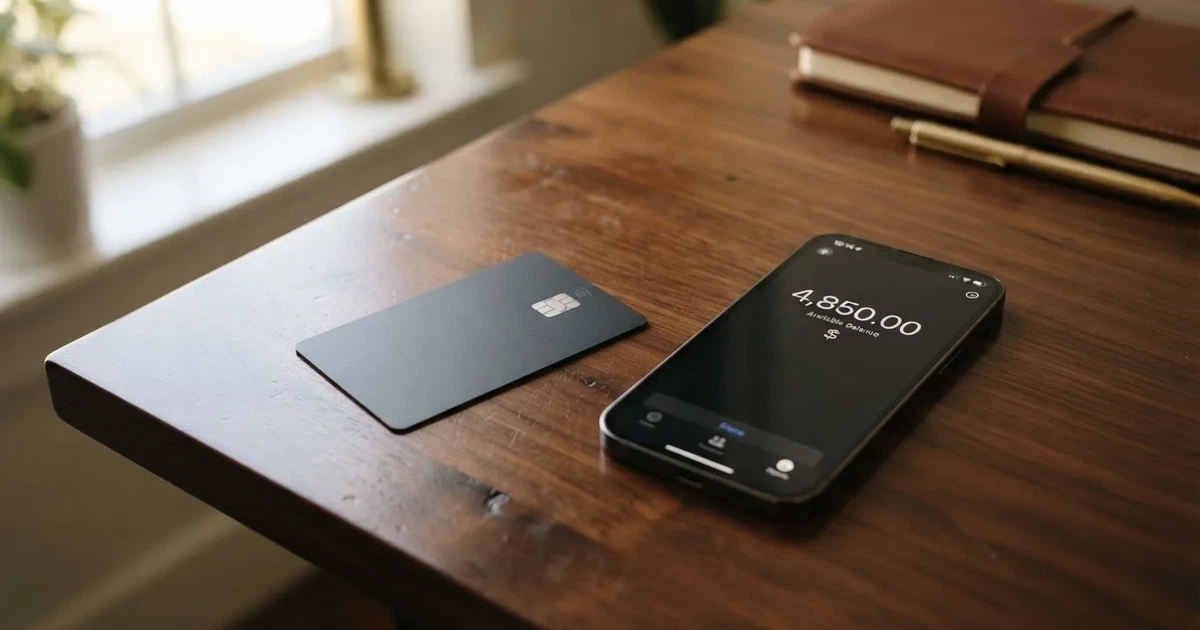
The card conditions are current as of October 28, 2026.
Who this suits, in one line: someone in the United States who already holds dollar stablecoins in Phantom, spends online or in stores through a phone wallet, and does not need cash or a plastic card. Who it does not suit: almost everyone else. There is no version of this product for a reader in the UK, the EU, Latin America or Asia, and the card’s own pages do not publish its fees.
Verdict: 5.3 out of 10, and the reason is narrowness rather than danger
Nothing I found here reads as a red flag in the sense of an obvious scam. The people involved are real regulated names — Lead Bank issues the card under Visa’s licence, Bridge Ventures LLC is the programme manager, Stripe processes transactions. The problem is not safety; the problem is that the product is thin, restricted to one country, and opaque about money.
| Criterion | Mark | Why |
|---|---|---|
| Who can get it | 4 / 10 | United States only, excluding New York, by place of residence |
| Cost | 7 / 10 | Fees officially not disclosed; unofficially issuance, replacement and inactivity are free, top-ups free, international transactions 1% + $0.30 |
| Top-up options | 4 / 10 | The card spends a CASH balance; you top up with Apple Pay, Google Pay, a debit card or a bank, or withdraw to a bank or Solana wallet; direct crypto top-up is not named |
| Reliability and complaints | 6 / 10 | Issuer Lead Bank, programme manager Bridge Ventures LLC, Stripe; the virtual card is being replaced as the issuer changes, no dates given; no complaints found |
| Everyday use | 5 / 10 | Virtual Visa, Apple Wallet and Google Wallet only; unofficially no ATMs |
| Total | 5.3 / 10 | A narrow, quiet product with an undisclosed fee schedule |
Two things shaped that total more than the others. First, the audience note that runs through the product: US residents who hold dollar stablecoins in Phantom. That is a real but small group. Second, and more awkwardly, the cost. The card’s own cost material says only “fees may apply” and points to a Cardholder Agreement. Everything specific I could find — no issuance fee, free replacement, no inactivity fee, free cash loads, free US purchases, 1% + $0.30 on international transactions — comes from a third-party card-details page, not from Phantom. I have kept those figures out of the tables below except where I label them unofficially, because a number that nobody at the card has confirmed is not something I want you budgeting against.
Will they give you the card?
United States only, and not in New York. The restriction is by residence — where you live, not what passport you hold. That is the whole eligibility statement, and it is short.
If you are reading this outside the United States, you can stop here: there is no application to make, no waiting list, and no workaround. The exclusion of New York is not unusual in itself — US card issuers routinely carve out individual states, often for licensing reasons — but combined with a country restriction it means the eligible population is a subset of a subset.
One more detail worth knowing before you apply: opening a Phantom wallet itself does not require identity verification. The verification step belongs to the money side — bank transfers, direct deposit and the debit card. So you can hold assets in Phantom without showing documents, but the Cash card sits behind verification handled through Link for the virtual card, which the marketing page describes as handled by Stripe for bank transfers, direct deposit and debit card. Applicants must be 18 or older. Whether proof of address is requested is not stated. The verification levels, how long they take and the reasons a check could be refused are all not stated either — which means if you are in a hurry, or you have a complicated address history, you are being asked to apply without knowing the rules in advance.
How to get it
The route the card describes is short and runs entirely inside the Phantom app:
- Fund your Cash balance
- Complete identity verification
- Get the virtual card
- Add it to Apple Wallet or Google Wallet
That is the whole sequence. It is a virtual prepaid Visa debit card and it works wherever Visa is accepted. No physical card is stated to exist, and delivery details are not stated because there is nothing to deliver. The currency is not stated either — the balance is denominated in CASH, so US dollars are implied but nowhere written down.
You should know what kind of card this is before you apply, because the label matters. A prepaid card draws on a stored balance; a standard debit card asks your bank to withdraw from a linked account at the moment of purchase. This one behaves like the first kind. You convert or top up a balance, and the card spends only that balance — which means it cannot overdraw, and equally, it cannot spend money you have not already put there.
Fees: what it really costs, and what nobody has published
The official position is a single sentence: fees may apply, with the amounts not stated and a pointer to the Cardholder Agreement. The fee schedule, the ATM policy and the spending limits are all not stated on the pages I read. Stablecoin trades inside the product are described as fee-free.

Here is what that leaves. The rows marked unofficial come from a third-party card-details page dated September 2026, part of which the site itself flags as carried forward from an older dataset — treat them as a useful orientation, not as terms.
| Fee or limit | Value | Status |
|---|---|---|
| Issuance | No card issuance fee | Unofficial |
| Replacement | No replacement fee | Unofficial |
| Inactivity | No inactivity fee | Unofficial |
| Cash loads | Free | Unofficial |
| US purchases | Free | Unofficial |
| International transaction | 1% + $0.30 | Unofficial |
| ATM withdrawals | No | Unofficial |
| ATM fee | Not disclosed | Unofficial |
| Daily spending limit | $2,000 by default, up to $5,000 on request | Unofficial |
| Monthly limit | Not disclosed | Unofficial |
There are no tiers — it is a single card and a single Cash account, and no tier structure is mentioned anywhere.
Now let me walk you through three ordinary payments and tell you which of those lines, if any, touches each one. This is where the table above either reassures you or does not.
Buying a coffee in the United States. If the unofficial figures hold, this costs you nothing beyond what you spent. There is no conversion in the way — the balance is already in dollars via CASH — and US purchases are listed as free. This is the card’s best case and its main reason to exist.
Paying for something online from a US merchant in dollars. The same picture. The one caveat belongs to the general category rather than to this card: some shops decline prepaid or foreign-issued card numbers, because a merchant can look up the issuing institution from the first six or eight digits of the card number and apply extra scrutiny when the issuer country differs from the billing address. That is why a card issued in one country can look foreign to a shop in another. It is also why some merchants check the billing address you type against the issuer’s records — a check that is mostly offered in the US, Canada and the UK and is generally unavailable for foreign-issued cards, which can cause declines.
Paying abroad, or paying a merchant that prices in another currency. This is where the 1% + $0.30 international transaction figure bites, if it is even the right number for your case. The card’s pages do not confirm it. On top of that, if you hold a stablecoin and convert it as part of the spend, you should assume the stablecoin can move against the dollar before you transact — stablecoins aim to hold a steady value but, as the BIS put it plainly, are not necessarily stable.
Top up: how the balance actually gets there
The card spends the Cash account balance, held in CASH. That balance is funded by Apple Pay, Google Pay, a debit card or a bank account, depending on your region. Fees and minimums for those top-ups are not stated. Stablecoin trades are described as fee-free.
You can also withdraw the balance out again: to a bank account in the United States, or to a Solana wallet. The fees and timing for withdrawals are not stated on the pages I read, and neither is what happens to a remaining balance if you close the account. That last one is worth thinking about, because a programme that ends is a real thing in this category.
Here is the practical picture. If you are already holding dollar stablecoins in Phantom, your instinct will be to send them straight to the card. The pages do not describe a direct crypto top-up path for the card balance. What is described is a fiat-style rail: Apple Pay, Google Pay, a debit card or a bank account. In other words, the everyday flow looks more like a prepaid card than like a self-custody card. If direct stablecoin funding matters to you, this is the single biggest gap, and you should confirm it in the app before you commit.
Paying with it every day
You add the card to Apple Wallet or Google Wallet. Restricted merchant categories are not stated, so in principle nothing is ruled out on paper — but that also means you cannot know in advance. The card lives in the Phantom mobile app. Platforms and store ratings are not stated on these pages I read.
A few everyday realities of this category, none of them specific to Phantom but all of them things you will meet:
- When you add a card to Apple Pay, the card number is replaced by a device-specific number stored in the phone’s secure hardware, never on Apple’s servers, and each payment carries a one-time dynamic code. That is a genuine security improvement over handing over a card number.
- The issuer can still restrict a tokenised number — for example block it on magnetic-stripe, phone or website use.
- Online payments may trigger a 3-D Secure check, where the issuer decides frictionlessly or challenges you with a one-time code or a biometric prompt. Under 3-D Secure, liability for a fraudulent online payment can shift away from the merchant — to your bank, or, critics argue, to you.
- A declined authorisation can leave a hold on your funds that stays for several days, typically up to seven.
- Gambling is classified under a four-digit merchant category code, MCC 7995. Many issuers block it on specific cards by policy rather than by law, and the blocked list varies by issuer.
There is no cashback stated for the card. Holding CASH is described as earning passive income without lock-ups, but no rate is given, so I would not build anything on that.
One genuine comfort on the money side: Stripe handles card disputes for debit card transactions. The process and the time frames are not stated, and I am not going to guess at them. What is worth knowing is that US debit card reversal rights come from Regulation E, prepaid-card coverage varies and should not be assumed, so the fact that a dispute handler is named is not the same as a strong claim.
What can go wrong
Three risks, in descending order of how likely they are to affect you.
The issuer is changing. Phantom’s own help centre carries an incident notice: your virtual Phantom debit card is being replaced as Phantom moves to a new card issuer, and you must re-add the replacement to Apple Wallet or Google Wallet. No dates are given. Until that happens, the setup is Lead Bank as issuer, Bridge Ventures LLC as programme manager and Stripe processing transactions and disputes — all of which are described as changing with the new issuer. This is a live, unresolved question about the card you are being asked to trust, and it is the reason I did not put reliability higher.
Your funds sit with several parties at once. The balance is secured on-chain as CASH. Phantom says it does not store KYC information — verification is handled by Stripe — and states plainly that it is “not a bank”. Lead Bank issues the card under Visa’s licence. That layering is normal for this category and it is also why you should understand who actually holds what: the card network routes messages and sets rules, the issuer holds the card programme, and the crypto brand is often only a programme manager or front end. Visa and Mastercard do not issue crypto cards to consumers themselves; they license issuers and can suspend a programme. In November 2022 Visa said it had terminated its global agreements with FTX, and the FTX US debit card programme was wound down by its issuer. More recently, WaveCrest, a Visa issuer that supplied crypto card brands, was suspended by Visa in Europe in 2018, closing all WaveCrest-issued Visa programmes. Programme closures follow a pattern: a notice period, then spending and loading stop, then users are asked to withdraw remaining balances. One 2026 closure reported by a secondary source ended new loads on 8 July 2026 and spending on 8 August 2026 — a single unconfirmed source, but the shape of it is what to expect.
Stablecoins are not what they sound like. They aim to hold a steady value against a currency like the dollar, but they can and do move. TerraUSD collapsed in May 2022; USDC temporarily lost its peg in March 2023 during the US banking crisis. Transfers are typically irreversible, and blockchain transfers have no built-in recovery — a deposit sent on a network the provider does not support, or to an address belonging to another network, can be lost or need manual support recovery with no guarantee. And stablecoins are not censorship-proof: Tether says it disables tokens in wallets on the OFAC sanctions list and has frozen funds tied to illicit activity.
What I did not find, and want to say plainly rather than leave you guessing: no complaints specific to Phantom Cash surfaced in the searches I ran, on Trustpilot or Reddit, and no user reports. That is weak evidence of a good record — absence of complaints often means absence of users. I also could not find any stated card freeze, two-factor authentication or insurance arrangement, so do not assume them. Support runs through a Phantom Help Centre with a “Start a chat” option; languages and hours are not stated.
One more thing that belongs on this page rather than in a footnote. If you are in the US, FinCEN guidance treats administrators and exchangers of convertible virtual currency as money transmitters, while people simply buying goods or services with their own crypto are not. And on tax, I am not giving you advice — only the mechanism: the IRS treats digital assets as property, so exchanging them for goods, services or dollars generally produces a taxable gain or loss, measured in dollars at fair market value on the date of the transaction. Each card payment funded from crypto may therefore be a separate disposal. Talk to someone qualified about your own situation.
What to take instead
If Phantom Cash’s US-only restriction or its undisclosed fees rule it out for you, the market has other crypto cards with published numbers. Here is how the alternatives compare on what they actually disclose.
| Card | Score | Who | Card type | Stated fees |
|---|---|---|---|---|
| Phantom Cash | 5.3 / 10 | US only, excluding New York | Virtual prepaid Visa | Not disclosed officially |
| BloFin Wallet Card | 6.9 / 10 | Country list not published on the card page; starting data lists 35 countries incl. US, Australia, Japan, UAE, Brazil, Mexico, Malaysia, New Zealand | Visa Platinum; virtual/physical not stated | Activation, annual, issuance, dormancy $0.00 each; cancellation free |
| Decaf | 6.2 / 10 | Not issued in a list of restricted countries (Belarus, China, North Korea, India, Iran, Iraq, Israel, Myanmar, Nepal, Russia, Syria, Turkey, Cuba, Ukraine, Venezuela, Vietnam, Nicaragua, Puerto Rico, Nigeria) and restricted US states incl. Arizona, Delaware, Georgia, Idaho, Louisiana, Maryland, Montana, Ohio, Oregon, Rhode Island, Washington, Wisconsin | Visa, virtual or physical (tracked delivery) | Activation: virtual $5 worldwide, physical $10 US only or $90 rest of world; no annual or monthly fee |
| SafePal | 6.2 / 10 | “Citizens of supported regions who live in supported areas”; the region list was empty when fetched | Virtual Mastercard debit; limits given in EUR | No account creation or management fees; issuance not stated |
Two of these deserve a closer look.
BloFin scores highest of the four and is the one with the most transparent fee schedule: no activation, annual, issuance or dormancy fees, and no cancellation fee. The trade-off is a spend fee of “1% or lower” that scales with a VIP tier — VIP 0 at 1.00% down to VIP 5 at 0.00% — charged at the moment of payment, with the FX fee not stated. So you pay per transaction instead of per month, which suits high-spend, low-transaction-count users. There is no cashback; the reduced spend rate is the reward. You top up with USDT and USDC on Arbitrum and Base, which is the direct crypto funding route Phantom’s pages do not describe. Its country list is the weak point — the app asks you to “select your country or region” and the page itself publishes no list, and whether the test is citizenship or residence is not stated.
Decaf is the one with real published numbers on getting hold of the card: $5 worldwide for the virtual version, $10 for the physical card in the US, or $90 elsewhere, with no annual or monthly fee. It is also the most transparent on currency conversion, stating that it adds no FX fee of its own — the rate is the one Visa offers — though its crypto conversion fee is not stated. Its country list is long and specific, and it is the only one of the four that names restricted US states. Whether it applies by citizenship or by residence is not stated, and Russia and Belarus both appear on its restricted list. You pay in by card, bank transfer or USDC; the app runs on Solana and Stellar, and which coins and networks top up the card itself is not stated.
SafePal is interesting for a different reason: its top-up fee is 0%, but its Mastercard non-USD settlement carries a 1% FX fee, refund processing costs 1 USD/EUR/CHF/7 CNH, and swaps include a spread that is not quantified. Elsewhere its own pages advertise crypto top-up “as low as 0.4%” on the top tier. It tops up from 40+ blockchains converted to USDC or fiat, on Arbitrum. There is no cashback; the reward is referral commissions of up to 40% of referred top-up fees plus tier privileges tied to deposits, referrals and staking. Its eligibility wording — “citizens of supported regions who live in supported areas” — is the vaguest of the four, and the regions page came back empty.
Who I would recommend it to
I would recommend the Phantom Cash card to a specific person, and if you are not that person, I would tell you to skip it.
That person lives in the United States, outside New York, already uses Phantom, and holds dollar stablecoins there. They shop online and in stores, pay by phone, never need a cash withdrawal, and would rather not think about a monthly fee. They are comfortable that the card is being moved to a new issuer and plan to re-add it to their wallet when that happens. They have read that the fee schedule is not public and have made peace with checking the Cardholder Agreement themselves.
For anyone else — anyone outside the US, anyone in New York, anyone who needs a physical card, anyone who needs an ATM, anyone who wants to load the card straight from crypto on a chain of their choosing, and above all anyone who wants published fees — one of the three alternatives above will serve you better, and all three publish more than Phantom does.
And if what you actually need is not a crypto card at all but an ordinary bank card in your own country, that is worth checking first. This card is for a narrow slice of one market; the honest answer for most readers is that the problem it solves is not theirs to solve with crypto.
Frequently asked questions
What is the Phantom Cash card?
It is a virtual, prepaid Visa debit card that spends the balance of your Phantom Cash account, and that balance is held in the CASH stablecoin. It works wherever Visa is accepted. There is no physical card stated to exist — it is designed to be added to Apple Wallet or Google Wallet and used from your phone. It is not a bank account and Phantom describes itself as “not a bank”.
How does the Phantom Cash card work?
You fund your Cash balance, verify your identity, receive the virtual card, and add it to your phone’s wallet. The card then draws on that stored balance rather than on a linked bank account, which means it can only spend money you have already put in. Lead Bank issues the card under Visa’s licence, Bridge Ventures LLC manages the programme, and Stripe processes transactions.
Who can get the Phantom Cash card?
United States residents only, and not residents of New York. The test is where you live, not which passport you hold. Applicants must be 18 or older. Opening a Phantom wallet itself does not require identity verification, but the Cash card does, which is why the country restriction matters in practice as well as on paper.
Does the Phantom Cash card require KYC?
Yes, for the card and the money side. Identity verification through Link is required for the virtual card, with the marketing page describing verification as handled by Stripe for bank transfers, direct deposit and debit card. Phantom says it does not store KYC information itself. Whether proof of address is requested, what the verification levels are and how long they take are all not stated on the public pages.
How much does the Phantom Cash card cost?
Officially, the answer is “fees may apply”, with amounts pointed to in the Cardholder Agreement and not published on the pages I read. Third-party, unconfirmed figures list no issuance, replacement or inactivity fee, free cash loads, free US purchases, and 1% + $0.30 on international transactions. I would not budget against those numbers — read the agreement.
How do I top up the Phantom Cash card?
Through the Cash account balance, which is funded by Apple Pay, Google Pay, a debit card or a bank account depending on your region. Fees and minimums for those top-ups are not stated, though stablecoin trades are described as fee-free. The public pages do not describe a direct crypto top-up for the card balance itself, which is the gap to check in the app first.
Can I withdraw money from Phantom Cash?
Yes, to a bank account in the United States or to a Solana wallet. The fees and the timing are not stated on the pages I read, and neither is what happens to a leftover balance if you close the account. There are unofficially no ATM withdrawals at all, so this is a digital route only.
Is the Phantom Cash card safe?
The parties involved are established regulated names, which is reassuring, but you are trusting a chain of them: Lead Bank as issuer, Bridge Ventures LLC as programme manager, Stripe processing and handling disputes, all of which are changing as Phantom moves to a new card issuer. No card freeze, two-factor authentication or insurance arrangement is stated. Phantom’s help centre carries a notice about the issuer change, with no dates.
Is the Phantom Cash card available in my country?
If you are in the United States outside New York, yes. Everywhere else, no. The card is US-only by residence, with no waiting list and no application route for other countries. If you are outside the US and want a crypto card, look at BloFin, Decaf or SafePal instead, each of which publishes more about eligibility and fees.
How do I delete or close my Phantom Cash account?
The public pages do not describe account deletion or what happens to a remaining balance on closure, and I found nothing reliable to fill that gap. Before you close anything, withdraw your balance to a bank account or Solana wallet first and get confirmation that it arrived — closures in this category typically mean spending and loading stop, then users are asked to withdraw what is left.
Wallet card options – cryptocardoptions.com
Content created by the «cryptocardoptions.com» team