
HostFi card review: what the public pages actually say — and what they don't
 Available in US
HostFi is one of those names that turns up when you search for a crypto-funded payment card and you quickly notice how little the company has put in writing. The website talks about cards in general terms, the App Store listing is for Nigeria, and the terms of service are governed by Nigerian law. That makes HostFi a real product, but a particularly hard one to evaluate, because the official pages don’t disclose the things a card user usually needs to know before signing up: the fees, the supported coins, the issuing bank, or the licences the operator holds.

I went through every official page HostFi publishes, the App Store listing, the help centre entries and the small print of the terms, and looked for outside coverage. The score below reflects what I could verify, and it leans heavily on what is missing rather than what is wrong. I also tested it against three alternatives — Cardex, TakeCard and OkiCard — so you have somewhere to go if HostFi doesn’t fit.
Conditions are current as of October 28, 2026.
Verdict
HostFi earns 4.3 out of 10 from me. That is not a “bad product” score so much as a “not enough to evaluate” score. The brand is registered, the app exists on the App Store in Nigeria, the cards are virtual-only and the user can pick between Visa and Mastercard, but the official pages do not publish the fees, the supported coins, the licence of the operator or the issuing bank. For a card that asks you to load it with money, those are the basics you need before you commit.
The card is well suited to a narrow reader: someone in Nigeria who wants a virtual Visa or Mastercard to spend from a balance held in the HostFi app, who is comfortable with a Naira-denominated card, and who does not need a physical card or a wide set of supported coins. It is poorly suited to almost everyone else. If you live outside Nigeria, you do not yet know whether HostFi will issue you a card. If you want a physical card, an ATM card, a published fee schedule or a card with a clear regulatory home, this is not the place to look.
| Criterion | Mark | Why |
|---|---|---|
| Who can get it | 4 / 10 | Country availability is not disclosed; the App Store listing is Nigeria, terms are governed by Nigerian law |
| Cost | 5 / 10 | Issuance, monthly, conversion, FX and ATM fees are all unstated on the official pages |
| Top-up options | 4 / 10 | The App Store says “fiat or digital assets”, but does not name the coins or the networks |
| Reliability and complaints | 5 / 10 | HostFi Services Ltd is named, but licences and the issuing bank are not; no public complaints; the App Store rating in Nigeria is 4.3 out of 5 across 89 ratings |
| Everyday use | 3 / 10 | Virtual cards only, on Visa or Mastercard, with no wallet or ATM information published and a rewards section still marked “Coming soon” |
Who they will give the card to
HostFi’s own pages are unusually quiet on this. The website says only that “Some products are available only in selected countries”, and the App Store listing for HostFi is the Nigerian storefront. The terms of service that govern the relationship are stated to be Nigerian law. Naira-denominated virtual cards are the concrete example mentioned in the App Store release notes, and a search for the app on the US or UK App Store does not surface it.
In practice, the picture I can draw is this: HostFi’s card product as described today is positioned for users in Nigeria. If you are a Nigerian resident signing up from a Nigerian phone and a Nigerian Apple ID, the path is the one the App Store describes. If you are somewhere else, the site gives you nothing to go on — no country list, no exclusions, no application form to fail in a helpful way. The same App Store listing says you can fund the cards with fiat or digital assets and create several cards, but it does not state what documents you will be asked for, what the age requirement is, or whether proof of address is required. The site does not mention KYC at all.
You should treat this as a Nigerian product until HostFi publishes a country list. If you are reading this from elsewhere because you came across HostFi in a search, that is itself the signal: there is not enough published information to confirm you are eligible. Before you sign up, you will want to open the app, attempt sign-up with your real details, and watch the verification step rather than trust a marketing claim.
How to get it
HostFi does not describe a separate sign-up flow on its website; the App Store listing is the most concrete description of the user experience. There is no public application form on the site, no pricing page, and no waitlist.
What I can confirm from the App Store description: you install the app, sign up, complete whatever verification HostFi applies, fund the card with fiat or digital assets, and create one or more cards. You pick Visa or Mastercard at card creation, and you “choose your preferred currency” — but the supported currencies are not named on that page. Naira is the example that appears in the App Store release notes.
There is no physical card. Every card HostFi describes is virtual. There is no mention of a delivery step, an address check or a shipping fee, because the cards do not ship. Cards are issued inside the app.
What is not stated is just as important as what is. HostFi does not publish a KYC document list, age requirement, address requirement, account tier structure, or processing time. The App Store description says cards can be funded with fiat or digital assets, but it does not name the cryptocurrencies, the networks, the supported exchanges or the on-ramps. A reader weighing HostFi against an alternative will not find a checklist on the official site to tick.
The practical advice: download the app, attempt the sign-up with the documents you would normally have at hand (a government photo ID, a proof of address, a phone number), and treat the outcome of the verification step as the source of truth. The website will not tell you in advance whether you qualify.
What it really costs — HostFi fees
This is the section where the review has to admit a basic fact: HostFi has not published a fee schedule. The website and the App Store listing say nothing about the issuance fee, the monthly fee, the conversion fee, the FX margin, the ATM fee, or the daily and monthly limits. A reader who wants to know what a HostFi payment will actually cost them has no numbers to work with.

The Naira example in the App Store release notes is the only concrete monetary detail that appears in HostFi’s own material. Everything else is a gap. The “costs” table below records the same gaps, because the table is only as useful as the source.
| Fee or limit | HostFi |
|---|---|
| Issuance | Not stated |
| Monthly fee | Not stated |
| Crypto-to-fiat conversion fee | Not stated |
| FX margin | Not stated |
| ATM withdrawal fee | Not stated |
| Daily spending limit | Not stated |
| Monthly spending limit | Not stated |
Now, two or three everyday payments, written as a person would actually run into them. I am putting these in because the costs table by itself is empty, and a reader needs at least a sense of what to expect.
- Paying for a subscription in dollars with a Naira-denominated card. If the card’s balance is in Naira and the merchant charges in USD, the network will convert. Whether HostFi charges a spread, a flat conversion fee, or both, the official pages do not say. The only way to find out is to make a small test payment and read the app’s history carefully.
- Loading the card with USDT from a self-custody wallet. On-chain transfers carry a network fee charged by the blockchain itself, not by HostFi. The fee HostFi might charge on top — a load fee, a conversion fee, a minimum top-up — is not stated. You will not know until you see it in the app.
- Withdrawing Naira to a local bank account. The App Store describes HostFi as a “crypto banking app” and says Naira withdrawals to bank accounts are supported. The fee for that withdrawal, the daily limit, and the cut-off time are not stated.
Until HostFi publishes a fee schedule, treat any number a third party quotes as unofficial and unconfirmed. The pattern with newer card programmes is that the visible fee is only part of the cost: spreads on conversion, network FX margins, and on-chain gas for crypto top-ups are usually where the real money is, and HostFi does not disclose any of them.
Top up options
The App Store listing for HostFi says cards “can be funded with fiat or digital assets”, and that is the most specific public statement of the top-up model. The website adds nothing more on the topic.
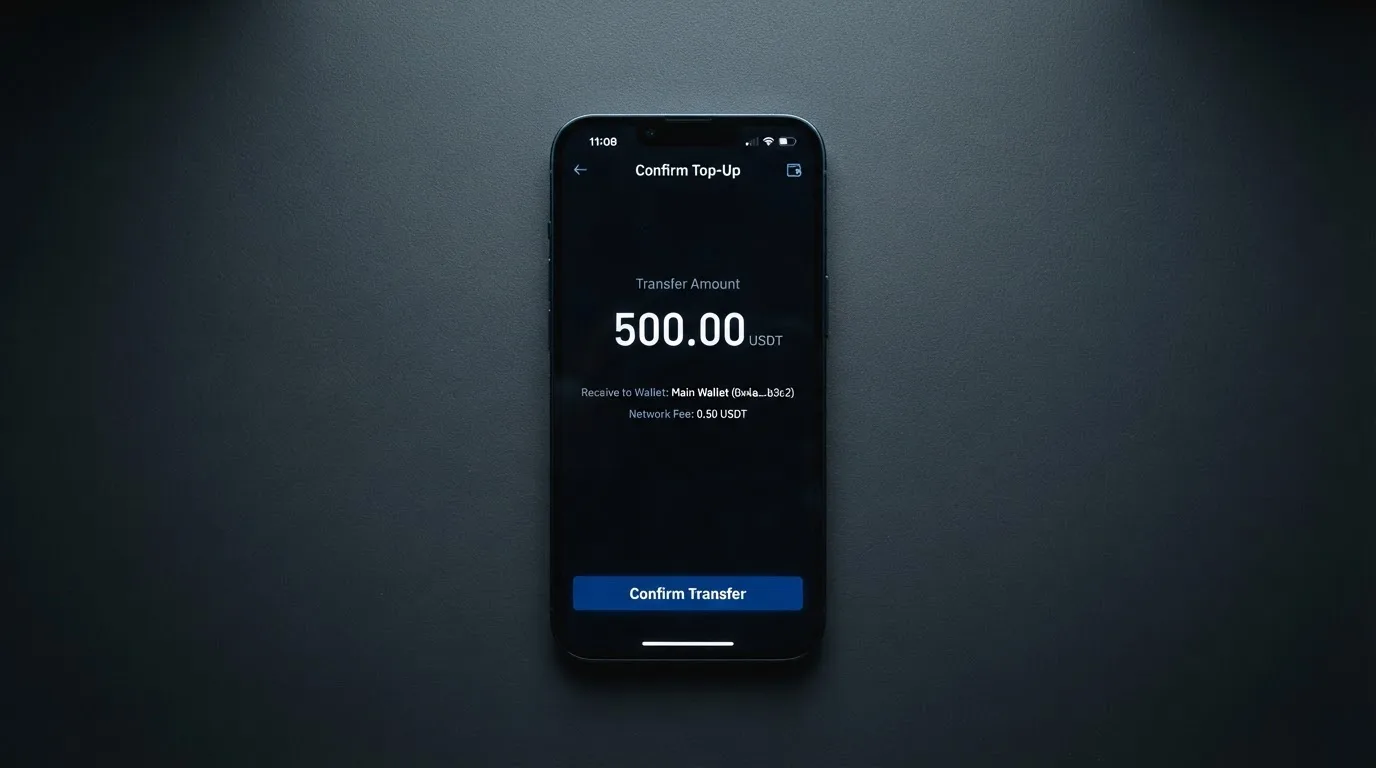
What the page does not name: which digital assets, on which networks, with which minimums, and at what conversion rate. The listing also does not say whether the top-up is an in-app purchase, an on-chain transfer to a HostFi address, or a card-funded load. Two of the most common HostFi-style flows in the wider market are: (a) a custodial model where you buy crypto inside the app and the app loads the card for you, and (b) a self-custody model where you send stablecoins from your own wallet to a HostFi deposit address. HostFi does not say which model it uses.
On the withdrawal side, the App Store listing mentions Naira withdrawals to bank accounts, framed as part of a “crypto banking app” feature. That is a positive signal: the product is built around Naira in and Naira out, with the card sitting on top. It also means that the card itself is a spending surface, not necessarily a withdrawal surface. There is no public mention of ATM access, and the cards are virtual only, so the “card to cash” route would be a bank transfer, not an ATM.
The short version: if you are a Nigerian user funding a Naira card, the top-up path is described in broad terms. If you are a non-Nigerian user hoping to send USDT or USDC from a self-custody wallet, the official material does not confirm the path exists. Check it in the app before relying on it.
Paying with the card every day
The cards are virtual, the user picks Visa or Mastercard, and the user picks a “preferred currency” (Naira is the example). That is the everyday-use picture HostFi has chosen to put in writing.
There is no published information about mobile wallet support. The card might tokenise into Apple Pay or Google Pay, and most modern Visa and Mastercard programmes do, but HostFi has not said so on the public pages. If you rely on contactless phone payments, you will need to test it in the app rather than trust the marketing. There is no statement about card controls — instant freeze, online-only, single-use, merchant locks — and there is no statement about whether the card supports 3-D Secure for online checkout, although most Visa and Mastercard programmes do by default.
There is no cashback programme. HostFi has a points-based rewards section in the app and a referral scheme (“Invite friends to HostFi and earn rewards”), but the cards themselves are not described as paying cashback. The rewards section on the site is, as of the check date, still labelled “Coming soon” — which is unusual for a product that the App Store is already distributing, and is worth bearing in mind.
App availability is iOS and Android. The App Store rating for the Nigerian storefront is 4.3 out of 5 across 89 ratings, which is a solid mark for a regional fintech app at this stage. A Google Play rating is not stated in the app listing. The lack of a Google Play rating in the listing is itself something to check yourself if you intend to install on Android.
Disputes, chargebacks, and what happens if a transaction goes wrong are not addressed in any public HostFi page I could find. That is a meaningful gap for a card product, and it is one of the things that would make me cautious about using HostFi for anything more than small, easily-reversed spending until the policy is published.
What can go wrong
Most of the risks with HostFi are the ones that come from missing information, not from a known failure.
The card product itself is labelled “Coming soon” on the site. The cards are available in the app (the App Store listing describes them, and the release notes refer to Naira virtual cards), but the rewards section on the website is still marked “Coming soon” as of the check date. If the public website does not yet have a card page, that is a small but real signal that the card programme is not fully shipped. I would treat it as a product in the early phase of its rollout.
The operator is named but not licensed. HostFi Services Ltd is the company behind the brand, trading as Host Finance. The address on the site is in Wilmington, Delaware, and the terms of service say the relationship is governed by Nigerian law. The licence HostFi operates under, the regulator it answers to, and the issuing bank that puts the Visa or Mastercard number on the cards are not named in any public material I could find. The App Store developer field lists “HostFi Services Limited”. That is a thin set of facts for a card that handles your money.
The country story is incomplete. The site says products are available only in selected countries, the App Store is Nigerian, and the terms are Nigerian. None of that tells a non-Nigerian reader whether they can sign up. The risk of being told “this product is not available in your country” mid-sign-up is real, and you may not find out until you have installed the app and entered your details.
No third-party complaint footprint. I searched for “HostFi card reviews trustpilot reddit” on 2026-10-21 and there was no HostFi page or thread (the search surfaced an unrelated brand called HostFaddy). A small complaint footprint can mean a small user base, and a small user base can mean a thinner support operation. It can also simply mean the product is new, which fits the “Coming soon” labels. Either reading points in the same direction: do not load a balance larger than you can afford to lose track of.
Security is described in general terms. The site says HostFi uses “cold storage, multi-factor authentication, and advanced encryption”. That is platform-wide language, and it is the same language a lot of crypto companies use. HostFi does not say whether the card balance is held in a segregated account, whether the model is custodial or self-custody-linked, or what happens to your funds if the platform has a problem. Treat the published security claims as a floor, not a ceiling.
Support is contact-form and email. HostFi has a help centre and a contact email link. The languages, hours and average response time are not stated. If your card declines on a Friday evening, you may be waiting until Monday, and that is before you account for time zones.
Programme shutdown risk. Any card programme can be wound down by its issuer or by the card network. Recent history has examples of this: Visa terminated its global agreements with FTX in November 2022, and WaveCrest-issued Visa programmes in Europe were closed in 2018. If HostFi’s card programme were ever shut down, users would be told to withdraw their balance within a window — but the size of that window, and whether HostFi would publish it, is not in the public material.
What to take instead
HostFi is not a bad idea; it is just one with very little published detail. The alternatives below each have gaps of their own, but they each put more on paper than HostFi does, which is the practical reason to compare them. I have kept the comparison to facts the providers publish, and where the alternative is also missing a fact, I have said so.
Cardex — 5.6 / 10
Cardex is the most direct comparison. The site says “one crypto card, 200+ countries”, with no published list of exclusions and an App Store listing that is Naira-focused. The card runs on Verve, Visa, Mastercard and UnionPay networks, and both virtual and physical cards are described in the App Store. The card currency is Naira per the listing.
On the cost side, the gap is similar to HostFi’s. Issuance and monthly fees are not stated, but the site does describe a “real-time crypto-to-fiat conversion at the moment of payment” with an “AI-Powered Conversion Rate” that scans global exchanges and picks the best one when you spend. There is no published fee percentage, so you still cannot quote a number. The coins listed are USDT, USDC and BTC; the networks are not named on the public page. Rewards are not stated.
Cardex is the right comparison if you are weighing two Nigeria-leaning virtual-first products and you want a programme that names the networks it runs on.
TakeCard — 5.5 / 10
TakeCard is a different shape. It is built on the Takenos platform and is the most concrete of the three on the cost side. The virtual card costs USD 5 to issue. The physical card is Bolivia-only and costs USD 20 to issue, plus USD 20 to ship (a separate article in the same help centre quotes USD 10 for the physical card in Bolivia — the two pages disagree, so I would check before paying). There is no monthly fee published. The card is prepaid, USD-denominated, and runs on the Visa network per the help article. The card is issued in the United States.
On fees, TakeCard charges a 1% commission per purchase. USD payments settle 1:1; other currencies go through the official Visa rate on the day. The crypto conversion fee is not stated. Top-up is from a Takenos balance, and the help article does not name the coins. Third-party starting data lists USDC and USDT over Polygon, BNB Chain, Tron or Ethereum into a Takenos account, but I have not seen that confirmed on an official page I could read.
TakeCard is the comparison to make if cost transparency is the deciding factor. It is also the only one of the three with a clearly-published purchase commission.
OkiCard — 6.0 / 10
OkiCard is the most open of the three on geography and pricing. The site says “150+ countries” (some pages say “200+”), with the caveat that you must confirm you are not in a sanctioned jurisdiction. The card is virtual, with a passing mention of a physical card on the site, and runs on “Visa/Mastercard” without specifying which. The card currency is USD or EUR pegged.
Pricing is split across the page and the FAQ. The pricing page shows issuance $0, monthly $0, and a “starting price” of $15 for the virtual card. The FAQ mentions a one-time issuance fee. The two pages disagree, so the published price is $0 issuance with a $15 starting price, and the FAQ implies a fee — exactly the kind of mismatch you should not have to resolve at the checkout. There is an initial deposit of 100 USDT.
Fees are the clearest of the three: a 3% load fee, 0% transaction fee in USD, and the site says “no hidden exchange spreads”. The FX fee is not stated. Funding is USDT on BSC, Ethereum, Tron and Solana, with USDC “soon” and BTC and altcoins “coming soon”. Deposits go to a generated address and are converted to fiat at the moment of spending. Rewards are not stated.
OkiCard is the comparison to make if you want a programme that names the supported networks and publishes at least some fees, even if the price page needs a second look.
Comparison at a glance
| Provider | Score | Geography | Card type | Published fees | Funding |
|---|---|---|---|---|---|
| HostFi | 4.3 / 10 | Not stated (App Store is Nigeria) | Virtual, Visa or Mastercard, Naira example | None | Fiat or digital assets (coins not named) |
| Cardex | 5.6 / 10 | 200+ countries, no list | Virtual and physical, Verve / Visa / Mastercard / UnionPay, Naira | None | USDT, USDC, BTC (networks not named) |
| TakeCard | 5.5 / 10 | Bolivia for physical; “any country” for the Takenos wallet | Virtual, USD, Visa | Virtual USD 5; 1% commission; published | Takenos balance (coins not named on the help page) |
| OkiCard | 6.0 / 10 | 150–200+ countries | Virtual, USD/EUR, Visa/Mastercard | 3% load, 0% USD transaction | USDT on BSC, Ethereum, Tron, Solana |
Who I would recommend it to
I would recommend HostFi to a narrow reader: someone in Nigeria who already has the HostFi app installed, who wants a virtual Visa or Mastercard denominated in Naira, who is comfortable funding the card from the HostFi balance rather than from a self-custody wallet, and who is happy to test the fee structure with a small amount before loading anything significant. For that reader, the App Store rating of 4.3 out of 5 across 89 ratings is a reasonable signal, and the fact that Naira bank withdrawals are described in the App Store is a useful feature for a card that is otherwise a closed loop.
I would not recommend HostFi to almost anyone else. If you live outside Nigeria, the official pages do not confirm you are eligible. If you need a physical card, HostFi does not issue one. If you need to see a fee schedule before you sign up, there is no fee schedule. If you want to know the issuing bank, the licence, or the regulator, those are not on the public page. If you want cashback, the rewards section is “Coming soon”. If you want to fund the card with USDT over Tron from a self-custody wallet, HostFi has not said the coin or the network is supported.
A more general reader — someone choosing between several crypto cards — will be better served by OkiCard if geography and network choice are the deciding factors, by TakeCard if published fees are the deciding factor, and by Cardex if a multi-network card with Verve, Visa, Mastercard and UnionPay is what you need. HostFi earns its place in that comparison only if you are a Nigerian user for whom the alternative programmes do not work.
If you do go ahead with HostFi, the small-print checklist is: confirm your country in the sign-up step, do a small test load, do a small test spend, do a small test Naira withdrawal, and read the app’s history carefully for the fees HostFi does not publish on its website. Do not load a balance you would not be comfortable seeing stuck in a programme that is still showing “Coming soon” sections on its own marketing pages.
Frequently asked questions
What is the HostFi card?
The HostFi card is a virtual payment card described in the HostFi mobile app. The user picks Visa or Mastercard, chooses a currency (Naira is the example in the App Store), and funds the card with fiat or digital assets. The card is virtual only; there is no physical version in HostFi’s public material.
How does the HostFi card work?
The App Store listing says cards can be funded with fiat or digital assets, and the user can create several cards. The app description frames HostFi as a “crypto banking app” with Naira withdrawals to bank accounts. The card sits on top of the in-app balance, and you spend from that balance. The fee for converting crypto to spendable balance is not stated.
Is HostFi a bank?
HostFi’s site and App Store listing describe a “crypto banking app”, and Naira withdrawals to bank accounts are mentioned. The company is HostFi Services Ltd, trading as Host Finance. The banking licence, the issuing bank for the Visa or Mastercard programme, and the regulator are not named in the public material, so HostFi should be treated as a payments-and-crypto app rather than as a bank in the formal sense.
Who owns HostFi?
HostFi Services Ltd is the legal entity behind the brand. It trades as Host Finance, lists a Wilmington, Delaware address on the site, and is identified as “HostFi Services Limited” in the App Store developer field. The terms of service are governed by Nigerian law. The owner, parent company and beneficial owners are not stated in the public material.
Is the HostFi card available in my country?
HostFi’s site says only that “some products are available only in selected countries”, without listing them. The App Store listing is the Nigerian storefront, and the terms are governed by Nigerian law. To find out whether you can sign up, the only reliable check is to install the app and attempt the sign-up — the public pages do not give a country list.
How do I get a HostFi card?
You install the HostFi app (iOS or Android), sign up, complete any verification step the app applies, fund the balance, and create a card. You pick Visa or Mastercard at card creation. The site does not publish a KYC document list, an age requirement or a processing time, so the sign-up step is the source of truth.
Does the HostFi card require KYC?
The website does not describe a KYC step. The App Store listing does not describe one either. Like any regulated payments product, HostFi will almost certainly apply some form of identity check before or shortly after sign-up; the documents it asks for, the time it takes, and the cases in which it declines are not described publicly. Treat the in-app verification step as the actual rule.
How do I top up a HostFi card?
The App Store listing says you can fund cards with fiat or digital assets. The website does not name the cryptocurrencies, the networks, the minimum top-up or the load fee. The Naira withdrawal path is described (to a bank account), but the in-app top-up path is not specified. The only way to confirm a top-up path is to open the app and try it.
Is the HostFi card safe?
The site describes platform-wide security as “cold storage, multi-factor authentication, and advanced encryption”. The card balance is held by HostFi, and the regulatory home (licence, regulator, issuing bank) is not published. Custodial platforms have a record of failures, and HostFi has not published enough about its setup for an independent reader to judge safety beyond the marketing claims.
Is the HostFi card worth it?
It depends on where you are and what you are comparing it to. For a Nigerian user who wants a Naira-denominated virtual card, the App Store rating of 4.3 out of 5 across 89 ratings is a workable signal. For almost anyone else, the missing fee schedule, missing licence information, missing supported-coin list, and the “Coming soon” labels on the rewards section of the website make the card hard to evaluate. The 4.3 out of 10 in this review reflects the gap, not a judgement that the product is broken.
Virtual card options – cryptocardoptions.com
Content created by the «cryptocardoptions.com» team