
A crypto exchange's card, not a bank account: what KuCard is, what it costs, and where the paperwork stops
 Available in US
KuCard is a Visa debit card issued to people who already hold a KuCoin EU account. The card draws on crypto held in that account, converts it to euro, and behaves like an ordinary payment card at the till. That is the whole idea, and it works in the way it advertises. The complications are all around the edges: who is eligible, what the fees are in currencies other than euro, how the crypto actually gets onto the card, and how much of the practical detail the public documents simply do not tell you. I went through the terms, the fee schedule and the support pages, and this is what I found. My score for the card is 6.0 out of 10 — respectable for someone already inside the KuCoin ecosystem, much less so if you are choosing a card from scratch.
Conditions are current as of October 28, 2026
Verdict: 6.0 out of 10 — best for people already inside KuCoin, awkward for everyone else
KuCard sits in the middle of the pack. It scores well on everyday use, because a Visa card with Apple Pay and Google Pay that works at any terminal is exactly what most people want, and it scores poorly on access and funding, because it locks you into one exchange, one region and one chain-agnostic promise. If you already use KuCoin for your crypto, the card is a natural companion. If you do not, there is little here that a traditional bank card or another crypto card cannot do better with more published detail.
The score breaks down as follows, and I explain each mark in the sections below.
| Criterion | Mark | Reason |
|---|---|---|
| Who can get it | 5 / 10 | Only citizens and residents of the EEA plus Iceland, Liechtenstein and Norway; not available in Malta |
| Cost | 6 / 10 | First virtual card free, further ones about €9.90, physical €9.90; euro payments free, non-euro 2%, ATM in Europe €2 |
| Top-up options | 4 / 10 | Main source is crypto held in the KuCard account, defaulting to USDT; the coin and network list is not disclosed |
| Reliability and complaints | 7 / 10 | Issuer is Wallester AS in Estonia under the Estonian FSA; few card complaints, one card-specific Trustpilot review, exchange complaints about withdrawal limits |
| Everyday use | 8 / 10 | Visa, virtual card instantly and physical Chip&Pin; unofficially Apple Pay and Google Pay; ATM €2; the virtual card expires at month end |
| Total | 6.0 / 10 | A working card for an existing user, not a well-documented general-purpose one |
The everyday-use mark of 8 is the strongest argument for the card. Everything else is a qualification on that.
Who will give you the card
Only citizens and residents of the European Economic Area can get a KuCard, and the card also has to be applied for with an identity document issued in the EEA. The permitted jurisdictions named in the terms are the EU states plus Iceland, Liechtenstein and Norway, and the help centre adds that it is not available in Malta. There is no workaround here: if you live outside the EEA, or you are an EEA resident without an EEA-issued ID, the card simply is not offered to you.
If you are in the region, the rule is straightforward — EEA citizenship or residence, plus an EEA-issued ID. Citizenship and residence are both named, so a non-EU citizen living in, say, Germany with a German ID is inside the rule. The age floor is 18.
This is the single biggest limit on the card and the main reason it scores 5 out of 10 for eligibility. A product that only works inside one regulatory region cannot be the answer for a reader in Dubai, São Paulo or Bangkok, whatever their crypto holdings are. What makes it more noticeable is that there is no published fallback for people outside the region. The card states the boundary and stops.
How to get it
There is no separate application. The card is tied to the exchange: you need a valid KuCoin EU account, full identity verification with a supported EEA-issued document, a verified address, and to be 18 or older. From there the path runs through the platform itself — KuCoin EU account, KYC, then apply for the virtual or physical card inside the app or on the site.
There is a single KYC level, not a tiered ladder: a full check with an EEA-issued ID or passport, an address check, and 18+. The card’s own documentation lists the reasons an application gets refused, which is unusually honest: an invalid phone number, a wrong name or date of birth, an invalid 3DS password, not enough balance to cover the fee, or risk control. It does not state how long processing takes, so plan for the application to sit without a stated deadline.
Once you have the card, activation happens in the KuCoin app or site, not by phone call or post. The physical card is posted to the address you give. Express card delivery is €30 per card; replacing a lost or damaged card is €9.90. Standard delivery time and cost are not stated, which matters if you need the plastic before you can use it. The card works across the EEA excluding Malta.
Fees: what it really costs
The fee picture is a mix of clarity and gaps. Euro payments are free, which is the number most people will care about, because it means a card used inside the euro area behaves like an ordinary free debit card. Everything else adds up quickly. Here is what the card’s own documents say.

| Fee or limit | What it costs |
|---|---|
| First virtual card | Free |
| Further virtual cards | €9.90 per card (an older support article says €9.99) |
| Physical card | €9.90 for the first card / €19.90 (ambiguous as written) |
| Card replacement | €9.90 |
| Express card delivery | €30 per card |
| Euro transactions | Free |
| Non-euro transactions | 2% of the transaction total |
| ATM inside Europe | €2 per withdrawal |
| ATM outside Europe | 2% of the transaction total plus €2, plus the ATM operator’s own fees |
| Declined payment (insufficient funds) | Free |
| Refunds | Paid in euro, at the euro value at the time of the transaction |
| Overdraft | Not available |
| Monthly fee | Not stated; a €2 monthly inactivity fee on a virtual card after 90 days without a transaction is reported unofficially |
Two categories of cost sit outside the table because the card does not put a number on them: “local fees, third party fees, network fees, a conversion spread, and IOF fees may apply”. The conversion spread is the one to understand before you top up, and I come back to it under funding.
Now the three everyday payments that decide whether this card costs you anything:
A coffee in an euro country. You pay, the crypto in your account is converted to euro, and the euro transaction itself is free. The card’s conversion rate from crypto to euro is set by KuCoin, so the cost here is the rate, not a fee on the card. Read that rate as part of the price of the coffee.
A meal or a hotel in a non-euro country. You pay 2% of the transaction total on top of whatever the merchant’s own local pricing does. If the merchant also adds a foreign-currency surcharge, that is a third layer. On a €100 dinner this is €2 before you count the conversion rate; it is not a rounding error over a month of travel.
A cash withdrawal at a European ATM. €2 per withdrawal, and the ATM operator may add fees of their own on top. That single fixed charge is why using this card for cash makes sense for a large withdrawal and not for a €20 one.
The limits are where the documentation simply gives up. The card’s terms point to a FAQ for daily and monthly spending limits and say the issuer may set them, but no figures are published. A third-party site reports that KuCoin does not publish one universal spending and ATM limit table. So the honest position is this: you cannot find out in advance how much you may spend in a day or a month, and you will only learn by trying. If you need a card with a known, generous limit — a large monthly rent, say, or a country where you will spend heavily — this uncertainty is itself a reason to look elsewhere.
Top up: how the money gets onto the card
The card does not have its own balance. You top it up from supported cryptocurrency held in your KuCard account, and the default spending currency is USDT. The card converts the crypto to euro and spends the euro. That is the entire mechanism, and it is simple in a way that many people will like.
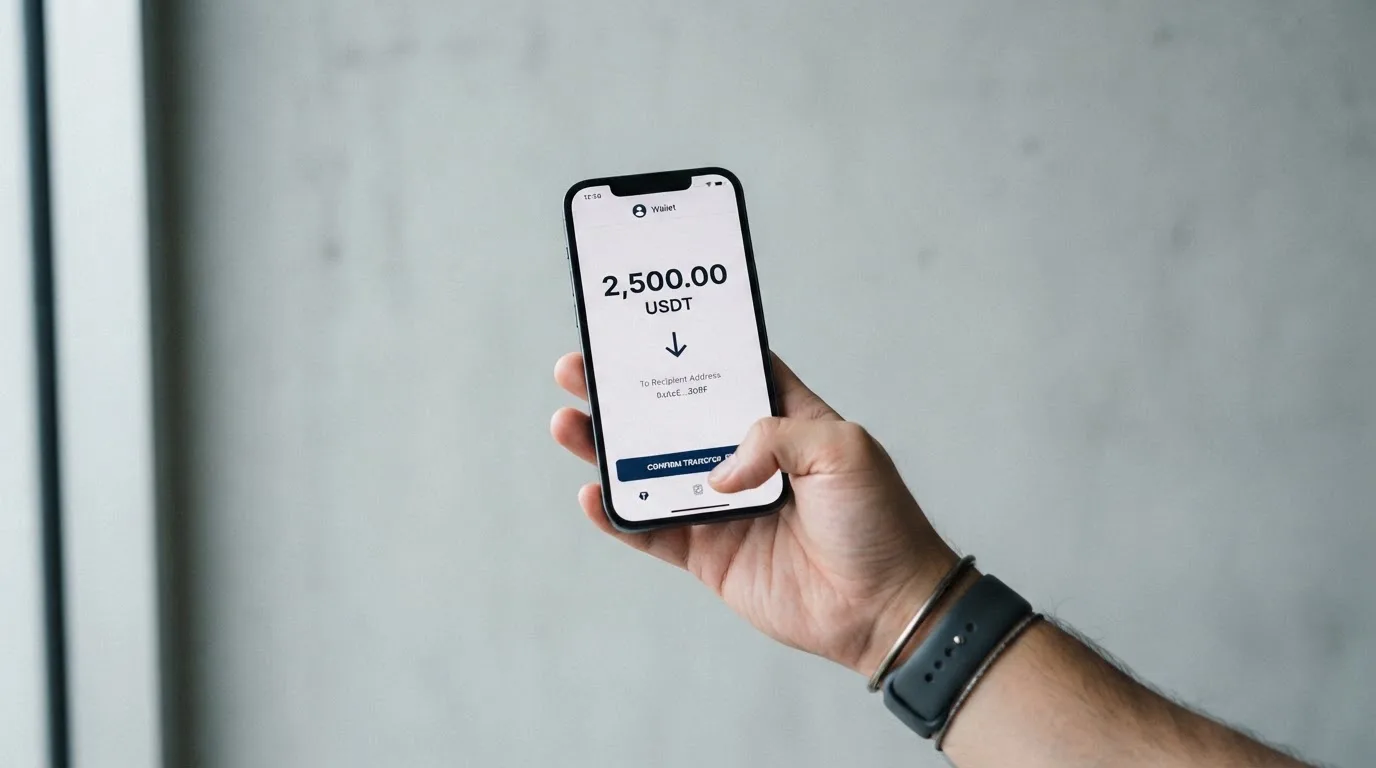
The complication is the details. The list of supported coins is not published, and neither is the list of networks you can transfer on. The default is USDT, but the card’s pages do not tell you which chains you can deposit from or which ones will actually credit. This is where experience with crypto transfers becomes a genuine skill rather than a background one. A transfer sent on the wrong network, or to an address of a different network, can be lost or need manual support recovery with no guarantee — the network itself cannot reverse a transfer. Tether states it disables tokens in wallets on the OFAC sanctions list and has frozen funds tied to illicit activity, so a stablecoin balance is not censorship-proof in either direction.
Two more things the card does not spell out: there is no top-up fee row in the fee schedule, but a “conversion spread” may apply on the way in; and the crypto-to-euro rate is set solely by KuCoin. So the cost of funding is the spread plus the rate, and neither is a fixed number you can read in advance.
What you cannot find stated anywhere: whether you can top the card with fiat directly, what the minimum top-up is, or who pays the blockchain network fee for your deposit. On-chain network fees for a deposit are charged by the blockchain, not by the card provider, so plan to have a small amount of the native coin on hand for the transfer itself. On Ethereum, for instance, gas is paid only in ETH, which means a wallet holding USDT but no ETH cannot send it at all.
Moving money back off the card is the other gap. How to withdraw a card balance to crypto or to a bank account is not stated. Cancelling a card is free, refunds are always paid in fiat, an unactivated card may be closed after three months with no refund of service charges, and a card may be terminated after four consecutive months closed or blocked or six months of non-use. What happens to a remaining balance on closure is not stated. Treat the card as a way to spend, not as a place to park money.
Paying with it every day
Everyday use is this card’s best suit, and it earns the 8 out of 10. It is a Visa debit card. The virtual card is available immediately, and the physical card is a standard Chip&Pin. It works at Visa-accepting terminals and for purchases not prohibited by law; there is no published merchant category list.
Officially, Apple Pay and Google Pay are not stated as supported on the card’s pages. Unofficially — that is, per third-party sources, not confirmed by the card — Apple Pay and Google Pay are supported. If having the card in your phone wallet is important to you, treat this as something to verify in your own app rather than a promise.
Two practical notes on daily use. The virtual card expires at the end of the month and has to be reapplied; it is a spending tool, not a card you keep. And the card is funded from your KuCard account on the exchange platform, which in practice is custodial — the card’s terms do not use that word, but the balance is not yours in the way a self-custody wallet is. You are trusting the platform to hold the funds and to convert them at its rate.
On rewards, the terms mention only “different benefits or rewards” from time to time, with no rates. Unofficially, an EU rewards programme is reported by spending tier, from 1% below 500 USDC of monthly eligible spend up to 8% above 30,000 USDC, with points available after 15 days and expiring after 90 days, 1,000 points being worth 1 USDC. The same source notes KuCoin has no single published reward table. I would not plan a budget around these numbers until you see them in your own account.
On disputes: unauthorised transactions have to be reported within 60 days of the transaction date or they are treated as correct. That is the card’s term, and it is shorter than the protection you may be used to. Refunds are valued at the euro amount at the time of the transaction; the refund processing time is not stated, and fees are non-refundable.
What can go wrong
The risks here are less about fraud and more about access, concentration and paperwork.
Access risk. The card is for the EEA only, minus Malta. A change in where you live, or a change in the exchange’s regional policy, can take the card away from you.
Concentration risk. Your card balance is your exchange balance. If the exchange restricts withdrawals, freezes an account for compliance review, or goes down, your money for the card goes with it. This is not hypothetical for exchange balances generally: custodial platforms have a history of failures, including Mt. Gox, Coincheck and Ronin Network. It is also not hypothetical for this one exchange in particular — see complaints below.
Document risk. The card’s terms lean on a Fee Schedule and a FAQ that are not fully shown on the public pages. Where a fee or a limit is not stated, you are relying on the platform’s in-app display, which can change. The fee schedule page was last updated on 29 September 2026.
Complaints. I found almost nothing specific to the card: no Reddit threads, no official incident, and one card-specific Trustpilot review from July 2026 about about $120 stuck after the card on file expired, with KuCoin asking for an old bank PDF statement and replies being slow. That is a thin record, and thin in both directions — it means no pattern of card-specific complaints, but also very little evidence of a well-exercised card. The much larger body of complaints sits on the KuCoin exchange profile, not the card: 1,597 reviews with 78% one-star, themes including withdrawal and account restrictions, dormancy fees and repeated ID demands, P2P disputes, and deposits not credited. The card inherits those risks because the card lives inside that account.
Programme risk. Cards are issued under a network licence, and that licence can be withdrawn. Visa terminated its global agreements with FTX in November 2022 and the FTX US debit card was wound down; WaveCrest, a Visa issuer that supplied crypto card brands, was suspended by Visa in Europe in 2018, closing all its Visa programmes. Closures typically mean a notice period, then spending and loading stop, then you are asked to withdraw what is left. On the positive side I found no licence loss or fine against this card’s issuer.
Who stands behind it. The issuer is Wallester AS, an Estonian company registered under 11812882, a Visa principal member supervised by the Estonian FSA. An Estonian e-money institution, UAB EURLITA, operates the virtual currency exchange and deposit side. KuCoin runs the platform. That is a regulated structure — an EU e-money institution must safeguard customer funds, though safeguarded funds are not the same as bank deposits and may not sit under a deposit guarantee scheme. Support runs through a Help Centre and a “Submit a Ticket” on KuCoin EU, with articles available in Russian; chat, Telegram channel and operating hours are not stated.
Lost or stolen. You freeze your account in the platform immediately. Strong authentication (two independent elements) is required, liability for unauthorised use is capped at €50 unless there was fraud or gross negligence, and two-factor authentication and insurance are not specifically mentioned. One card-specific complaint above turned on an expired card on file, which is a reminder to keep your details current.
What to take instead
If the KuCard card does not fit — you are outside the EEA, you want a published limit table, you want to spend from a card you hold yourself — the alternatives are worth a look. Here is how they compare on the score and on what each publishes.
| Card | Score | Card type | Cost | Key strengths | Key gaps |
|---|---|---|---|---|---|
| KuCard | 6.0 / 10 | Visa debit, virtual and Chip&Pin physical | First virtual free; further €9.90; non-euro 2% | Works inside the euro area free; EEA-regulated issuer | EEA only minus Malta; no published limits or coin/network list; ends-of-month virtual expiry |
| MSX | 6.4 / 10 | Not stated officially | Not stated | Slightly higher score | Nothing material published on the pages I could read |
| Bybit Card | 6.0 / 10 | Virtual and physical; Mastercard or Visa depending on region | Virtual free; physical 29.99 USD (Australia), 5 USD/USDT (Argentina), 29.99 USDT (Georgia, Kazakhstan, Asia Pacific) | Published tiered cashback; many regions | Explicitly not for EEA customers; complex regional fee table |
| MEXC | 5.6 / 10 | Virtual only | Issuance 20 USD; service 0% | Simple cashback by tier | Physical cards not yet available; lowest score here |
Bybit Card is the strongest of the alternatives for someone who wants published rewards. Its cashback is tiered by monthly spend — from 2% with a 5 USD cap at the base level up to 10% with a 600 USD cap at the top — and only crypto-funded transactions earn. But its cards page states plainly that the product is not meant for EEA customers and that all EEA participation is strictly prohibited, so it is an option only if you are outside the euro area. Its FX fee is 2% on top of the network rate in several regions, higher elsewhere, so it is not obviously cheaper to spend than KuCard.
MEXC Card scores lowest but is the simplest to understand: virtual only, USDT funding, and cashback by M-score tier paid by the 15th of the following month. Physical cards are not yet available, which is the main limitation for daily use.
MSX scores marginally above KuCard at 6.4, but I could not find official pages stating its card type, cost, fees, funding or rewards. I would not let a slightly higher score tempt you past that much missing information.
If you are inside the EEA and already a KuCoin user, KuCard remains a reasonable pick — the free euro payments and the regulated Estonian issuer are real qualities. If you are starting fresh, the comparison above is the argument for spending an afternoon elsewhere first.
Who I would recommend it to
I would recommend KuCard to an EU or EEA resident who already keeps their crypto on KuCoin, pays mostly in euro, and wants a Visa card that draws down that balance without thinking about it. In that narrow band it is a good card: euro spending is free, the issuer is a supervised Estonian institution, and the everyday mechanics — virtual card now, physical Chip&Pin in the post, Apple Pay in the phone — are what people actually want.
I would not recommend it to someone outside the EEA, or to an EEA resident without an EEA-issued ID, because the card is not offered to them. I would think twice if you need a known spending or withdrawal limit, because none are published; if you plan to hold a balance on the card, because withdrawal back to crypto or a bank is not stated; if you spend heavily outside the euro area, because non-euro transactions carry 2% and ATMs €2; or if your income arrives in a country whose banking you would rather not route through an exchange account, because the funds sit inside that exchange.
And if you are choosing between cards purely on paper, the honest summary is this: KuCard publishes its fee logic clearly enough for euro spending and leaves the rest — limits, networks, coins, withdrawal — to the in-app display. Cards that publish more of that are easier to plan around, even if their headline score is not higher.
Frequently asked questions
What is KuCard?
KuCard is a Visa debit card issued through the KuCoin EU platform. It draws on cryptocurrency held in your KuCard account, converts it to euro at a rate set by KuCoin, and spends the result as an ordinary card. You get a virtual card you can use immediately and a physical Chip&Pin card posted to your address. It is not a bank account, and the card states it is for citizens and residents of the EEA only.
How does KuCard work?
Your crypto sits in your KuCard account; the card’s default spending currency is USDT. When you pay, that crypto is converted to euro and the euro is spent. The card works at any Visa-accepting terminal for purchases not prohibited by law. The conversion rate is set solely by KuCoin, and a conversion spread may apply, so the rate and the spread together are the real cost of each purchase.
Who can get a KuCard?
Only citizens and residents of the European Economic Area, with an EEA-issued identity document, verified address, and age 18 or over. The permitted jurisdictions are the EU states plus Iceland, Liechtenstein and Norway, and the card is not available in Malta. There is no published route for applicants outside the EEA, so if that is you, the card is not an option.
How do I apply for a KuCard?
Through KuCoin itself. You need a valid KuCoin EU account, complete KYC with a supported EEA-issued document, and a verified address. Then apply for the virtual or physical card in the app or on the site. Applications can be refused for things like an invalid phone number, a wrong name or date of birth, an invalid 3DS password, insufficient balance for the fee, or risk control.
What does a KuCard cost?
The first virtual card is free; further ones cost €9.90 each, and a replacement is €9.90. Euro payments are free. Non-euro payments cost 2% of the transaction total. A European ATM withdrawal is €2, and international withdrawals are 2% plus €2, plus any operator fee. Express physical delivery is €30. Physical card pricing is published ambiguously as €9.90 for the first or €19.90.
How do I top up a KuCard?
From supported cryptocurrency already held in your KuCard account, with USDT as the default spending currency. The coin list and the network list are not published, so check which chains your account supports before transferring. On-chain network fees are charged by the blockchain, not by KuCoin, so keep a little of the native coin for gas. Fiat top-up, minimum amounts and refund of balances are not stated.
Can I use a KuCard with Apple Pay or Google Pay?
Unofficially, yes — third-party sources report Apple Pay and Google Pay as supported, and an older payment-industry report says the same. The card’s own pages do not state this, so it is not something the card confirms. The virtual card expires at the end of the month and must be reapplied, so treat it as a short-term spending card rather than a permanent one in your wallet.
Is KuCard safe?
The issuer is Wallester AS, an Estonian Visa principal member supervised by the Estonian FSA, and an Estonian e-money institution handles the exchange side, so the structure sits inside EU regulation. Safeguarded customer funds are not the same as bank deposits and may not be under a deposit guarantee. The card’s balance sits inside your exchange account, so it carries exchange and custody risk as well as card risk.
What are KuCard’s spending limits?
This is the card’s weakest published area. The terms say the issuer may set daily limits and point to a FAQ, but no figures are published, and a third-party source notes there is no universal spending or ATM limit table. You will not find a firm number in advance; the practical limit is whatever your account allows once it is set. If a known, high limit matters to you, this is a reason to look at another card.
Is KuCard worth it?
For an EEA resident who already uses KuCoin and mostly spends in euro, yes — euro payments are free and the card is a clean way to spend a crypto balance. Outside the EEA it is not available, and if you want published limits, a choice of networks, or to withdraw back to crypto, the card’s silence on those points makes it harder to recommend than alternatives that publish them.
Exchange card options – cryptocardoptions.com
Content created by the «cryptocardoptions.com» team