
A new crypto card with most of its details still undisclosed
 Available in US
UstarPay sells itself as a Visa debit card funded from a crypto balance, aimed at people who struggle to get an ordinary bank card. The promise is straightforward: top up with USDT, spend anywhere Visa is accepted, optionally add the card to a mobile wallet. After a week of reading what UstarPay publishes and what is being said about it, the picture is unusually thin. The card is real, the funding flow is real, but most of the details a reviewer normally leans on are simply not on the public page. That alone shapes this review, because it is hard to recommend a financial product whose own operator will not tell you what it costs.
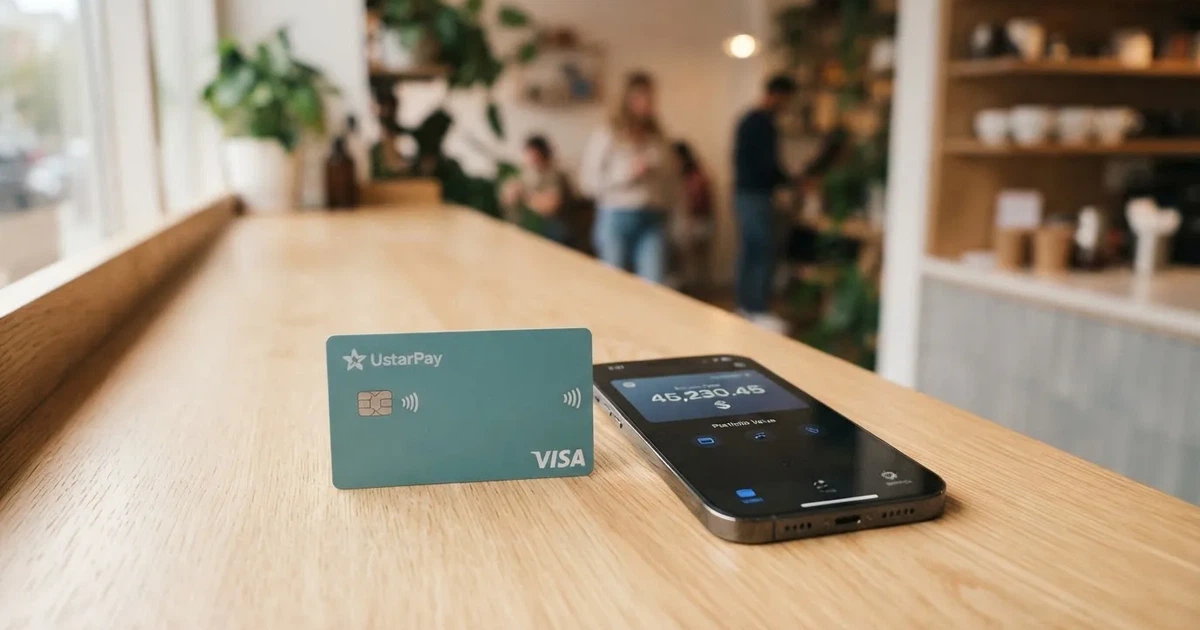
The conditions described below are current as of October 28, 2026.
Verdict
UstarPay earns 4.8 out of 10 in our scoring. The card is interesting to a narrow audience of early adopters who are comfortable funding a brand-new Visa product with USDT and who already accept that the operator has not published most of its fees, limits or corporate details. For anyone who needs a clear picture of monthly cost, withdrawal fees or even a country list, the documentation is not there yet, and the official channels have not closed the gap.
The score is built from six criteria, each marked out of ten with a short reason:
| Criterion | Mark | Reason |
|---|---|---|
| Who can get it | 5/10 | The official pages do not list supported countries; access depends on KYC and a regulated-country check, with details only available through unofficial sources. |
| Cost | 5/10 | A virtual card issuance fee exists in the base product but the amount is not published; conversion, FX, ATM and replacement fees are all undisclosed. |
| Top-up options | 5/10 | The only confirmed funding path is USDT into the in-app wallet on Ethereum, Bitcoin or Solana; other listed assets are swapped into USDT inside the app. |
| Reliability and complaints | 4/10 | The operator is named as a Hong Kong company incorporated on 12 January 2026, the issuing bank is not named, and there is no multi-year record. |
| Everyday use | 5/10 | The card can be added to Apple Pay or Google Pay depending on device and region, but the card form, ATM support and delivery terms are not described. |
| Total | 4.8 / 10 | A new, lightly documented product that suits only a narrow early-adopter audience. |
The intended user, going by the product’s design, is an early adopter funding a new Visa card with USDT. If that is not you, the rest of this review explains what to check before you spend time on the application, and what to look at instead.
Who will they give you the card
UstarPay’s public pages do not publish a country list. The way access is described in third-party coverage is that the operator runs a regulated-country check as part of KYC, and the decision on whether to onboard you is made on a case-by-case basis. That is not unusual for a young crypto card, but it means you cannot tell from the homepage whether your country is supported. You would have to start the application, attempt KYC, and wait for approval.
What we do know: the app treats KYC as mandatory before funding or spending, and the documents you are asked for vary by region. There is no published indication of tiered verification, no “light” account, and no statement on minimum age beyond the general rule that prepaid and debit cards are for adults.
The card is described as a Visa debit card. The issuing bank is not named on any page that could be read, and the operator behind the app is identified in third-party sources as USTAR GLOBAL TECH LIMITED, a Hong Kong company incorporated on 12 January 2026. Two other corporate names appear in starting data — CORAL GLOBAL TECH PTE. LTD. (Singapore) and FASTESTPAY LTD. (Canada MSB) — and the sources differ. None of this has been independently verified, and the company itself has not put a corporate page in front of reviewers.
If you live in a heavily sanctioned jurisdiction, expect to be turned away at KYC; if you live somewhere with a working Visa-issuing bank, you may sail through. The middle ground — the country you actually live in — is the one UstarPay does not talk about in public. Verify the current list on official channels before you install the app.
How to get it
UstarPay does not publish a step-by-step onboarding flow. What we can piece together from the app’s general behaviour and from third-party reports is roughly this:
- Download the app, create an account, and complete the mandatory KYC before any funding or spending is allowed.
- Wait for KYC approval. The documents requested vary by region; nothing in the public material tells you what “approved” looks like or how long it takes.
- Order a card. The product is described as a Visa debit card; whether you get a virtual card, a physical card, or both, and how either is delivered, is not stated.
- Top up the in-app wallet with USDT and start spending.
There is no public statement on card delivery, on whether the physical card is shipped internationally, or on whether there is a virtual-only tier. The App Store listing is too short to read and the App Store reviews are too few to rate, so we cannot lean on user experience either. Plan on the application taking a few days and on a high chance that the operator will ask you for additional documents if anything in your KYC looks unusual.
If your priority is a quick yes-or-no on whether you are eligible, UstarPay is the wrong place to start. The faster path is to ask the operator directly through its X account or its Telegram channel, both linked from the website, and to be ready to send proof of residence and a government ID.
What it really costs: Fees, FX, ATM and limits
This is the section where UstarPay is most visibly under-documented. The public material confirms that a virtual card issuance fee exists in the base product, but the amount is not published, and time-limited campaigns have waived it. Everything else — monthly fees, FX margins, ATM withdrawal fees, decline fees, replacement fees, in-app swap spreads — is not published. The cardholder has to discover the cost on a real transaction.
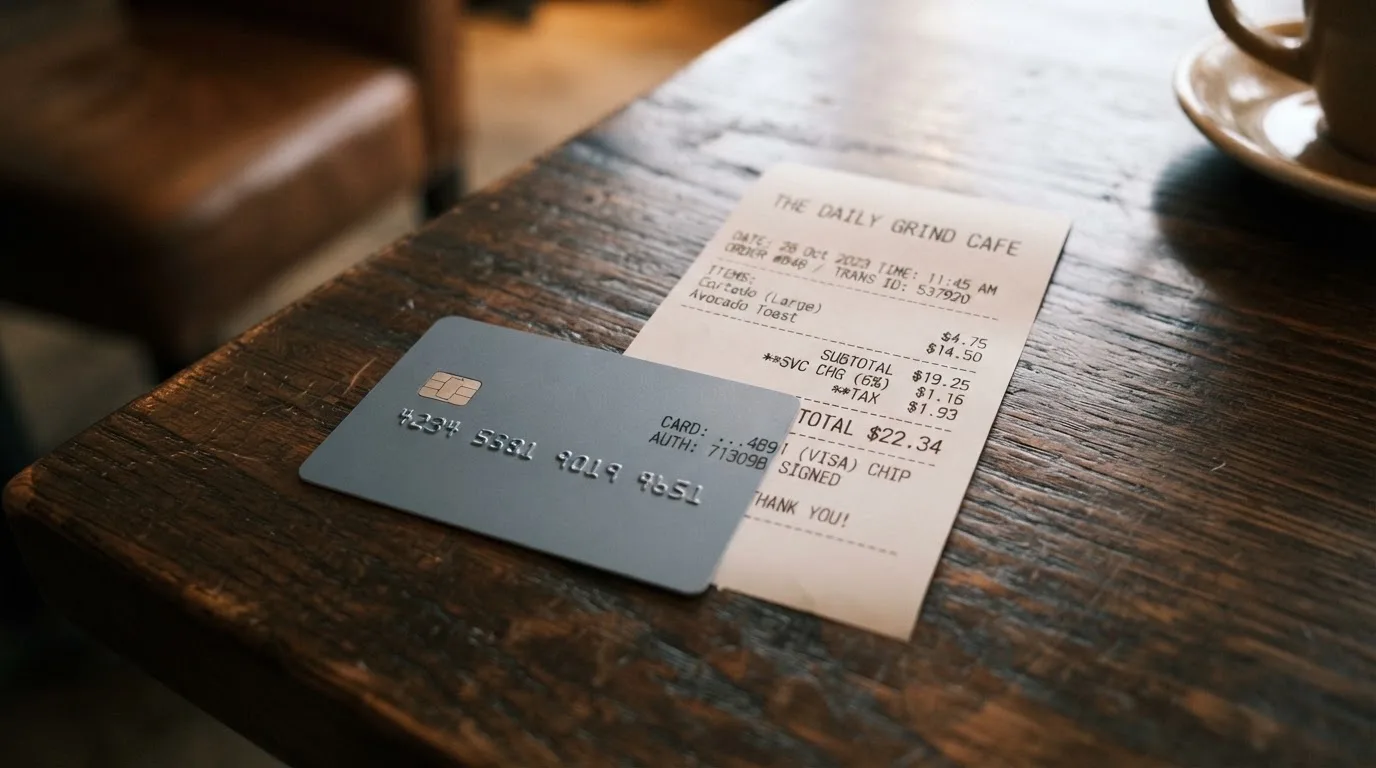
A comparison table of what is and is not stated:
| Fee or limit | Stated? | Detail |
|---|---|---|
| Virtual card issuance | Not published | Fee exists in the base product, amount not disclosed; campaigns have waived it (unofficial). |
| Monthly fee | Not stated | — |
| FX / conversion margin | Not stated | The card converts crypto to fiat at the moment of payment; the spread is not published. |
| ATM withdrawal fee | Not stated | ATM support itself is not confirmed. |
| Decline / replacement fee | Not stated | — |
| Daily and monthly limits | Not stated | No limits published. |
| Card currency | Not stated | — |
| Top-up network fee | Not UstarPay’s | The blockchain fee on a USDT transfer is the network’s, not UstarPay’s. |
To make this concrete, here is how the cost plays out in three everyday payments.
Buying lunch for the equivalent of $20 with USDT funding. UstarPay converts your USDT to fiat at the moment of payment, then the network routes the authorisation. You pay the on-chain fee when you sent the USDT into the wallet, you may pay an in-app swap spread if you held a different asset and converted to USDT, and the merchant is paid in local fiat. The exact spread and any local fee are not published, so you cannot quote a cent-accurate cost.
Paying a $500 online invoice in a foreign currency. A foreign-currency transaction normally carries two costs: the issuer’s FX margin, and any fee added on top. UstarPay publishes neither. The only thing you can rely on is that the on-chain fee you paid on the way in is fixed by the blockchain.
Withdrawing $100 from an ATM abroad. ATM support, ATM fees, daily ATM limits and any FX applied to a non-USD ATM withdrawal are all unstated. If you can withdraw at all, you are accepting whatever the operator charges without seeing the rate first.
In short, the costs section is a list of things to ask the operator about before you commit any meaningful balance, not a list of answers.
Top up
Funding is the clearest part of the UstarPay flow, and it is also where you can lose money most easily. The only confirmed funding path is to send USDT into the in-app wallet, on one of three networks: Ethereum, Bitcoin or Solana. If you hold other listed assets, an in-app swap converts them into USDT before the card sees the balance. The on-chain transfer fee is the blockchain’s, not UstarPay’s.
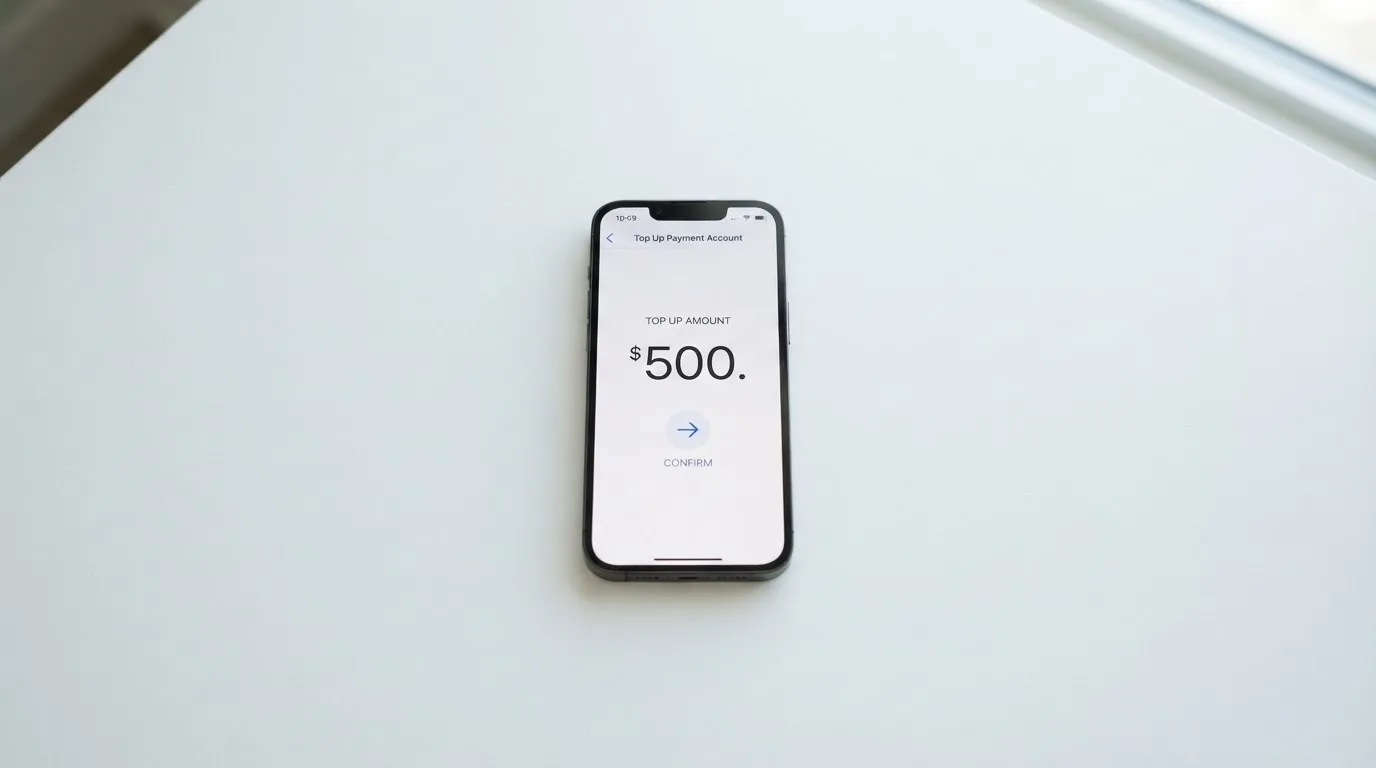
A few things to know before you send:
- Network matters. A USDT transfer sent on a network UstarPay does not support, or to a deposit address that belongs to a different chain, is effectively lost. Crypto transfers are irreversible; the network cannot freeze or return the funds.
- Gas is paid in the chain’s own asset. If you only hold USDT and you are sending on Ethereum, you also need a small ETH balance to pay gas. Otherwise the transfer simply will not go through.
- Minimums and deposit addresses are not published. The app generates a deposit address per user; what minimum it expects is not stated, so very small deposits may sit unswept or be rejected.
- No withdrawal path is described. The card spends from the balance, but the public material does not say how, or whether, you can move unused balance back out to your own wallet.
For most crypto card users, the day-to-day funding habit is: keep a small float of USDT on the right network, send it in when the balance gets low, and let the card spend from the converted fiat. The risk is always the wrong network, the wrong address, or a stablecoin that is not the one the operator expects.
Paying with it every day
The everyday-use picture is mostly potential. UstarPay’s official posts have said the card can be added to Apple Pay or Google Pay, with support depending on device and region. Whether the card works at a physical terminal, at an online checkout, at an ATM or in a country where Visa’s foreign-BIN filters are strict, is not documented. The card form (physical, virtual or both), the ATM policy and the shipping terms are all unstated.
There is no permanent cashback rate. Unofficial sources note a set of time-limited campaigns: a $1 sign-up coupon, a $2 verification coupon, a $50 reward for the top referrers until 31 October 2026, and a 3 USDT payout per qualifying friend up to a cap. Treat these as launch promotions, not as a rewards programme.
If you are the kind of person who likes to set the card up once, drop it into a mobile wallet, and then forget it, the UstarPay flow can become that. The mobile wallet hides the card number behind a device-specific token, and 3-D Secure handles the online checks. The open question is whether your local merchants will accept a card from a brand-new issuer, in a country the merchant has never seen a card from before. Visa’s address-verification system, for example, is mainly used in the US, Canada and the UK, and is generally unavailable for foreign-issued cards, which can cause declines. There is no published list of merchant categories UstarPay blocks or supports.
The app itself is light on reviews, and the support channels are a website, an X account (@ustarpay) and a Telegram channel. There are no published support hours, no published service-level targets, and no published statement on whether the team supports languages other than English. If your card gets stuck at a checkout, you are relying on the responsiveness of a small support team behind a brand-new company.
What can go wrong
Most of the risks here come from the product being young and under-documented, not from a specific bad behaviour.
- The company is three weeks old. USTAR GLOBAL TECH LIMITED was incorporated on 12 January 2026, per third-party sources. There is no multi-year track record, no audit history, and no public record of how the team has handled a security incident, a sanctions event or a banking partner pulling out.
- The card-issuing bank is not named. A Visa card needs a licensed issuer, and the issuer can suspend the programme. Visa itself terminated its global agreements with FTX on 13 November 2022, and the FTX US debit card was wound down. WaveCrest, a Visa card issuer that supplied crypto card brands, was suspended by Visa in Europe in 2018, closing all WaveCrest-issued programmes. UstarPay is not in that situation, but it sits in the same shape of dependency: a single partner bank whose decision can end the card.
- Custodial risk on the balance. Funding a card moves your USDT from your own wallet into the operator’s wallet. From that point on, you do not hold the private key. Crypto transfers are irreversible, a stolen private key has no built-in recovery, and custodial platforms have a record of failures. UstarPay says it uses multi-signature and a cold/hot split, but those claims are not independently audited.
- Wrong-network deposits are lost. A USDT transfer sent on a chain the operator does not support cannot be reversed. Recovery typically depends on the operator’s support team deciding to help, and there is no guarantee.
- No complaint or chargeback history is published. Trustpilot shows the company profile as unclaimed with zero reviews, and no recurring complaint themes have emerged. That is not a clean bill of health — it is the absence of evidence either way, for a product that has barely been live long enough to generate complaints.
- Stablecoins are not risk-free. Tether’s USDT and Circle’s USDC are US-dollar-pegged, but stablecoins have depegged before: TerraUSD collapsed in May 2022, and USDC temporarily lost its peg in March 2023 during the US banking crisis. Tether says it has disabled tokens in wallets on the OFAC sanctions list and frozen funds tied to illicit activity, so even “untraceable” crypto is not censorship-proof.
- Sanctions and frozen accounts. EU rules require the institution to refrain from a transaction or relationship if due diligence cannot be completed, and to end existing relationships where necessary. US debit reversal rights come from Regulation E, credit card rights from Regulation Z, and prepaid-card coverage varies and should not be assumed. None of this is a UstarPay-specific risk, but it is the framework a custodial card sits inside.
If the risks above sound heavier than the rewards in the previous section, that is the right read for most users.
What to take instead
Because the public material on UstarPay is thin, the comparison below uses alternatives that publish more of their own details, highlighting the cases each one is a better fit for. None of these are recommendations in the legal sense — they are simply cards with a different mix of disclosure and geography.
| Card | Score | Best fit | Key facts |
|---|---|---|---|
| Cardex | 5.6 / 10 | Users in Naira-denominated markets who want a multi-network card | One crypto card, 200+ countries, no country list or exclusions; debit card on VERVE, VISA, Mastercard and UnionPay; virtual and physical; card currency Naira per the App Store listing; real-time crypto-to-fiat conversion at the moment of payment; “AI-Powered Conversion Rate” scans global exchanges; no fee percentage published. |
| TakeCard | 5.5 / 10 | Bolivian residents who want a physical card; users in the wider Takenos footprint for a virtual card | Virtual USD 5, physical USD 20 issuance plus USD 20 shipping in Bolivia (one article in the same help centre says USD 10 for physical in Bolivia — conflicting); 1% commission per purchase; USD payments 1:1; other currencies at the official Visa rate; virtual card available immediately, physical card Bolivia only; funded from the Takenos balance. |
| OkiCard | 6.0 / 10 | Users who want published fees, multi-network stablecoin funding, and an EU-style compliance posture | “150+ countries” (some pages say “200+”), no passport-based geo-blocking, users must confirm they are not in a sanctioned jurisdiction; virtual card; pricing page lists issuance $0, monthly $0, starting price $15 (FAQ mentions a one-time issuance fee — pages disagree); initial deposit 100 USDT; 3% load fee, 0% transaction fee in USD; USDT on BSC, Ethereum, Tron, Solana; USDC “soon”, BTC and altcoins “coming soon”. |
A few notes on the comparison. Cardex’s strength is the network spread and the African focus, but the lack of a published fee makes a side-by-side hard. TakeCard is the most transparent on issuance and per-purchase cost, with a clear 1% commission, but the physical card is Bolivia-only. OkiCard publishes load and transaction fees and accepts USDT on four networks, which gives it a meaningful edge in everyday predictability, and it has the highest score of the three. None of the three are perfect; each one is a deliberate trade.
If you do not need a card at all and only need to spend crypto, paying a merchant directly in stablecoin where it is accepted removes the issuer risk, the FX spread and the KYC step, at the cost of accepting fewer places. If you do need a card, the rule of thumb is to pick the one whose fees, country list and licence you can read on the homepage, not the one that asks you to find out by trying.
Who I would recommend it to
Pulling the threads together, UstarPay is a card I would only point a narrow group of people towards. The honest answer for most readers is to wait until the operator publishes a country list, a fee schedule, the name of the issuing bank and a corporate page that does not depend on a third-party directory.
For the narrow group, here is who fits and who does not.
UstarPay fits you if:
- You live somewhere ordinary bank cards are hard to get, you already hold USDT, and you are willing to send it in from Ethereum, Bitcoin or Solana.
- You treat the card as a small spending float, not as your main account, and you are comfortable that the operator has not published most fees.
- You want to be an early adopter of a brand-new Visa programme and you have read enough to understand what that means.
UstarPay does not fit you if:
- You need a published fee schedule, a published country list, or a published issuing bank before you put money in.
- Your main spending is in a non-USD currency and the FX margin is the deciding factor for you.
- You rely on cash withdrawals, or on a rewards programme that is not a time-limited promotion.
- You need a chargeback process you can read before you spend.
The product has room to grow. The cleanest path for the operator is to publish a country list, a fee table, the issuing bank’s name and a corporate page; the cleanest path for you is to wait for those and to use OkiCard, TakeCard or Cardex in the meantime, depending on which trade you want to make.
Frequently asked questions
What is the UstarPay card?
UstarPay is a Visa debit card funded from a crypto balance held in the UstarPay app. You top up the app’s wallet with USDT, the app converts that into fiat at the moment of payment, and the card spends the resulting balance wherever Visa is accepted. The card is described as a Visa card in third-party sources; the issuing bank is not named in the public material.
How does the UstarPay card work?
The flow is: install the app, complete KYC, order the card, send USDT to your in-app deposit address on Ethereum, Bitcoin or Solana, and spend. The card converts USDT to the merchant’s currency at the moment of authorisation. The card can be added to Apple Pay or Google Pay, depending on the device and region, and tokenisation replaces the card number with a device-specific one inside the mobile wallet.
Is UstarPay a bank?
No. UstarPay is a card programme run by a Hong Kong-incorporated company called USTAR GLOBAL TECH LIMITED. The card itself is issued by a licensed bank whose name is not published. The Visa and Mastercard networks do not issue cards directly to consumers; they license issuers, and the crypto brand is usually a programme manager on top of that licence.
Who owns UstarPay?
Third-party directories name the operator as USTAR GLOBAL TECH LIMITED, a Hong Kong company incorporated on 12 January 2026. Starting data also lists CORAL GLOBAL TECH PTE. LTD. (Singapore) and FASTESTPAY LTD. (Canada MSB), and the two sources disagree. None of this has been independently verified by us, and UstarPay’s own pages do not put a corporate identity in front of the reader.
Is the UstarPay card available in my country?
UstarPay does not publish a country list. Access depends on KYC approval and on your country being on the operator’s regulated-country list. The fastest way to find out is to ask the operator directly through its X account or Telegram channel before you install the app, and to be ready to provide proof of residence and a government ID.
Does the UstarPay card require KYC?
Yes. KYC is mandatory before any funding or spending, and the documents requested vary by region. There is no published tiered verification or “light” account; you either complete KYC and are approved, or you cannot use the card.
How do I top up the UstarPay card?
Send USDT to the deposit address generated inside the app, on one of three networks: Ethereum, Bitcoin or Solana. If you hold other listed assets, an in-app swap converts them into USDT before the balance is loaded onto the card. The on-chain transfer fee is the blockchain’s, not UstarPay’s.
How do I add the UstarPay card to Apple Wallet or Google Pay?
The operator’s posts say the card can be added to Apple Pay or Google Pay, with support depending on device and region. In practice, you open the app, go to the card view, and follow the prompt to add to wallet; if the option is not there, the card or the device does not currently support tokenisation in your region. There is no public compatibility list to check ahead of time.
Is the UstarPay card safe?
The card uses the standard crypto-card safety layer: tokenisation in mobile wallets, app-based 2FA, and 3-D Secure for online checkouts. Beyond that, the operator’s multi-signature and cold/hot wallet claims are not independently audited, the company is three weeks old at the most recent incorporation date we could find, and the card-issuing bank is not named. Safety here is more about counterparty risk on a young operator than about a specific vulnerability.
Is the UstarPay card worth it?
For most readers, not yet. The product works as described, but the public disclosure is thin enough that a meaningful cost comparison is not possible. The card is worth trying only if you already hold USDT, you are comfortable funding a brand-new Visa programme, and you keep the balance small. For everyone else, OkiCard, TakeCard or Cardex offers more published detail at a similar or higher score, depending on which geography and which trade you want to make.
Virtual card options – cryptocardoptions.com
Content created by the «cryptocardoptions.com» team